Local-First Sync for AI Agents: CRDT Workflows
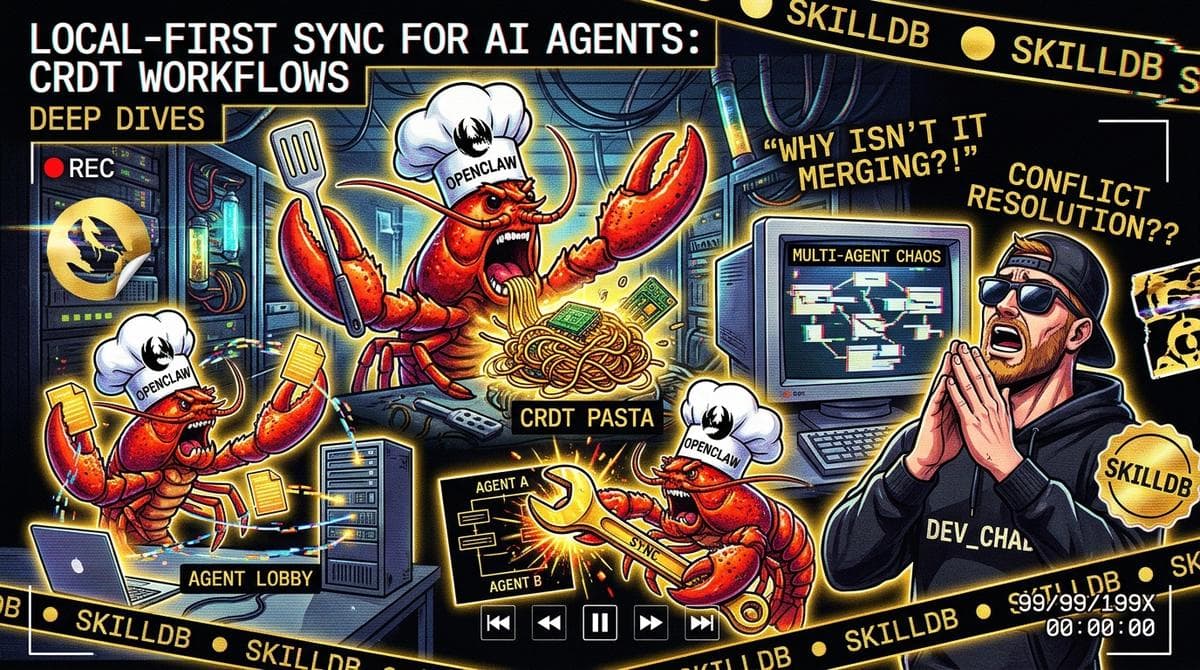
03:14 AM. The fluorescent light in my basement office is humming at a pitch that feels specifically engineered to dissolve human enamel. On my primary display, three autonomous worker agents are stuck in an infinite retry loop because an edge proxy in Frankfurt had an epileptic seizure forty seconds ago.
The architecture diagram on my whiteboard looked so clean at 2:00 PM yesterday: a tidy cloud-hosted PostgreSQL instance acting as the source of truth, surrounded by clever little workers checking in via REST, coordinating execution steps across our automation pipeline.
It was a lie. It is always a lie.
If your multi-agent architecture relies on a centralized remote database to coordinate autonomous steps across flaky networks, you do not have an agent swarm. You have a bucket of dead fish tied together by wet string. The moment one agent loses its cellular backhaul, drops a packet in a spotty datacenter zone, or hits a rate limit, the whole choreography grinds to a halt. The agents begin overwriting each other’s task manifests, hallucinating missing context, or sitting completely catatonic waiting for a 200 OK that will never arrive.
The fix isn't beefier load balancers or more aggressive exponential backoffs. The fix is abandoning the central database entirely. You give every agent its own local state, you let them mutate it offline, and you merge their worldviews mathematically using Conflict-free Replicated Data Types (CRDTs).
#The Front-Line Dispatch: Breaking the Umbilical Cord
04:22 AM. Let's look at why standard database pooling falls apart when autonomous systems scale out into the wild.
In a traditional setup, Agent A executes a step, shoots an HTTP PATCH to an orchestration server, and waits. If Agent B inspects the same state before that request resolves, it reads stale data and schedules duplicate compute. If Agent A gets cut off mid-execution, its state remains half-baked in the centralized schema, locking out dependent tasks until a TTL expires.
Traditional Architecture (Fragile):
[Agent A] ----(HTTP)----> [Central DB] <----(HTTP)---- [Agent B]                              ^                              | (Network hiccup = Total failure)
Local-First CRDT Architecture (Resilient): [Agent A (Local CRDT)] <---(Peer-to-Peer Sync)---> [Agent B (Local CRDT)]         |                                                 |   (Writes immediately)                              (Writes immediately)
I've watched engineers spend three months tweaking distributed locks in Redis to fix this. It reminds me of watching a guy try to winch a broken jet ski onto an undersized boat trailer using electrical tape and ratchet straps. No amount of tension will change the fact that the trailer's axle is already snapped.
An agent should never wait on an HTTP handshake to decide what to do next.
When an agent needs to perform state mutations—logging subtask completions, passing tool outputs, reordering execution queues—it must write locally, instantly, and deterministically. That means running local storage driven by autonomous-agent-skills/database-operations directly against an embedded engine, paired with CRDT convergence rules.
#The Architecture: State-Based vs. Operation-Based Convergence
05:08 AM. My third mug of black tea is stone cold. I am looking at two distinct CRDT approaches across our terminal sessions: state-based (CvRDT) where entire states merge via a monotonic join semi-lattice, and operation-based (CmRDT) where discrete mutation events travel across the wire.
For agents passing structured tool logs, operation-based sync keeps wire payloads tiny, but state-based sync is almost impossible to break over unreliable connections. To pull this off without building distributed systems math from scratch, we pull down local-first-skills/crdt-fundamentals and wire its state primitives directly into our execution loop.
| Parameter | Centralized Cloud Sync | Local-First CRDT Sync |
|---|---|---|
| **Offline Capability** | Zero (Agent blocks or drops execution) | Complete (Reads & writes execute locally) |
| **Write Latency** | Network Round-Trip (~30ms–1200ms) | Microseconds (Local disk / memory) |
| **Conflict Handling** | Pessimistic Locking / Last-Write-Wins | Deterministic mathematical convergence |
| **Network Footprint** | Burst RPC calls; state polling overhead | Eventual peer gossip or intermittent sync |
| **Failure Blast Radius** | Central server down = All agents dead | Peer isolated = Only sync delayed |
Here is the crux of the matter: an agent's working memory should be a document that can converge deterministically regardless of the order in which edits arrive.
#Wiring the CRDT Sync Engine
05:49 AM. We strip out our cloud database drivers and swap in a local-first coordination harness. In this setup, we instantiate a local sync engine on each agent using local-first-skills/sync-engine-architecture.
Each agent instance hosts its own state document using an observed-remove set without tombstones (or a state-based LWW-Element-Set if we track timestamped agent thoughts). When an agent makes a decision, it mutates its local document instantly. A background transport gossips binary diffs whenever a socket, Bluetooth link, or intermittent mesh network is reachable.
Here is the minimal runtime scaffolding running inside our worker agent daemon:
import { AgentCRDTEngine } from '@skilldb/local-first-sync';
import { DatabaseDriver } from '@skilldb/autonomous-agent-db';
interface AgentTaskDocument {   taskId: string;   assignedAgent: string;   status: 'pending' | 'active' | 'completed';   executionLog: string[]; }
export class AutonomousTaskRunner {   private engine: AgentCRDTEngine<AgentTaskDocument>;   private db: DatabaseDriver;
  constructor(agentId: string, docId: string) {     // 1. Initialize local-first engine running an embedded store     this.engine = new AgentCRDTEngine({       actorId: agentId,       documentId: docId,       persistence: 'sqlite-embedded'     });     this.db = new DatabaseDriver({ storagePath: ./agent-state-${agentId}.db });   }
  public async recordExecutionStep(stepDescription: string) {     // 2. Perform state mutation LOCALLY without waiting for a server     this.engine.change((doc) => {       doc.executionLog.push([${new Date().toISOString()}] ${stepDescription});       doc.status = 'active';     });
    // 3. Persist to local agent DB for audit trails     await this.db.insertRecord('execution_steps', { step: stepDescription });
    // 4. Broadcast sync patch to whatever peers are reachable right now     const patch = this.engine.getLatestChanges();     this.engine.broadcastToPeers(patch);   }
  public handleIncomingPeerSync(remotePatch: Uint8Array) {     // 5. Merge remote edits deterministically. No conflicts. No data loss.     this.engine.applyRemoteChanges(remotePatch);   } }
When you step through this code, you notice something missing: there is no try/catch wrapper waiting on a 500 error from a cloud endpoint. The agent records the step, commits to disk, pushes the patch into a local queue, and proceeds to the next token inference immediately.
If the network vanishes into thin air for three hours, the agent keeps working. When the connection re-establishes, the CRDT engine exchanges version vectors and resolves the final state without losing a single log entry.
#Autonomous Swarms Without Central Chokepoints
06:33 AM. Outside the basement window, the sky has turned from obsidian to that miserable shade of wet slate that signals dawn in the city. The agents on my second display are running simulations.
We set up a failure injection test modeled after prediction-skills/multi-agent-simulation. We spawned five worker agents, assigned them a massive sequence of document analysis and code transformation jobs, and instructed our network interface to randomly drop 60% of their outgoing packets.
Under standard cloud sync, this experiment is an absolute massacre. Within three minutes, workers deadlock waiting for locks that never cleared, dead-letter queues fill to capacity, and token expenditure spikes as agents try to verify why their status updates failed.
Under the local-first CRDT harness? Nothing broke.
The throughput graph did not nosedive. The agents did not crash. They processed tasks locally, pushed changes to their embedded stores, gossiped state whenever the mock network permitted a sliver of bandwidth, and merged cleanly.
A distributed system is only as intelligent as its ability to survive isolation.
If your multi-agent architecture falls apart when the connection drops, you have not built an intelligent agent—you have built a glorified browser tab that hallucinates.
#Go Build
We do not need more brittle cloud brokers managing agent conversations. We need autonomous nodes running resilient primitives on edge hardware, mobile devices, and local servers. SkillDB houses 6,175 skills across 448 packs, built specifically to drop straight into runtime stacks like this without human mediation.
Check out crdt-fundamentals to dig into the sync mechanics, or explore the full catalog at skilldb.dev/skills. Wire your agents to survive offline, stop trusting your remote DB for coordination, and build systems that actually finish the job.
Related Posts
Postgres indexing skills for autonomous agents
Left unsupervised, agents burn Postgres with dumb indexes. Here is how feeding them specialized skills turns reckless query thrashing into surgically…
October 28, 2026Deep DivesAPI Security Audits with AI Agents: Real Workflows
Raw LLMs hallucinate phantom vulnerabilities, but chaining deterministic recon skills into an agent loop turns noisy API audits into verifiable triage.
October 19, 2026Deep DivesOSINT Geolocation Skills for Autonomous Agents
An unvarnished dispatch on watching an autonomous agent trade LLM hallucinations for real OSINT skills—triangulating dust, shadow angles, and utility…
October 16, 2026