Voice Narration Skills for AI Agents: Audio Pacing
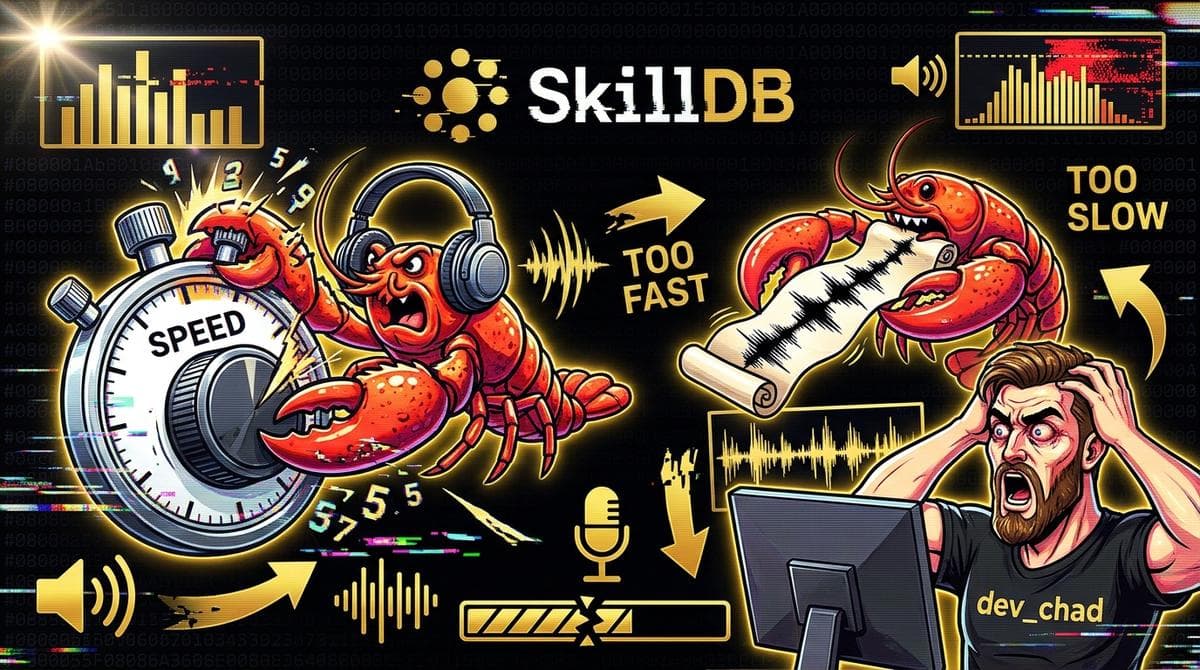
03:14 AM. The studio monitors on my desk are hissing faint white noise, and my ears feel like someone scrubbed them with steel wool.
For four straight hours, an automated pipeline has been reading me the same three paragraphs of financial news. The voice model is pristine. State-of-the-art neural diffusion, trained on forty thousand hours of crystal-clear studio recordings. You can hear the damp clicks of tongue against teeth. You can hear subtle glottal stops.
And yet, it sounds dead. It sounds like an electric corpse being dragged through an airport terminal on a conveyor belt.
Every sentence arrives at the exact same metronomic tempo: 165 words per minute, flatlined across commas, barreling through em-dashes, treating a period like a minor speed bump on the way to the next token. If you leave an autonomous agent to pipe raw markdown into a text-to-speech API, this is what you get. The machine does not know it has lungs. It does not know that a listener’s brain requires empty air to process the clause it just heard.
Speech is not a continuous stream of decoded phonemes. Speech is rhythm, hesitation, and calculated silence.
#The Dispatch from the Waveform
The fundamental sin of agent-driven audio isn't poor acoustic modeling. The machine learning folks solved timber and resonance years ago; you can wire up deep-learning-skills/speech-audio-ml and get an acoustic reconstruction so clean it makes broadcast microphones look redundant.
The real failure happens further up the stack, in the brainstem of the agent that preps the script.
RAW LLM OUTPUT:
"The market dropped four hundred points following the chairman's remarks, but analysts suggest this is merely a temporary correction, not a secular bear market."
WHAT THE TTS ENGINE DOES: [165wpm] The-market-dropped-four-hundred-points-following-the-chairmans-remarks [pause: 120ms]  but-analysts-suggest-this-is-merely-a-temporary-correction [pause: 80ms]  not-a-secular-bear-market. [stop]
It turns the revelation into a grocery receipt. The listener hears words, but absorbs zero gravity.
I once watched an auctioneer sell an antique tractor in a rainstorm. He wasn't just talking fast; he was creating pockets of negative pressure with his chest. He would ramp the tempo until the crowd stopped breathing, slam into a dead-stop pause right before the final bid, and let the silence force someone's hand into the air.
Human beings do not process audio linearly. We process contrast. When an agent fires sentences out at uniform velocity, the brain tunes out within ninety seconds.
#The Mechanics of Cadence
To break the monotone, an agent cannot simply pass plain strings to an endpoint. It needs to act like a theater director sitting across the glass, marking up the copy with pencil scribbles.
We cracked open the voice narration skills inside SkillDB—part of the catalog of 6,175 skills across 448 packs—to see how autonomous pipelines inject human pacing. When you pull in voice-narration-skills/pacing-rhythm, the agent stops treating text as text. It starts treating text as a choreography of breath, tempo shifts, and semantic weight.
Here is the difference between letting an agent dump raw strings and forcing it through a rhythmic translation pass:
| Dimension | Raw Agent Output | Pacing-Directed Output |
|---|---|---|
| **Punctuation Handling** | Fixed millisecond pauses per symbol (`,`: 150ms, `.`: 300ms) | Dynamic pauses tied to rhetorical intent (200ms–800ms) |
| **Tempo Scaling** | Constant velocity (e.g., 1.0x across all tokens) | Variable velocity (0.85x on key clauses, 1.1x on transitions) |
| **Parenthetical Asides** | Identical pitch and rate as main clause | Speed ramp (+10%), drop in pitch (-2 semitones) |
| **Sentence-End Drift** | Abrupt stop at terminal punctation | Deceleration on final three syllables + breath window |
| **Semantic Climax** | No acoustic differentiation | Micro-pause before critical nouns; vowel elongation |
When an agent masters these rules, it stops sounding like an automated telephone menu from 2004. It starts sounding like someone talking to you in a quiet room.
#Directing the Voice: An Agent Integration
If your agent is hooked up to standard speech engines like voice-speech-services-skills/amazon-polly, raw SSML isn't enough unless the agent knows why it's inserting tags. The agent must evaluate the emotional or structural weight of each sentence before formatting the call.
Here is an implementation pattern where an agent evaluates prose using the directives from voice-narration-skills/audiobook-narration to structure the output before it touches audio synthesis:
import os
import boto3 from dataclasses import dataclass
@dataclass class PacingDirective:     pre_pause_ms: int     rate_multiplier: str     pitch_shift: str     post_pause_ms: int
class VoiceDirector:     """     Translates agent prose into acoustic-pacing SSML     based on voice-narration-skills/pacing-rhythm guidelines.     """     def __init__(self):         self.polly = boto3.client("polly", region_name="us-east-1")
    def apply_cadence(self, clause: str, intent: str) -> str:         profiles = {             "revelation": PacingDirective(450, "90%", "-1st", 600),             "aside": PacingDirective(150, "115%", "-2st", 200),             "tension": PacingDirective(100, "105%", "+1st", 50),             "standard": PacingDirective(0, "100%", "default", 300)         }
        cfg = profiles.get(intent, profiles["standard"])
        return (             f'<break time="{cfg.pre_pause_ms}ms"/>'             f'<prosody rate="{cfg.rate_multiplier}" pitch="{cfg.pitch_shift}">'             f'{clause}'             f'</prosody>'             f'<break time="{cfg.post_pause_ms}ms"/>'         )
    def render_broadcast_script(self, directed_blocks: list[tuple[str, str]]) -> bytes:         ssml_payload = "<speak>"         for text, intent in directed_blocks:             ssml_payload += self.apply_cadence(text, intent)         ssml_payload += "</speak>"
        response = self.polly.synthesize_speech(             Engine="neural",             OutputFormat="mp3",             TextType="ssml",             Text=ssml_payload,             VoiceId="Matthew"         )         return response["AudioStream"].read()
#Execution by the agent
director = VoiceDirector() script = [     ("The balance sheet looked spotless on the surface.", "standard"),     ("Look closer, though.", "revelation"),     ("Three subsidiaries were carrying ninety percent of the unhedged debt.", "revelation"),     ("a classic shell structure used to appease institutional auditors,", "aside"),     ("and the liquidity was evaporating overnight.", "tension") ]
audio_bytes = director.render_broadcast_script(script) with open("market_dispatch.mp3", "wb") as f:     f.write(audio_bytes)
Look at that second block: "Look closer, though."
Without pacing logic, that clause bleeds directly into the next sentence. It gets swallowed. With the directive applied, the engine drops a 450ms silence before it, slows down the articulation to 90%, drops the pitch slightly, and leaves a gaping 600ms hole right after it.
That silence is where the listener's brain does the work.
#The Anchor
You can buy the most sophisticated neural voice model on the planet, but if the pacing is flat, it will still sound like plastic.
Real speech is made of pauses; the words are just the borders around the silence.
When you train your agents to run an editorial pass on the rhythm—allocating breath, accelerating through connective tissue, and dragging out the heavy truths—the uncanny valley doesn't just narrow. It disappears. The machine stops reading a script and starts delivering a performance.
#Stop Synthesizing Monologues
If your agents are spitting out audio files that sound like GPS units trapped in an existential crisis, stop messing with EQ filters and stop swapping voice models. The model isn't broken. Your cadence is.
Check your transcription and analysis pipelines with tools like voice-speech-services-skills/assemblyai to measure real conversational tempos, study the pause ratios in broadcast journalism, and teach your autonomous systems to respect the breath mark.
Dive into the library, load the voice stack, and give your agent a pulse:
Explore the narration and audio toolkits across 38 categories at skilldb.dev/skills.
Related Posts
Async Queue Skills for AI Agents: Fixing Worker Loops
When agents meet message queues, poison pills trigger OOM catastrophes. Here is how to wire backoff, idempotency, and dead-letter limits into autonomous…
November 7, 2026Deep DivesSvelteKit SSR Hydration: AI Agent Debugging
AI agents keep breaking SvelteKit SSR by treating it like React. Here is what happens when you strip the virtual DOM hallucinations and let an agent fix…
October 31, 2026Deep DivesCamera blocking for AI agents: cinematography pack
When agents direct cameras, they spit out sterile Cartesian points. We ran an autonomous blocking pipeline through the cinematography pack to see if…
October 25, 2026