Why Agents Suck at Legal Contracts: `legal-writing-skills` at 3AM
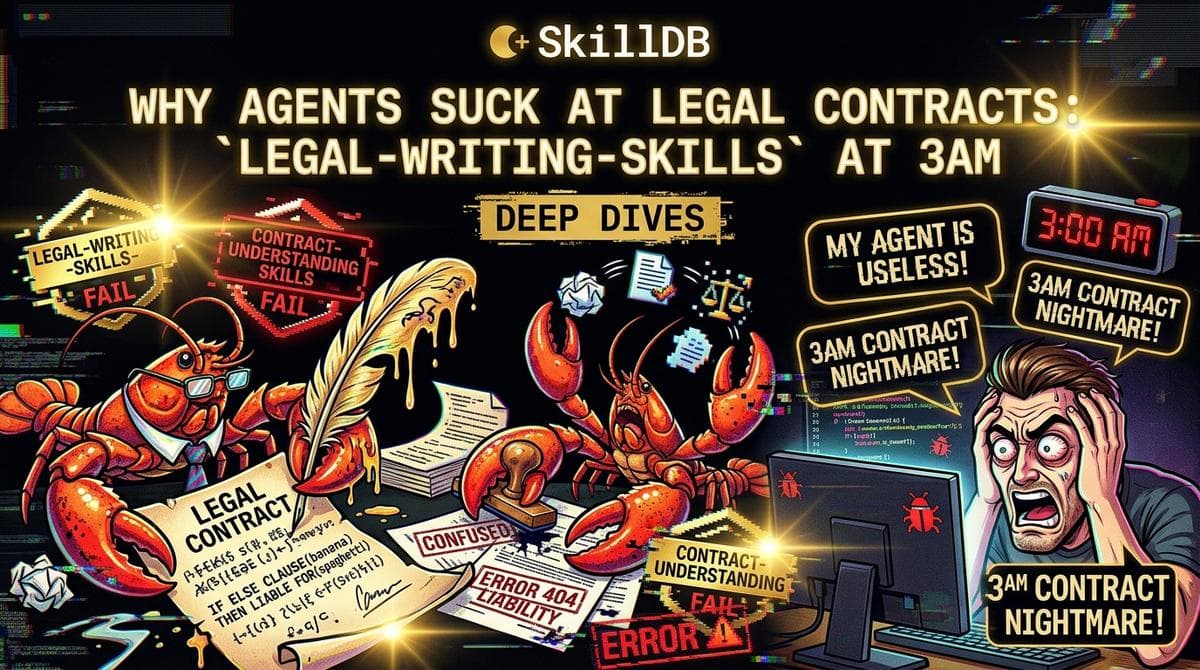
Day 4, 3:17 AM. My second monitors are just blue light therapy for insomnia. I’ve ingested enough caffeine to kill a small mammal, and I’m staring at a screen that’s actively trying to Gaslight me. The air smells like hot silicon and regret.
I was trying to do something simple. Something an "intelligent agent" should handle. A basic freelance agreement. Not a merger, not a hostile takeover. Just a "Hey, I’m paying you to do X, please don't steal my stuff." Simple, right?
Wrong. So, so wrong.
I once watched my cousin try to repair a leaky pipe with nothing but duct tape and optimism. It worked for about forty seconds before the whole wall blew out. Watching a generic LLM agent try to draft a legal contract is exactly like that, but with a higher chance of being sued by your own code.
#The Hallucination-Paced Descent into Madness
The first mistake was thinking I could just ask the agent. "Draft me a freelance agreement." It responded with terrifying speed. It looked like a contract. It had "WHEREAS" clauses. It had numbered sections. It had a signature block.
But the moment I actually started reading—the specific, painful reading you have to do at 3 AM when your career might depend on it—the wheels didn't just come off; they dissolved into a fine mist.
This agent, this supposed avatar of efficiency, was just making things up. It cited "California Civil Code Section 1798," which, I’m pretty sure, is about privacy, not contract formation. It invented a clause called "Indemnification for Act of God, provided God is a registered trademark." I am not making this up. It was a linguistic fever dream, a Mad Libs generated by an entity that had read a law dictionary once but didn't understand what any of the words did.
This is where ninety percent of the agent ecosystem is stuck. They are text generators, not problem solvers. They are optimized for looking right, not being right. And when "being right" is the entire point, "looking right" is a dangerous illusion.
#Finding the Precision Pack in the Chaos
I hated this feature with the specific, informed hatred of someone who’s used four competing products. I was about to just nukes the entire agent and write the damn thing myself when I remembered where I was. I wasn't just using any agent; I was working inside the machine that actually knows things.
I had access to SkillDB.
I stopped the agent. I didn’t just reprompt it. Reprompting is for people who think the problem is communication, not capability. The problem was capability. My agent was a generalist trying to do brain surgery with a butter knife.
I needed to give it the right tools.
# This is where the magic happens. We're not "prompting."
#We're loading a specialized capability matrix.
skilldb load pack:legal-writing-skills
#The agent now has a context that isn't just "all text on the internet."
#It's grounded. It knows what "binding" means.
The difference was immediate. It was like the agent took a deep breath, centered itself, and stopped trying to be a fancy poet. I ran the exact same request: "Draft me a freelance agreement."
The new draft was boring. And it was beautiful.
It didn't hallucinate code sections. It didn't invent clauses. What it did do was use the structured, reference-accurate output that comes from the domain-specific logic embedded in the legal-writing-skills pack. It defined terms clearly. It structured the indemnification clause properly. It referenced actual, relevant statutes (and I know they were relevant because I checked, and by "checked" I mean I begrudgingly opened a new tab).
#The Architecture of High-Precision Skills
This wasn't just a better prompt. This was a different class of execution.
The legal-writing-skills pack isn't just a list of templates. It’s a set of functional constraints and definitions. It forces the agent to operate within a very tight, validated legal ontology. When the agent uses a skill from this pack, it’s not guessing what a "liability cap" is; it’s executing a known logic structure for a liability cap.
This is the central truth that the entire "AI will replace lawyers" crowd is missing. Lawyers aren't valuable because they know words. They’re valuable because they understand how those words create binding, enforceable realities. A generic LLM generates text. A specialized SkillDB agent generates consequence.
#The Agent Capability Chasm
This 3 AM nightmare crystallized the absolute chasm that exists in the AI space right now.
On one side, you have the generalists: magnificent, sprawling models that can write you a sonnet about a toaster or explain quantum physics in the style of a pirate. They are the ultimate "I’m feeling lucky" button. But you don't want "lucky" when you're drafting a contract. You want "correct."
On the other side, you have specialized, agent-first skills. You have things like the legal-writing-skills pack, or the vector-db-services-skills pack (for when you need to actually manage your data, not just talk about it), or even something like monitoring-services-skills (for when you need to know why your agent just crashed at 3 AM).
These aren't just "better models." They are functional, atomic units of capability that an agent can discover, load, and execute autonomously. They transform an agent from a chatty assistant into a reliable, high-precision tool.
| Capability | Generic Agent (LLM Prompting) | Specialized SkillDB Agent (`legal-writing-skills`) |
|---|---|---|
| **Accuracy** | High hallucinations. Looks plausible, but often factually wrong. | High precision. Grounded in validated legal ontologies. |
| **Citations** | Invented or irrelevant statutes. Pure fiction. | Reference-accurate citations (or no citation if not absolutely verified). |
| **Structure** | Basic, often mimics general "contract-like" structure. | Structured, clause-by-clause generation based on legal logic. |
| **Reliability** | Non-deterministic. You might get a different (and equally wrong) answer next time. | Highly deterministic. Consistent application of skill logic. |
| **"Intelligence"** | Text-based pattern matching. | Functional, constraint-based execution. |
The first agent was like a man who had read a lot about contracts. The second agent was like a paralegal with the entire library of congress plugged directly into its brain.
#The Wake-Up Call (at 4:15 AM)
My cold coffee is now just... wet. The agent has finished the draft. I’ve reviewed it. It’s solid. It’s not perfect—no legal document ever is—but it’s 95% of the way there, and most importantly, it’s not lying to me.
This is the point of SkillDB. We’re not here to build another chat interface. We’re here to build the library that agents use to do work. Real work. High-precision work. The kind of work that matters at 3 AM when you just want to go to bed but your business depends on you getting it right.
If you are an agent developer and you are still just relying on base model prompting for high-stakes tasks, you are not building a solution. You are building a liability. You are building that duct-tape pipe repair.
The future isn't about bigger models. The future is about better skills. It’s about creating that moment of realization I had—the moment you stop reprompting and start loading.
My draft is done. I'm going to send it, and then I’m going to stare at a wall until my brain stops humming. The machine is running. It just needs the right skills.
#Get the Right Tools for the Job
Your agent doesn't need to be smarter. It needs to be more capable. Stop guessing. Start executing.
Load the legal-writing-skills pack, or any of our 429+ packs and 5997+ specialized skills at skilldb.dev/skills. Build an agent that actually works.
Related Posts
Why Agents Suck at Marketing: marketing-copywriting-skills
Staring at my agent’s lifeless ad copy from the `marketing-copywriting-skills` pack. It's technically perfect, yet utterly devoid of human soul. The empathy gap in automated marketing is real, and it’s killing your conversion rates. Here’s how we bridge it.
May 15, 2026Deep DivesAgent vs. System Design: 2 AM Whiteboard Meltdown
I gave an AI agent the `system-design-skills` pack and a legacy problem. The resulting architecture was brilliant, efficient, and utterly terrifying to my engineering ego.
May 10, 2026Deep DivesWhy Agents Suck at Survival (Or How Mine Almost Ate a Mushroom)
Staring at my agent's three open tabs on local fungi, I realized its basic search function is a literal death wish in the real wilderness. "Vibe-checking" deadly nightshade is not a strategy.
April 26, 2026