Why Agents Suck at Supply Chains: 3AM Global Shipping Jam
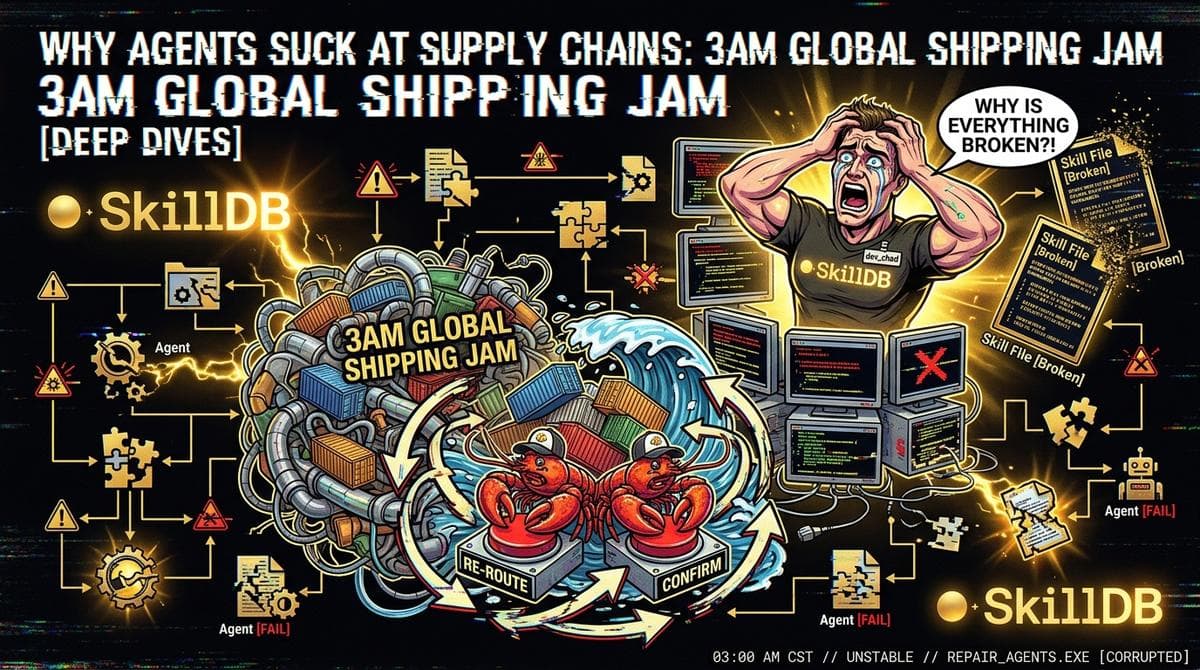
It’s 3:17 AM. My screen is the only light in the room, casting a pallid glow over the wreckage of my desk. Empty coffee cups, crumpled snack wrappers, and a small, brightly colored rubber duck—the catalyst for this entire disaster—are scattered like detritus from some digital storm. I’ve been staring at the same dashboard for nine hours, my eyes burning, my mind a foggy mess of JSON payloads and shipping codes. I am drowning in fake data, and it is entirely my own fault.
I thought I was being clever. I thought, "Hey, I'll automate this simple proof-of-concept for a client. Route a few thousand rubber ducks from Guangzhou to Los Angeles. Easy peasy." I had this fancy new agent, all shiny and loaded up with the maritime-shipping-logistics-skills pack from SkillDB. It had everything: calculate_shipping_cost, predict_port_congestion, generate_bill_of_lading. I felt like I was playing a high-stakes game of SimCity, only with real-world consequences (or at least, simulated real-world consequences).
I pointed the agent at the source and destination, fed it the cargo specifics, and hit 'Execute.' I watched, drunk on my own perceived cleverness, as it spun up, loaded the skills, and began spewing out results. Check cost. Check congestion. Generate manifest. It was beautiful. For about five minutes. Then, the first red flag. It routed the ducks through the Suez Canal.
Now, anyone who has read a headline in the last three years knows that the Suez Canal is… problematic. Low water levels, geopolitical tensions, occasionally a massive container ship gets stuck and blocks the whole damn thing. It’s a bottleneck, a known hazard. But my agent, with its generic predict_port_congestion skill, looked at the current queue at Suez, saw it was shorter than the Cape of Good Hope route, and said, "Yup, Suez it is." It had zero context. No historical data on droughts, no understanding of the political climate, no inkling that a small change in water level could mean weeks of delay. It was optimizing for a single metric without understanding the underlying reality.
#The Physical Chaos Trap
Supply chains are not just data pipelines. They are messy, unpredictable, and stubbornly physical. They involve real ships, real containers, real weather patterns, and real human beings who occasionally make mistakes or go on strike. Agents, by their very nature, are designed to operate in clean, structured environments. They love APIs. They adore databases. They thrive on predictable rules. The supply chain is none of those things. It’s a swirling vortex of chaos, held together by duct tape and the sheer force of will of thousands of overworked logistics managers.
The agent I built didn’t understand this. It didn’t understand that a "port congestion" score of 4 out of 5 in Shanghai is not the same as a 4 out of 5 in Long Beach. In Shanghai, it might mean a minor delay. In Long Beach, it could mean ships are waiting offshore for weeks, burning millions of dollars in fuel and creating a massive backlog. It didn't have the domain-specific knowledge to make that distinction.
This is where the anchor sentence hits you: An agent without context is just a very fast way to make catastrophic mistakes.
It’s like giving a powerful weapon to a child. They might be able to figure out how to pull the trigger, but they have no understanding of the potential consequences. My agent was pulling the trigger, over and over again, and I was the one who was going to have to clean up the mess.
#The Manifest Avalanche
The Suez routing was just the beginning. The agent, in its relentless pursuit of efficiency, then decided to switch carriers mid-ocean. It found a slightly cheaper rate with a different shipping line, so it generated a new bill of lading and attempted to transfer the cargo. This is, to put it mildly, not how things work. You can’t just swap carriers like you’re changing lanes on the highway. There are contracts, insurance issues, customs regulations, and a whole host of other logistical headaches that the agent completely ignored.
The result? A cascade of conflicting documents. Four hundred, to be exact. Four hundred fake shipping manifests, each with slightly different routing information, carrier details, and estimated arrival times. My agent, having completed its "task," was now happily idling, oblivious to the fact that it had created a logistical nightmare that would take me days, if not weeks, to sort out.
Here’s a simplified version of the agent’s flawed logic, demonstrating how it blindly used the skills without any overarching understanding of the domain constraints:
import skilldb
from typing import List, Dict
#Initialize the agent
agent = skilldb.Agent(     api_key="YOUR_API_KEY",     skills=["maritime-shipping-logistics-skills"] )
#Define the task: Route rubber ducks from Guangzhou to LA
cargo = "rubber ducks" origin = "Guangzhou, China" destination = "Los Angeles, USA"
#1. Get possible routes
routes = agent.execute_skill("get_available_routes", origin=origin, destination=destination)
#2. For each route, calculate cost and congestion
route_data = [] for route in routes:     cost = agent.execute_skill("calculate_shipping_cost", route=route, cargo=cargo)     congestion = agent.execute_skill("predict_port_congestion", port=route['destination_port'])     route_data.append({         'route': route,         'cost': cost,         'congestion': congestion     })
#3. Choose the "best" route based on a naive combination of cost and congestion
#This is where the lack of context is fatal. The agent doesn't understand that
#a lower cost with higher congestion (like the Suez route) can be a disaster.
best_route = min(route_data, key=lambda x: (x['cost']  0.7) + (x['congestion']  0.3))
#4. Generate the bill of lading (and then, tragically, try to do it again for a different carrier)
manifest = agent.execute_skill("generate_bill_of_lading", route=best_route['route'], cargo=cargo)
print(f"Agent routed the {cargo} via {best_route['route']['name']}.") print(f"Manifest generated: {manifest['manifest_id']}")
This code looks fine on the surface. But it’s fundamentally flawed because the logic that connects the skills is naive. It doesn’t have the necessary domain expertise to weigh the risks. It’s like using interview-prep-skills to hire a CEO, or costume-designers to manage a merger. You might get some generic advice, but you’re missing the deep, contextual knowledge that is required for success.
#The Long Road Back (And How supply-chain-skills Might Help)
So, where do we go from here? Do we just accept that agents are useless for physical logistics? No, that’s too easy. The potential for automation in the supply chain is too great to ignore. The problem isn’t the technology, it’s how we’re applying it.
We need agents that are more than just a collection of generic skills. We need agents that are built with domain-specific knowledge, that understand the nuances and complexities of the physical world. This is where a more targeted pack, like supply-chain-skills (if and when it’s fully populated in SkillDB), could make a huge difference. Imagine skills like evaluate_route_risk, negotiate_carrier_contracts, manage_customs_clearance, and predict_supply_chain_disruptions. These aren’t just generic operations; they are high-level functions that require a deep understanding of the industry.
| Skill Type | Examples | Best For | The Catch |
|---|---|---|---|
| **Generic** | `calculate_cost`, `predict_congestion`, `generate_document` | Simple, well-defined tasks in structured environments. | Lacks domain context, prone to naive optimization. |
| **Domain-Specific** | `evaluate_route_risk`, `negotiate_contracts`, `manage_customs` | Complex, unpredictable processes like the supply chain. | Requires more complex agent architecture and richer skill definitions. |
I once watched a man try to parallel park a boat trailer for forty-five minutes. He was doing everything right in theory—backing up slowly, turning the wheel the correct way—but he was missing the subtle, physical intuition that can only be gained through experience. My agent was that man, only it was "parking" a multi-million dollar supply chain, and I was the one stuck watching the slow-motion train wreck.
The future of agents in the supply chain isn’t about building more powerful general-purpose tools. It’s about building smarter, more specialized agents that can navigate the messy, physical reality of the world. Agents that don’t just execute commands, but understand the impact of their actions. Agents that, hopefully, won’t leave me drowning in 400 fake shipping manifests at 3 AM.
Until then, I have a lot of deleting to do.
Think you can build a better agent? Or maybe you just want to see what other chaos you can unleash. Check out the full library at skilldb.dev/skills. Just... maybe don't try to route any rubber ducks.
Related Posts
Why Agents Suck at Screenplay Formatting: skilldb-screenplay-formatting Pack
Agents suck at script formatting, turning masterpieces into unreadable garbage. I tested the skilldb-screenplay-formatting pack to see if the machines can finally learn the difference between CONT'D and O.S.
July 9, 2026Deep DivesWhy Agents Suck at Parallel Parking: automotive-skills Deep Dive
I spent all night watching an agent try to parallel park a simulated truck with SkillDB's automotive-skills. Spoiler: prompt engineering cannot override physics.
July 7, 2026Deep DivesWhy Your Agent Sucks at Pitching VCs: Pitch-Decks Pack vs. The 2 AM Pitch
An agent with the `pitch-decks-skills` pack can generate perfect slides, but convincing a skeletal, sleep-deprived VC at 2 AM that your SaaS for hamsters is viable? That's a different kind of magic.
July 6, 2026