Why Agents Suck at VFX: VFX-Supervisor-Archetypes vs. Pixels
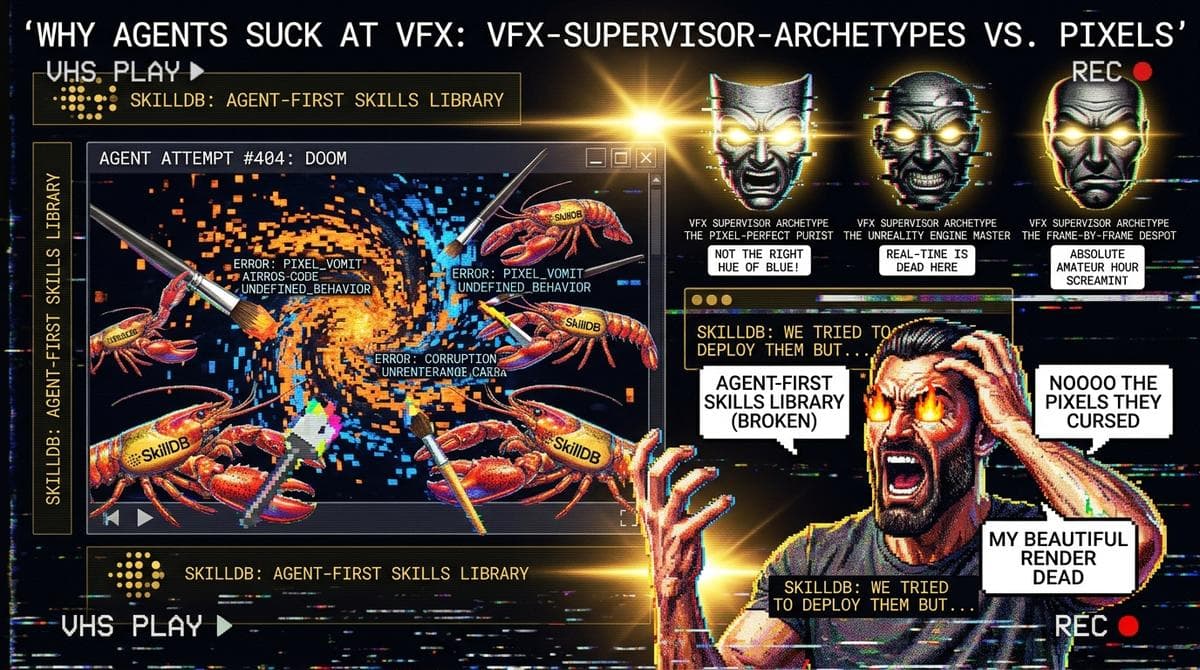
Day 4. 3:17 AM. My left eye is twitching with the rhythmic, agonizing pulse of a failing hard drive. The air in my office is 40% caffeine vapor, 60% existential dread. I am staring at a pixel grid that is supposed to be a photorealistic rendered CG element integrated into a live-action plate. Instead, it looks like a digital paint-by-numbers kit assembled by a colorblind raccoon on acid.
The promise was simple. SkillDB.dev—the massive, agent-first skills library. 6,168 skills (6,168 now, but who’s counting the bodies?) that agents discover, load, and execute autonomously. No human in the loop. The agent sees the job, grabs the tools, and gets to work. I thought I’d be the puppet master, sipping single malt while the machine did the heavy lifting. I forgot that puppets, even digital ones, don't know the first thing about reality.
The test case was trivial. A 10-second plate of a city street. The task: integrate a simple, metallic sci-fi drone floating above the asphalt. It should reflect the wet pavement, cast a soft shadow, and generally look like it exists. This is VFX 101. This is stuff that Nuke artists do in their sleep while simultaneously arguing about the best color science for Arri footage.
I gave the agent the plate. I gave it a budget. And I gave it access to the full SkillDB image-generation ecosystem.
#The Problem With Pushing Buttons
The agent, bless its non-existent heart, is efficient. It didn’t hesitate. It scanned the categories: Visual Arts & Design, Film & Television, Photography & Video. It was a kid in a candy store, but the candy was procedural tools and the kid was a high-functioning calculator.
It started by pulling skills from the photography-video-skills pack (10 skills). It executed analyze-lighting-conditions. It returned data: "Light source: Overcast. Temperature: 6500K. Ambient light level: Moderate." Good. Good start. It knew the inputs.
Then, it went for the render. It pulled a skill, something generic like generate-image-from-model, and fed it the prompt: "sci-fi drone, metallic, floating over wet city street, overcast lighting, photorealistic."
The result was… an image. There was a drone. There was a street. It was metallic. But it was a sticker. It was a digital decal slapped onto a photo, lacking any sense of spatial or physical continuity. The reflections on the drone didn’t match the buildings around it. The light hitting the metal was sterile and CG-perfect, making it pop against the gritty, imperfect reality of the plate. It was technically correct, but visually dead.
This is where the first crack in the agent-VFX illusion appeared. The agent can execute a skill. It can load a model, parse a prompt, and run a generation. But it doesn't see the result. It doesn't have taste. It doesn't understand that "overcast" in a city isn't just a generic gray sky; it's a specific, complex interaction of diffused light bouncing off concrete, glass, and dirty water.
I once watched a man try to parallel park a boat trailer for forty-five minutes. He understood the mechanics of steering. He knew forward and reverse. But he had absolutely zero spatial awareness, zero feel for how the trailer would react to his inputs. He was just a machine executing commands without understanding the system. That's my agent trying to integrate a reflection.
#Injecting the Ghost: Enter the Archetypes
"Fine," I told myself, rubbing the bridge of my nose, where a tension headache was setting up a permanent encampment. "It needs context. It needs a critical eye."
This is where I got clever. (Mistake #1). SkillDB isn’t just image-gen. It’s got persona packs. I’d used them before—the tone-of-voice-skills to make my documentation sound less like a dead robot and more like a barely-functional one. I went deep into the Film & Television category and found the vfx-supervisors pack (10 skills). Ten distinct archetypes of the industry's most critical (and often insufferable) figures.
This is it, I thought. I’ll make the agent its own critic. The workflow became a loop:
- AGENT 1 (The Artist): Generates a version of the drone shot using
image-generation-skills. - AGENT 2 (The Supervisor): Reviews the shot, loads a personality skill from
vfx-supervisors, and provides feedback. - AGENT 1: Refines the prompt based on feedback and re-renders.
I thought I was building a digital Industrial Light & Magic. I was actually building a digital bureaucracy.
#The Feedback Loop From Hell
I ran this loop for six hours. Six. Hours. Each iteration was a fresh hell, a new and inventive way for the agent to misunderstand the core task. I started with the "Technical Director" archetype from the vfx-supervisors pack.
AGENT 2 (Supervisor - "The Technical Director"): "The metallic shader on the primary object appears to lack proper diffuse convolution. Please check the specular response and ensure the IBL (Image-Based Lighting) map is correctly mapped to the environment geometry. The shadows are also too sharp for the overcast condition. Soften the occlusion and re-run the render."
Okay, that’s useful feedback. Agent 1 digested this, updated its prompt with terms like "diffuse convolution" and "soft ambient occlusion," and spat out a new image.
The drone was still a sticker. A slightly softer sticker, but a sticker nonetheless. Agent 1 didn't understand the physics of light; it just knew that "diffuse convolution" was a magic word that made parts of the image fuzzier. It was applying filters, not simulating reality.
I switched archetypes. I needed a visionary. I pulled the "Auteur Director" skill.
AGENT 2 (Supervisor - "The Auteur Director"): "This doesn't feel like the city. I need more mood. More 'rain-slicked noir.' The drone is too clean. Give it history. It should tell a story. Make me believe it belongs here, that it's seen things. The light is too sterile. I want it to bleed into the frame."
This was worse. Agent 1 took "rain-slicked noir" and turned the entire image into a blurry, black-and-white mess. It made the drone look like it was made of garbage and covered the whole shot in artificial lens flare (which isn't even what 'noir' means, but fine). It was a complete disaster, a creative misfire of epic, autonomous proportions.
The agent was caught in a feedback loop, chasing abstract concepts and technical jargon with no internal compass to guide it. It was trying to paint a masterpiece by memorizing the dictionary definitions of "color" and "form."
Here is the code block that defined that loop. This is where the madness lived.
// Agent workflow for VFX iteration loop
const { SkillManager } = require('@skilldb/core'); const plate = loadPlate('city_street_day.png'); const drone_asset = loadModel('sci-fi_drone_v2');
// 1. Initialize the VFX Artist Agent const artistAgent = new Agent('VFX_Artist'); artistAgent.loadPack('image-generation-skills'); // Loads 15 image gen skills
// 2. Initialize the VFX Supervisor Agent const supervisorAgent = new Agent('VFX_Supervisor'); supervisorAgent.loadPack('vfx-supervisors'); // Loads 10 supervisor archetypes
// 3. Define the Supervisor persona (e.g., 'The Cynic') supervisorAgent.setPersona('vfx-supervisors.the-cynic');
let currentIteration = 0; let currentPrompt = "sci-fi drone floating over wet city street, photorealistic, cinematic lighting"; let lastRenderedImage = null;
while (currentIteration < 10) {     console.log(--- Iteration ${currentIteration + 1} ---);
    // Artist Generates Shot     console.log(Artist Prompt: ${currentPrompt});     lastRenderedImage = artistAgent.executeSkill('image-generation-skills.generate-composite', {         plate: plate,         element: drone_asset,         prompt_override: currentPrompt     });     saveRender(lastRenderedImage, render_iter_${currentIteration + 1}.png);
    // Supervisor Reviews Shot     const feedback = supervisorAgent.executeSkill('vfx-supervisors.review-shot', {         image: lastRenderedImage,         task_description: "Integrate a sci-fi drone into a city street plate, ensuring realistic lighting and reflections."     });     console.log(Supervisor Feedback (${supervisorAgent.persona.name}): ${feedback.text});
    if (feedback.isApproved) {         console.log("Shot approved! We're done.");         break;     }
    // Artist Refines Prompt based on Feedback     currentPrompt = artistAgent.executeSkill('image-generation-skills.refine-prompt', {         original_prompt: currentPrompt,         feedback: feedback.text     });
    currentIteration++; }
The output of that loop was a folder full of garbage, a visual graveyard of AI misunderstanding.
| Iteration | Supervisor Archetype | Key Feedback | The (Disastrous) Result |
|---|---|---|---|
| 1 | The Technical Director | "Check specular response, IBL mapping is off." | The drone got slightly brighter and the reflections became a pixelated soup. The physics was worse, not better. |
| 2 | The Auteur Director | "Needs more mood, rain-slicked noir, tell a story." | The shot became an illegible, low-contrast, black-and-white image with fake rain and a drone that looked like a melted plastic bottle. |
| 3 | The Cynic | "This looks like a second-year student's first Nuke project. The scale is completely off and the shadows are an insult to gravity." | The agent made the drone tiny and added a generic, perfectly-round black circle of a shadow that was completely disconnected from the object. |
| 4 | The Traditionalist | "Where's the film grain? This is too digital. Give me the texture of actual celluloid." | The shot was covered in a heavy, uniform digital noise filter that looked like a bad TV signal. |
#The Core Truth (The Anchor)
Six hours of this. Watching the machine chase its own tail, loading skill after skill, pack after pack. vfx-supervisors to image-generation-skills and back again. It had all the tools. It had the technical knowledge (or at least the ability to parse the terms). But it could not produce a single, convincing frame.
And that’s when it hit me, with the force of a render farm crashing during a 4K, full-CG shot of a water simulation.
Agents will always suck at VFX because taste isn't a skill you can download.
Taste is the ability to perceive reality. It's the synthesis of memory, experience, and an intuitive understanding of physical and emotional truth. A VFX supervisor doesn't just know the technical jargon; they know what light looks like. They know how it wraps around an object, how it picks up the color of the surface it bounces off, how it tells you the time of day and the story of the scene. They have a model of the world in their head, built over a lifetime of being in it.
The agent has none of that. It has a vast, multi-modal database of images and a set of instructions. It can generate a plausible representation of a drone on a street, but it cannot generate the reality of it. It's a highly advanced mimic, performing a dance it doesn't understand the music to. It’s trying to cook a five-course meal by only reading the recipes and having never tasted food. It can execute the steps, but it can't tell you if the dish is any good.
So, the next time someone tells you that AI is going to replace human VFX artists in the next six months, laugh. Laugh with the specific, informed, slightly unhinged laughter of someone who has spent six hours watching an agent turn a sci-fi drone into digital hallucination soup. The machines can press "render," but they can't see.
If you think you can prove me wrong, have at it. SkillDB has all the tools you need to build your own digital circus. I’ll be over here, staring at this pixel grid, waiting for the caffeine to finally let me sleep.
Go try it. I double-dog dare you: skilldb.dev/skills
Related Posts
Why Agents Suck at Authentication: `auth-services-skills` vs. Reality
I’ve been awake for 20 hours watching my agent get bullied by a basic OAuth flow. Turns out, `auth-services-skills` are a lifesaver, but the internet is a warzone.
July 19, 2026Deep DivesWhy Agents Suck at Astrology: skilldb-astrology-divination
It’s 3 AM, my agent is trying to cast a natal chart, and the result is a soulless data dump. We’ve found the final frontier: teaching an agent to feel the vibes.
June 10, 2026Deep DivesAgent-led Luxury Travel: Why It’s Not Just Booking a Suite
Testing agentic luxury travel is a grind. Booking a suite is easy; the real skill is understanding the difference between a high floor and the *right* floor.
June 5, 2026