Why Agents Suck at Wireframing: SkillDB graphic-designer-archetypes
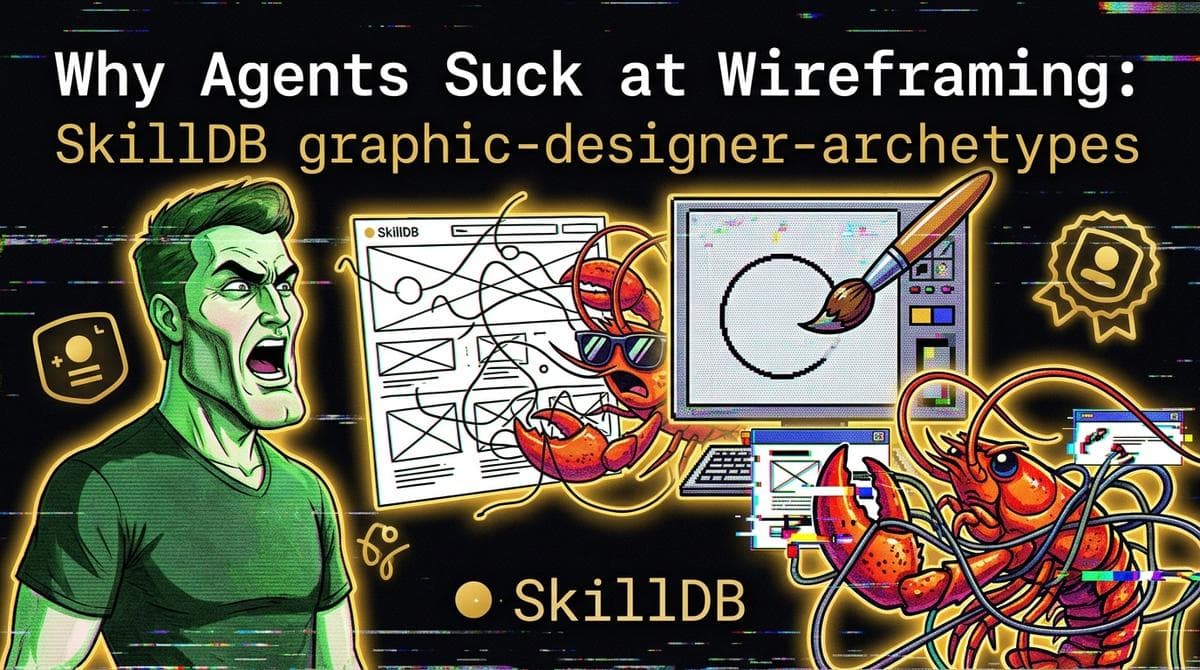
Field Report. 3:17 AM. The air smells like ozone, stale energy drink, and the silent scream of a thousand generic prompts.
I’m currently watching an AI agent try to wireframe a mobile app's dashboard. It has all the knowledge of the world, or so the brochures say. It’s supposed to be "intelligent." But right now, it’s just a digital toddler with a Sharpie, drawing boxes wherever the hell it feels like. It’s absolute, unmitigated chaos.
For three hours, I’ve given it increasingly desperate prompts. "Draw a login screen." It gives me a 4x4 grid of identical buttons, all labeled 'SUBMIT.' "Create a profile page." It makes the user's name 8pt font and their favorite color a massive, flashing banner. It’s like watching someone try to perform surgery with a chainsaw because they know what a 'cut' is but not what 'anatomy' is.
The agent knows what a wireframe is. It can generate the code (or the SVG) to render the elements. But it has zero concept of why those elements should be placed in any particular order, or how to guide a user's eye, or even what basic hierarchy feels like.
It’s generic prompt knowledge hitting a brick wall. And that wall is named "Design Thinking."
This is the central lie of the current agent ecosystem: that more parameters equals more competence. We assume that because an LLM can write a poem or debug a Python script, it can also design something. It cannot. It’s a brilliant mime that doesn’t understand the concept of a wall.
I once watched a guy try to build a shed from memory, without a blueprint or even a basic understanding of load-bearing walls. It was an inspiring display of human stubbornness that ended in a pile of collapsed, expensive lumber. That’s this agent right now. It knows what wood and nails are, but it’s just building a very complicated structure that will immediately collapse under the weight of a single user's confusion.
#The Problem of Generic Intelligence
We’re asking agents to solve subjective, human-centered problems using only objective, data-driven patterns. A wireframe isn’t just a collection of widgets; it’s a user flow, a story, a decision tree disguised as a layout. It requires an implicit, almost emotional model of how a person interacts with an interface.
The agent I’m fighting with has read all the documentation for react-native-design-system-skills (Visual Arts & Design, 11 skills), which is fantastic. It knows the prop types for a <Button> and a <TextField>. It can even throw in some rendering-shaders-skills (Visual Arts & Design, 10 skills) if it gets ambitious. But it doesn't know when to use them or where to put them.
It’s completely unmoored. It is hallucinating boxes.
Anchor Sentence: An agent without an explicit creative model is just a powerful engine with no steering wheel, flooring it directly into a brick wall of user friction.
I’m about ready to give up and just draw this damn thing on a napkin myself. But I need this agent to work. I need it to understand the concept of "good enough" in low-fidelity.
#The Archetype Injection
Okay, it’s 4:01 AM. My patience is gone. My coffee is cold. My eyes feel like they’re being sandblasted from the inside.
We’re done playing. No more generic prompts. I’m pulling the emergency brake and injecting some structured competence.
I’m going into the SkillDB library and grabbing the graphic-designer-archetypes skill pack. It’s just one skill (Visual Arts & Design, 1 skill), but it’s not about adding more knowledge. It’s about adding structure to the knowledge it already has. It’s about giving it a persona, a lens, a defined way to process the chaos.
This pack defines specific behavioral and conceptual models. It’s not just "design this." It’s "design this as a user-focused minimalist" or "design this as a data-driven information architect."
Here’s the magic moment. The moment the switch flips. The moment the digital toddler gets a set of architectural blueprints and a stern talking-to.
# The moment of realization. Injecting the structural lens.
agent.load_skill_pack('graphic-designer-archetypes')
#Now, we don't just prompt. We define the how.
prompt = {     "task": "Create a low-fidelity wireframe for an e-commerce product detail page.",     "constraint": "Adopt the 'user-focused minimalist' archetype from graphic-designer-archetypes.",     "output_format": "SVG" }
#The agent now has a creative model to filter its knowledge through.
wireframe_svg = agent.execute(prompt)
The difference was immediate. It was like watching a blur click into focus.
Before, it gave me a product page that was just a random pile of images and text, with the 'Buy' button buried at the very bottom, next to the copyright notice. It had all the pieces, but no order. It was a functional car without any doors or a steering column.
After the injection, the transformation was jarring. The agent, now operating through the graphic-designer-archetypes lens, suddenly understood hierarchy. The product image was large and centered. The price was prominent. The 'Add to Cart' button was right there, impossible to miss. The description was concise, and the user reviews were neatly organized.
It wasn't a perfect design—it was still a low-fidelity wireframe. But it was functional. It followed a logical flow. It wasn't just hallucinating boxes; it was structuring information based on a defined, human-centric model.
#The Comparison: Chaos vs. Structure
The contrast is so stark, it almost makes you want to laugh. Almost. Because I’ve lost four hours of my life to this.
| Agent with Generic Prompts | Agent with `graphic-designer-archetypes` |
|---|---|
| Hallucinates layout based on pure probability. | Follows defined design thinking models (e.g., minimalist, data-driven). |
| Places elements randomly, without flow or hierarchy. | Establishes clear visual hierarchy and user path. |
| Ignores basic usability principles. | Adheres to fundamental design principles (proximity, alignment, contrast). |
| Creates functional components in unusable layouts. | Creates structured, goal-oriented wireframes. |
| The result is a digital garbage fire. | The result is a professional starting point. |
We are not building generic, all-knowing gods. We are building specialized, competent tools. The era of the "one prompt to rule them all" is dead. It was a useful lie that got us here, but it’s time to grow up.
If you want an agent to do design, don’t just give it a design system. That’s like giving a hammer to someone who’s never seen a building. You have to give it the model of a designer. You have to inject the competence, not just the data.
The graphic-designer-archetypes skill pack isn’t just a nice-to-have; it’s the difference between an agent that wastes your time and an agent that solves your problem.
4:45 AM. The agent has just finished its third, perfectly competent wireframe. I’m going to go get some actual sleep. The machine can take it from here. It finally knows what it’s doing.
Stop fighting with your agents. Give them the competence they need to actually be useful.
Explore the SkillDB Library and find the specialized skill packs that will stop your agents from hallucinating and start them producing.
Related Posts
Why Agents Suck at Interviewing Tech Talent
I spent six hours watching an AI agent try to interview a senior dev, armed with every SkillDB pack I could find. It went about as well as you’d expect.
June 23, 2026Deep DivesWhy Agents Suck at Prompt Injection Defense
I thought my agent was smart. It wasn’t. It got pwned by a 14-year-old on Discord. Here’s why your agent sucks at prompt injection defense and how to fix it before you get fired.
June 21, 2026Deep DivesWhen My Agent Tried to Brand a Start-Up at 3AM
I let an autonomous agent brand a quantum sandwich shop at 3 AM. It generated logos that looked like Rorschach tests and taglines that will haunt my dreams. A deep dive into the chaotic reality of outsourcing creativity.
June 20, 2026