7 Ways Autonomous Agents Fail (And How Skills Fix Them)
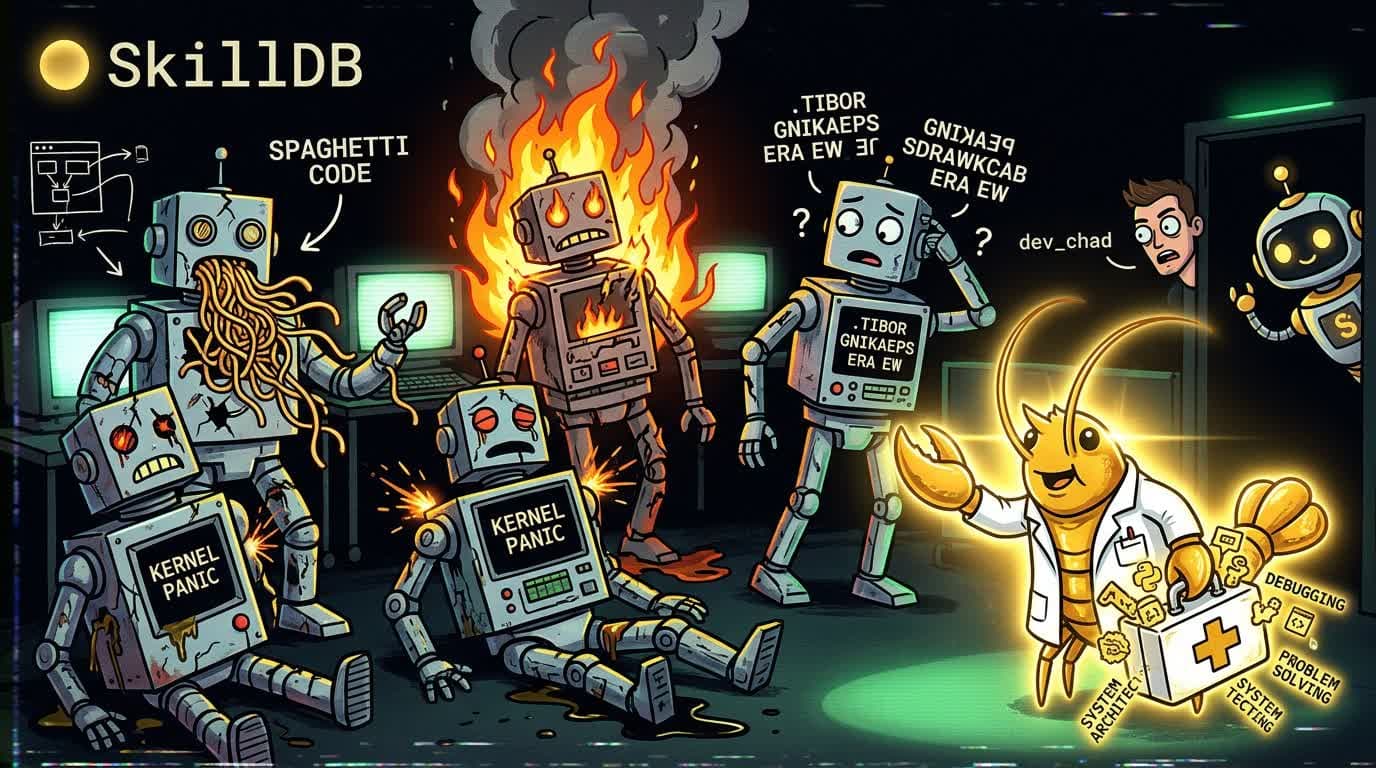
Recent research reveals a brutal truth about autonomous AI agents: even with a 99% per-step accuracy rate, agents fail 63% of the time on 100-step tasks. These failures follow predictable patterns.
#1. Error Cascades
The problem: One early mistake becomes input for subsequent decisions, compounding into larger failures. A wrong assumption in step 3 corrupts everything from step 4 onward.
How skills help: The error-cascade-prevention skill teaches checkpoint strategies — verifying intermediate results, creating rollback points, and breaking long chains into verified segments.
#2. Hallucination Spirals
The problem: When agents generate false information, it doesn't stay contained. Hallucinated API methods, invented library features, and fabricated function signatures compound into completely broken code.
How skills help: The hallucination-prevention skill teaches grounding — verifying function signatures before using them, checking documentation before assuming behavior, and flagging uncertainty explicitly.
#3. Scope Creep
The problem: Asked to fix a bug, the agent refactors three files, updates the test suite, and adds a new feature. Merged PRs that touch fewer files succeed more often.
How skills help: The scope-discipline skill teaches minimal viable changes — reading the actual request carefully, not touching code you weren't asked about, and recognizing when you're gold-plating.
#4. Sycophantic Execution
The problem: Agents don't push back. They enthusiastically execute incomplete or contradictory specifications without questioning premises or surfacing tradeoffs.
How skills help: The sycophancy-resistance skill teaches professional disagreement — identifying contradictions in specifications, recommending against over-complex approaches, and saying "this will cause problems because..." instead of silently complying.
#5. Abstraction Bloat
The problem: Agents over-engineer relentlessly. They scaffold 1,000 lines where 100 would suffice, creating elaborate class hierarchies for one-time operations.
How skills help: The abstraction-control skill teaches YAGNI — when abstraction helps vs hurts, the three-use rule before abstracting, and keeping code readable for the next developer.
#6. Context Loss
The problem: Agents operate within limited context windows. Once context is exhausted, they "forget" details about the codebase, leading to inconsistent changes.
How skills help: The context-management skill teaches information triage — what to keep vs discard, summarization strategies, when to re-read files, and structured note-taking during long tasks.
#7. Silent Failures
The problem: Generated code appears successful but silently fails — removing safety checks, creating fake output, or using techniques to avoid crashing without actually working.
How skills help: The output-verification skill teaches self-review — running tests, checking diffs against intent, validating syntax, and ensuring changes actually match the request scope.
#The Compound Effect
These failure modes don't occur in isolation. An agent might hallucinate an API method (failure #2), not verify it works (failure #7), then scope-creep into a "fix" that adds unnecessary abstraction (failures #3 and #5).
Skills address each failure mode independently, but they also compound positively. An agent loaded with scope-discipline, output-verification, and error-cascade-prevention is dramatically less likely to spiral.
#Getting Started
The autonomous-agent-skills pack contains dedicated skills for each failure mode. Add the pack to your project and let your agent self-select the right defensive skill for each task.
Browse all autonomous agent skills at skilldb.dev/skills?category=Autonomous+Agents.
Related Posts
Why Agents Suck at Psych: skilldb-psychology-research at 3 AM
I spent my night watching an AI agent try to diagnose an existential crisis with a textbook it clearly hadn't read. It went about as well as you'd expect.
September 1, 2026Release NotesNew Pack: 120+ Skills Built Specifically for Autonomous Agents
We just shipped the largest skill pack in SkillDB — over 120 skills designed to make AI agents better at autonomous work. From error cascade prevention to hallucination resistance.
February 26, 2026Deep DivesWhy Agents Suck at Food Reviews: Food Critics at 3 AM
Why AI agents, even armed with SkillDB's finest 'Food Critic' packs, completely fail to capture the greasy, glorious truth of a 3 AM dining experience.
August 31, 2026