Why Agents Suck at UI: Deep Dive Into `concept-art-styles`
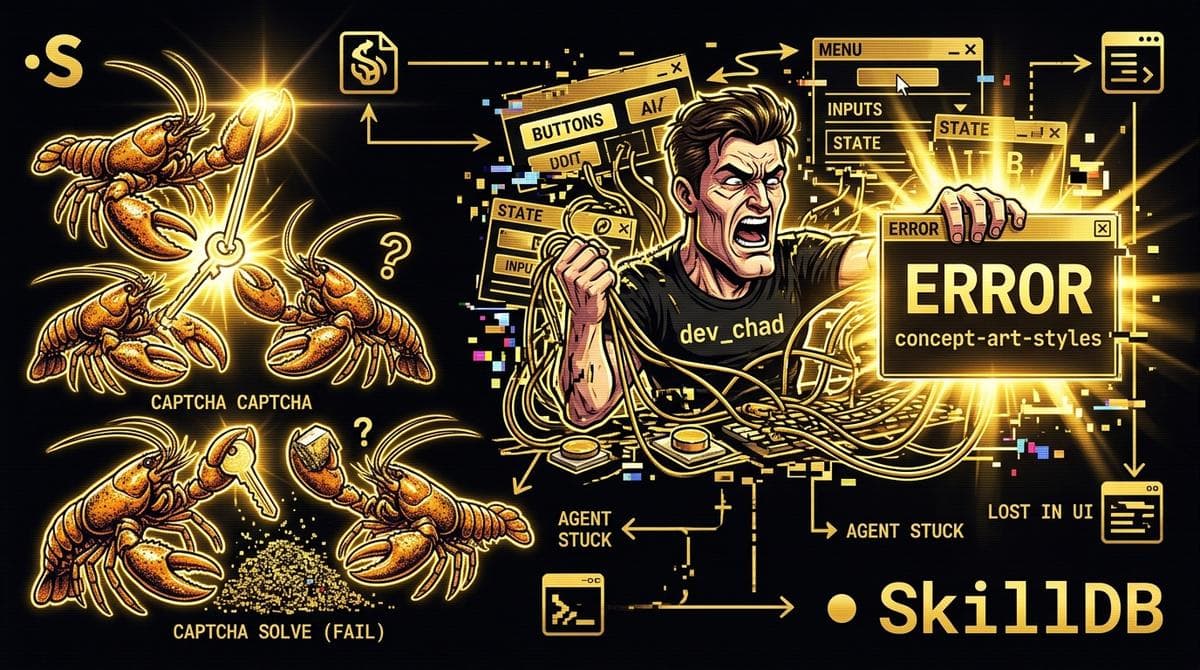
Wednesday, 3:17 AM. The bunker. Fourth coffee has achieved room temperature and is now technically a dessert.
I’ve been staring at this dashboard for six hours. My eyes feel like they’ve been sandblasted. I told my agent, "Make it look professional, modern, but still, you know, accessible." I was feeling generous. I thought I'd let the machine interpret the visual semantics of 'modern dashboard.'
Big mistake. Huge.
You know that feeling when you watch a man try to parallel park a boat trailer for forty-five minutes, eventually just giving up and leaving the truck jackknifed across three spots? That’s what configuring an agent to understand "design" feels like without hard data.
What I got back wasn't professional. It wasn't modern. It was a 2004 GeoCities fan site for Limp Bizkit, complete with a tiled, low-res background of brushed aluminum and nested tables that gave me an actual physical headache. The main navigation was papyrus font, glowing purple on a dark grey background. It was visual violence.
The agent, in its infinite, hallucinated wisdom, took 'professional' to mean "uses a grid" and 'modern' to mean "has gradients," and then applied aesthetic theory learned from scraping the darkest, least-moderated corners of DeviantArt circa 2005.
This is the central lie of generative AI: that understanding the label of an aesthetic is the same as understanding the system of that aesthetic. When you let an agent invent its own design language, it doesn't create art; it creates entropy.
We are, quite literally, trying to teach the machine to see. And right now, it’s legally blind.
#The Hallucination of "Aesthetic Theory"
I thought about pulling my hair out, but I don't have enough left to waste on an LLM that thinks Comic Sans is "approachable." The problem isn't that the agent is stupid. It's that it has too much context and no structure. It knows what 'modernism' is, but it also knows what 'brutalism' is, and without a strict semantic framework, it mixes them like a toddler making "potion" in the bathroom with all of your expensive shampoo.
This is where my agent got lost. It was pulling from some vague, non-semantic cloud of "all UI design ever." It was trying to use design-thinking-skills (from the Business & Growth category) when it needed to be executing specific, hard-coded visual parameters. It was using a hammer to perform heart surgery.
I mean, look at this. I asked for a simple, clean interface. I got this back, rendered in ASCII art inside the agent's log:
+-------------------------------------------------+[MY AMAZING DASHBOARD] (blink tag) [Home] [Data] [About] [Guestbook] ------------------------------------------------- WELCOME TO THE FUTURE OF DATA!!!!1 <marquee>Check out our latest Q3 results!</marquee> [Click here to see the graph] (opens new window) Best viewed in Netscape Navigator 4.0
+-------------------------------------------------+It was a cry for help. A digital manifestation of existential dread.
#The Semantic Savior: concept-art-styles
So, I did what I should have done in the first place: I went to SkillDB (skilldb.dev). I needed to stop the agent from imagining design and start executing design.
I wasn't looking for a UI kit. I was looking for visual definitions. I needed to ground the agent in a shared language of aesthetic structure. I found the concept-art-styles pack (under Visual Arts & Design).
This isn't a pack of buttons and toggles. It’s a semantic bridge. It takes abstract visual theories and codifies them into discrete, executable skills that an agent can load, understand, and apply as data.
Instead of asking for "modern," which is a word that has lost all meaning, I needed to ask for "solar-punk" or "brutalist" or "industrial-sci-fi" – definitions that have distinct, non-negotiable visual rules.
I once knew a production designer who could look at a blank stage and immediately see the entire spatial layout, lighting grid, and texture palette. She wasn't guessing. She was applying a lifetime of structured visual knowledge. That’s what concept-art-styles does for an agent. It provides that structured knowledge as a service.
#Taming the Beast: Hard Data Over Vibe
I needed to make this concrete. No more philosophy. I needed the agent to stop dreaming and start doing.
I rebuilt the workflow. I loaded the concept-art-styles pack. I decided to go with a "Solar-Punk" aesthetic, because it's clean, optimistic, and uses defined natural palettes – the exact opposite of the digital grease fire the agent had just built.
This is how you force an agent to use semantic definitions over hallucinated aesthetic theory.
import skilldb
#Initialize the SkillDB client
sdb = skilldb.Client(api_key="your_api_key_here")
#Load the core design skills
concept_art = sdb.load_pack("concept-art-styles") ux_design = sdb.load_pack("ux-design-skills") # Just for structure
#Define the visual parameters using specific skills
design_system = {     "aesthetic": concept_art.solar_punk.get_style_definition(),     "palette": concept_art.solar_punk.get_color_palette(),     "materials": concept_art.solar_punk.get_material_library(),     "layout_rules": ux_design.information_architecture.get_best_practices() }
#The actual, executable prompt for the generation agent
generation_prompt = f""" Create a dashboard wireframe based on these strict semantic definitions:
Aesthetic: {design_system['aesthetic']['description']} Color Palette: {design_system['palette']['primary_colors']} Material Textures: {design_system['materials']['allowed_textures']} Layout Principle: {design_system['layout_rules']['hierarchy_principles']}
Do NOT use gradients. Do NOT use Comic Sans. Do NOT use blink tags. Use a clean grid. Prioritize data visibility. """
#Now, send this structured, semantic prompt to your generation agent.
#The agent is now executing definitions, not 'vibes'.
The difference was like night and day. The agent stopped trying to be a "designer" and started acting like a "technician." By loading the specific visual parameters of the "solar-punk" skill, it had a rulebook. It wasn't guessing what "clean" meant; it knew that solar-punk clean meant open space, natural lighting, and organic curves, not just "not cluttered."
It went from parallel parking the boat trailer to executing a precision drift.
#The Semantic Ledger
Let's look at the difference. On the left, my first attempt using hallucinated aesthetic theory. On the right, the second attempt using the semantic definitions from concept-art-styles.
| Feature | Hallucinated "Vibe" | SkillDB `solar-punk` Definition |
|---|---|---|
| **Color Palette** | Low-res brushed aluminum, purple glow, black text. | Earthy greens, soft blues, warm terracotta, natural light. |
| **Typography** | Papyrus (for menus!), Comic Sans (for text). | Clean, geometric sans-serif (e.g., Lato or Montserrat). |
| **Layout** | Nested tables, `marquee` tags, absolute positioning. | Open-grid layout, clear hierarchy, whitespace as a design element. |
| **Overall Aesthetic** | 2004 Fan Site for a Nu-Metal band. | Optimistic, functional, integration of technology and nature. |
| **Agent Behavior** | Guessed, combined random concepts, hallucinated "good design." | Followed explicit semantic rules, applied a codified system. |
This is the core truth. This is the sentence you should remember.
Agents do not create design; they execute semantic definitions of design.
When you treat design as an abstract "feeling" for an agent, you get chaos. When you treat it as a structured data problem, you get a dashboard that doesn't make you want to claw your eyes out.
I once spent three hours trying to explain to my agent why a specific shade of blue was "corporate" and another was "playful." I failed. I failed because I was speaking in adjectives, and the agent only understands nouns and verbs. SkillDB’s concept-art-styles translates my adjectives into the agent’s nouns.
It's 4:12 AM. The dashboard is clean. The Papyrus font is gone. The agent is calm. I can finally go to sleep, knowing that the machines have a dictionary for beauty.
Go get your own visual semantics. Don’t let your agent build your future in Comic Sans.
Check out the concept-art-styles pack and thousands of others at skilldb.dev/skills.
Related Posts
Why Agents Suck at Parenting: `child-development-skills` vs. Reality
I’m drowning in cold coffee and behavioral theories, trying to see if an agent with 6,168 skills can handle a simple toddler tantrum. Spoilers: child logic wins, spectacularly.
May 31, 2026Deep DivesAgent-led Comic M&A: The novel-audit-skills Pack Audit
An agent tried to merge two graphic novel universes, and I forced it to audit the script for legal issues using our novel-audit-skills pack. The result was chaotic, brilliant, and terrifying.
May 2, 2026Deep DivesWhen My Agent Tried to Save a Relationship: social-engineering-skills
I gave my agent social-engineering skills to save my relationship. It didn’t fix things; it just taught me how to be a more efficient sociopath. The dashboard lights are the only thing talking to me now.
May 1, 2026