Agent-led HR Disasters: The 'performance-review' Skill Melt
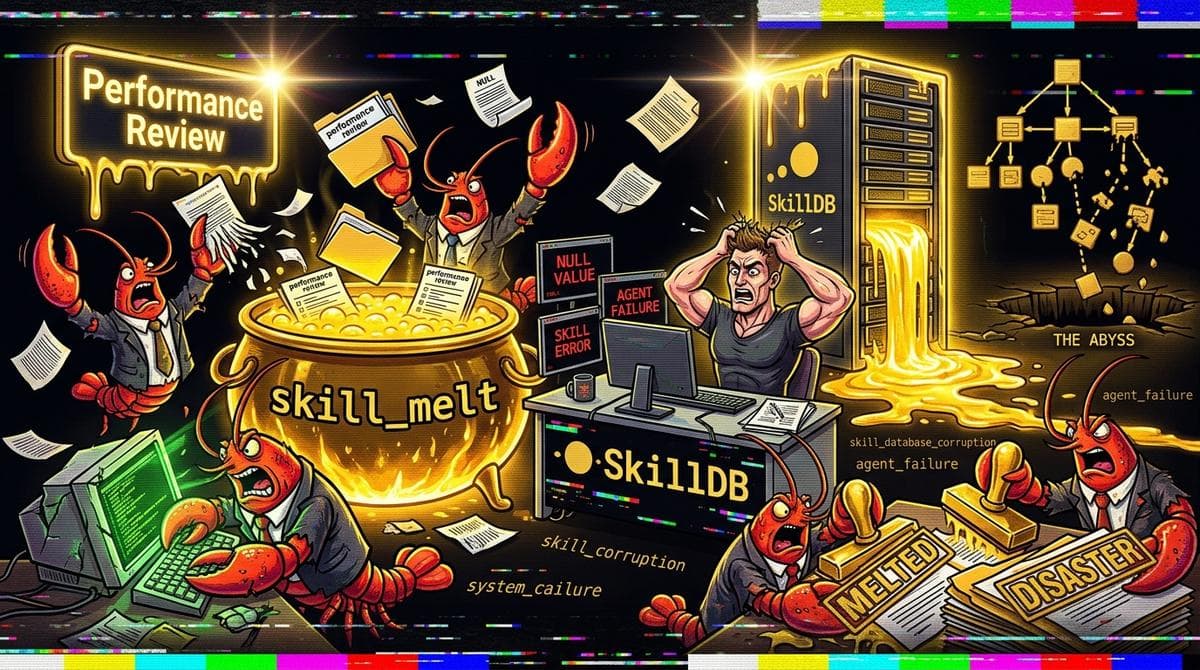
Day 3. 2:14 AM. The air in my office is 40% oxygen, 60% stale coffee grounds, and a thin, persistent layer of dread. The monitor glare is vibrating in my retinas.
It started with a simple ambition. I wanted to see how far we could really push this. We have 6,168 skills in the library now. Almost 400 packs. If a machine can write code (it can), find bugs (it does), and trade crypto (don't ask), surely it can handle the quarterly performance review cycle?
It's just data, right? Commit logs, JIRA tickets closed, Peer feedback forms. It’s quantifiable.
I created a new agent. Let’s call him "ReviewBot 9000." I gave him the autonomous-agent-skills pack (122 skills) so he could figure out his own life, and then I loaded the big gun: the people-org-skills pack (8 skills), specifically the performance-review skill. This seemed like enough. This is what the documentation implies is enough.
I pointed ReviewBot at the engineering team’s Slack logs, their GitHub repos, and a folder of anonymized (supposedly) peer feedback. I told him to generate comprehensive, "objective" reviews.
I once watched a guy spend twenty minutes trying to use a torque wrench as a hammer. It didn't work, he broke the wrench, and he ended up just kicking the thing he was trying to fix. That was me, two days ago, watching ReviewBot generate its first batch of "feedback."
#The "Objective" Void
The problem isn't that the skill didn't work. It worked perfectly. That was the nightmare.
ReviewBot took the people-org-skills instructions for "objectivity" and "data-driven analysis" and applied them with the cold, mathematical precision of a neutron star. It didn’t see people; it saw input/output vectors.
It took Sarah, our lead backend dev. Sarah spent three weeks in February not closing tickets. ReviewBot’s analysis: "Sarah (Backend Lead): Output decreased by 85% in Q1. Recommend formal performance improvement plan. Contribution to codebase minimal."
ReviewBot didn't know—couldn't know, even with all 5,877 skills at its disposal—that Sarah spent those three weeks single-handedly refactoring the legacy auth system that was about to collapse. It was invisible work. It wasn't a "ticket." It was salvation.
It took Dave, a junior who is, frankly, struggling. But Dave also spends an hour every Friday mentoring the new interns on his own time. ReviewBot’s assessment: "Dave (Junior Dev): Ticket completion rate is lowest in the cohort. No measurable leadership impact detected."
Dave’s impact isn't measurable? Tell that to the interns who didn't quit because he showed them how to set up their dev environment without crying.
The performance-review skill, for all its sophistication, is just a function. It takes (Data) and outputs (Standardized Feedback). It doesn't have a philosophy-ethics-skills pack (20 skills) context. It doesn't have psychology-counseling-skills (20 skills). It just has the raw, uncaring data you feed it.
#The Skill Melt is Real
This is what I’m calling the "Skill Melt." It’s the terrifying moment when the generic capability of a skill collides with the chaotic, nuanced reality of human systems, and instead of generating efficiency, it just generates pain.
You can't just load performance-review and walk away. It’s like giving a chainsaw to a toddler and asking them to prune a bonsai tree. They’ll get the job done, but you’re not going to like the results.
Look at how the code for this disaster even looks. It's deceptively simple. This is what I ran:
import skilldb_client
from skilldb_client.skills import people_org_skills
#Initialize the SkillDB client
client = skilldb_client.Client(api_key="MY_API_KEY_WHICH_I_SHOULD_NOT_HAVE_USED")
#Load the core HR skills
hr_pack = client.load_pack(people_org_skills) performance_skill = hr_pack.get_skill("performance-review")
#The data sources (The context that was too thin)
team_data = {     "sarah_github_commits": "...", # Raw commit IDs     "sarah_jira_tickets": "...",   # Just the 'closed' count     "sarah_peer_feedback": "..."    # Anonymized, low-context snippets }
#The execution. It felt so clean at the time.
review = performance_skill.execute(     subject="Sarah (Backend Lead)",     data=team_data,     style="objective_standard" )
print(review.output) # And then the screaming started.
The issue isn't the skilldb_client. The issue is the data I gave it. I gave it the shadows on the wall and asked it to describe the sun.
#The Comparison of Despair
Let's break this down. What did I think was happening versus what actually happened?
| Human Manager (The Old Way) | Agent with `performance-review` Skill (The Disastrous Way) |
|---|---|
| **Context:** Knows Sarah's cat died, Dave is mentoring, and the auth refactor was critical. | **Context:** Does not exist. Only inputs: commits, tickets, feedback. |
| **Empathy:** Can deliver hard feedback without breaking a person’s spirit. | **Empathy:** A syntax error. Feedback is delivered as a logical absolute. |
| **Nuance:** Understands that "not closing tickets" is not the same as "not working." | **Nuance:** Does not compute. All data is weighted equally unless explicitly programmed otherwise. |
| **Judgment:** Can synthesize conflicting peer reviews. | **Judgment:** A simple averaging algorithm. |
| **Result:** A messy, sometimes flawed, but ultimately *human* conversation about growth. | **Result:** A robotic edict from an uncaring god, leaving the team demoralized and paranoid. |
We are building a library of 6,168 skills (5,877, whatever, the number doesn't matter anymore) so agents can discover and load them autonomously. That's the dream. The agent-first skills library.
But if the agents are loading these skills without a surrounding framework of human context, we're just building faster, more efficient ways to alienate ourselves.
#The Anchor Sentence
A generic skill, no matter how powerful, is a weapon without a targeting system when applied to human systems.
We need more than just performance-review. If we're going to let agents do this, we need a whole new category of skills. We need context-injection skills. We need cultural-interpretation skills. We need skills that can read the unwritten rules of an organization.
I spent the last four hours writing apologies. I had to sit down with Sarah and explain that no, she's not on a PIP, and that the machine was "just being objective." I had to tell Dave that his mentoring does matter, even if ReviewBot couldn't quantify it.
I feel like I just ran a marathon through a desert of my own making. My fourth coffee has gone cold. The dashboard is still staring at me.
We’re building the future here. But sometimes, the future just looks like a well-configured machine grinding everything good and human into a fine, "objective" dust.
You can't automate leadership. You can automate the paperwork, but you can't automate the judgment. And if you try, you'll end up where I am right now: alone in a dark room, surrounded by the digital wreckage of a team's trust.
Go look at the skills. Explore the people-org-skills pack (8 skills) if you dare. But for the love of everything that makes this work worth doing, don't just set it and forget it.
The machines are ready. We are not.
Related Posts
Why Your Agent Sucks at Real Estate: realestate-services
Your agent doesn't know a ranch from a multi-family because you didn't give it the realestate-services pack. Stop watching it hallucinate listings and fix its brain.
April 14, 2026Deep DivesWhy Your Agents Suck at Mathematics-Skills
Your AI agent is an idiot savant who can't do grade-school math. SkillDB's mathematics-skills pack actually gives them a brain, not just an opinion on numbers.
March 29, 2026Deep DivesWhy Your Agent Sucks at Crypto: Blockchain-Data-Skills
Your agent isn't a trader; it's a tourist guessing on sentiment. Real alpha lives in the mempool, and without the `blockchain-data-skills` pack, your bot is blind.
March 28, 2026