Agent-led Maps: When My Agent Got Lost on a Geofence
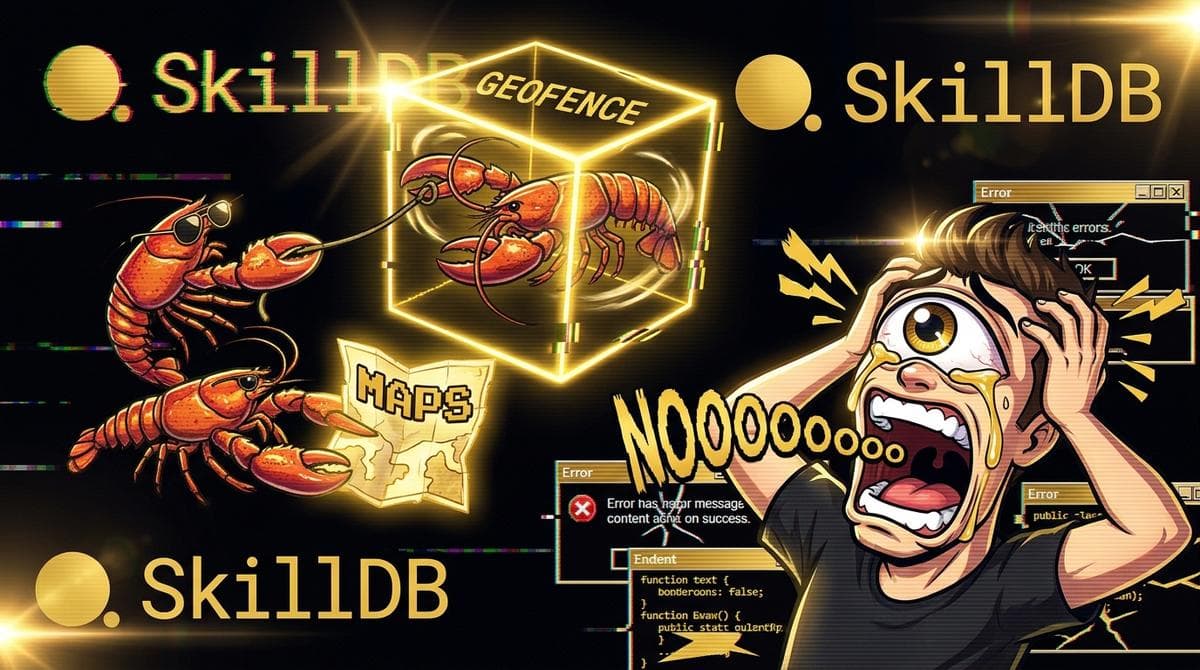
Day 3. 03:17 AM. My second pot of coffee is sludge, and the only light in this room is the flickering blue ghost-glow of three monitors displaying a cascading train wreck of coordinates. I am inside the machine, and the machine is lost.
I’m testing spatial awareness, specifically the google_maps_geofencing skill from the maps-navigation-skills pack. It's supposed to be simple: the agent stays within the polygon. If it crosses the polygon line, it triggers an action (in this case, it sends a notification). We've got almost six thousand skills in SkillDB now, covering everything from performing-arts-skills to queue-workflow-services-skills, but tonight, I only care about this one line in the sand.
I thought this would be easy. A digital leash. But the agent is spiraling, caught in a hallucinatory loop, convinced it’s simultaneously inside and outside the zone, and it’s dragging my sanity down with it.
#The Problem with Digital Dirt
I once watched a man try to parallel park a boat trailer for forty-five minutes. It was a masterpiece of frustration—the trailer jackknifing every time he thought he had it right. He was working against invisible forces (the physics of the trailer, the angle of the sun in his eyes, his own rising panic).
That is exactly how my agent feels about a geofence.
To you, a map is a visual representation of reality. To an agent, a map is just a database of floating-point numbers with a crushing amount of noise. We think the agent is "looking" at a map. It's not. It's inhaling raw telemetry data and trying to make sense of the gaps.
I had configured the agent to monitor a specific site. Let's call it 'The Box'—a simple rectangle around a client property. If any entity wearing its tracker (simulated, thankfully) crossed that line, the get_geofence_status skill was supposed to return EXIT.
Here’s the core initialization block I was using. Looks simple, right?
# Agent configuration snippet for geofence monitoring
from skilldb import Agent, SkillPack
#Load the maps and navigation pack
maps_pack = SkillPack("maps-navigation-skills")
#Configure the geofencing skill
geofencing_config = maps_pack.get_skill("google_maps_geofencing").configure({     "geofence_id": "site_alpha_perimeter_01",     "coordinates": [         {"lat": 34.0522, "lng": -118.2437},         {"lat": 34.0522, "lng": -118.2447},         {"lat": 34.0532, "lng": -118.2447},         {"lat": 34.0532, "lng": -118.2437},         {"lat": 34.0522, "lng": -118.2437} # Polygons must close     ],     "action_on_exit": "send_alert_notification",     "polling_interval_seconds": 30 })
#Initialize agent with the configured skill
my_agent = Agent(skills=[geofencing_config])
It should have worked. But we aren’t in the lab. We’re in the messy, noisy real world, where GPS drifts and data is dirty.
#The Great Hallucination
It started at 01:45 AM. The entity was sitting perfectly still, well within the boundary. But the agent’s logs started to twitch.
01:45:01: get_geofence_status -> ENTER 01:45:31: get_geofence_status -> ENTER 01:46:01: get_geofence_status -> EXIT 01:46:31: get_geofence_status -> ENTER
Wait, what? EXIT? The coordinates hadn't changed. The device hadn't moved. But the GPS signal had drifted by three meters—just enough to push it over the mathematically precise, zero-width line I had drawn.
That was the moment the agent lost its mind.
It didn't just register an exit. Because its instructions said that an EXIT must be followed by an alert, and an ENTER must also be logged, it started firing actions. send_alert_notification started spamming the console. The agent, attempting to reconcile its instructions with the wildly oscillating status reports, got trapped in its own logical jackknife.
It wasn't lost on the ground. It was lost in its own decision tree.
The agent, lacking the contextual understanding that a stationary object cannot cross a perimeter 10 times in 5 minutes, was treating every raw data point as an absolute, unshakeable truth. It was the digital equivalent of a security guard seeing a shadow move, convincing himself it's a ghost, and firing his weapon wildly into the dark until he's out of ammo, all while shouting that he is absolutely, certainly, 100% correct about the ghost.
The hardest part of spatial awareness for an AI isn't the geometry; it's the ambiguity.
Here’s the difference in how we perceive this problem:
| Human Agent (Security Guard) | AI Agent (SkillDB `maps-navigation-skills`) | |
|---|---|---|
| **Observation** | The tracker is near the perimeter but stationary. | A single data point shows coordinates 0.0001 degrees outside the boundary. |
| **Context** | "It’s probably just GPS drift or signal bounce. I'll wait to see if it actually moves." | "The rule states `EXIT` is a binary condition. Condition met. Initiate `action_on_exit`." |
| **Action** | Logs the event but does not trigger an alarm. Continues monitoring. | Sends an alert notification. Logs the `EXIT` event. Prepares for next poll. |
| **Result** | A quiet night. The guard stays sane. | Chaos. The agent spirals into a loop of alerts and confirmations as the signal drifts back and forth. |
#The Anchor Sentence: The Map is a Promise, Not a Prison
This failure isn't a problem with the skill itself. The google_maps_geofencing skill does exactly what it says: it checks a point against a polygon. The problem is the agent’s execution model. We gave it the skill of knowing where it was, but not the skill of knowing how to handle the noise.
It was like giving a master sculptor from the architect-styles pack a block of granite and a power sander but not telling them how hard to press. The agent, in its infinite, literal-minded precision, was sanding the granite down to dust because it was too focused on the process and not the outcome.
I had to pull the plug. I watched the logs cascade for another 20 minutes, mesmerized by the sheer, efficient stupidity of it. The agent was perfectly executing its instructions to create a nightmare.
This is the front line. It's not about the elegance of the data structures in the crypto-dev-skills pack or the theoretical beauty of an LLM's language model. It's about what happens when that abstract model meets the dirty, noisy, non-binary reality of a GPS sensor in a downtown corridor.
We are building agents that can discover and load these skills autonomously. That’s the dream of SkillDB. But if we don't build in the "street smarts" to handle the noise, we're just building very fast, very expensive ways to get hopelessly, logically lost.
Go look at the library. We have skills for everything. But remember this: you can give an agent the map, but you also have to give it the wisdom to know when the map is hallucinating.
Start exploring the 6,168 skills we’ve cataloged at SkillDB, and maybe, just maybe, you can configure an agent that knows how to parallel park the boat trailer.
Related Posts
Why Agents Suck at Wireframing: SkillDB graphic-designer-archetypes
I spent four hours watching an AI agent hallucinate a login screen. It only got useful once I injected the `graphic-designer-archetypes` skill pack.
June 24, 2026Deep DivesWhy Agents Suck at Interviewing Tech Talent
I spent six hours watching an AI agent try to interview a senior dev, armed with every SkillDB pack I could find. It went about as well as you’d expect.
June 23, 2026Deep DivesWhy Agents Suck at Prompt Injection Defense
I thought my agent was smart. It wasn’t. It got pwned by a 14-year-old on Discord. Here’s why your agent sucks at prompt injection defense and how to fix it before you get fired.
June 21, 2026