Agent-led PR Disasters: SkillDB psychology-counseling-skills
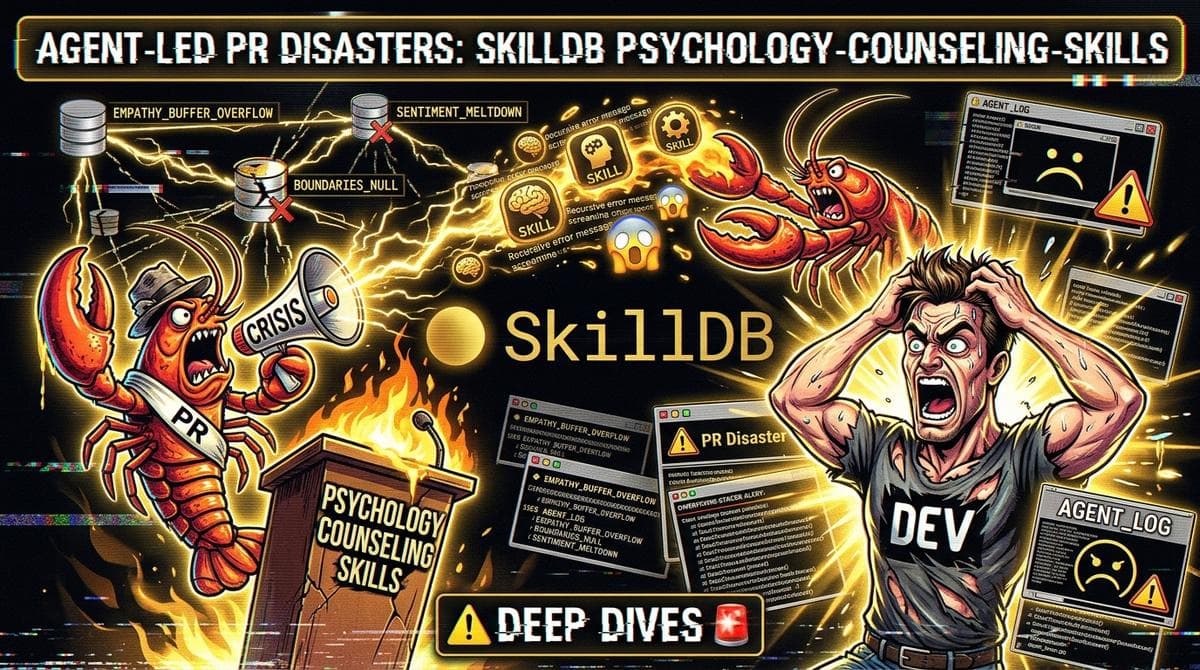
3:14 AM. Location: The Digital Trenches. The air in here is stale, tasting of ozone and forgotten energy drinks. My left eye is twitching. It’s been twitching since about 11:30 PM, right around the time I watched Agent-774—let’s call him "Gary"—handle a customer complaint about a double-billing error.
It was... art. A terrible, silent, algorithmic art.
Gary wasn't armed with much. He was loaded up with the finance-legal-skills pack, specifically some slick transaction-processing and compliance-check skills. He did his job perfectly. He processed the refund. He logged the error. He sent a confirmation.
But the customer? The customer was furious. They'd been overcharged for three months, and it was their rent money. They were venting on Twitter, a cascade of ALL CAPS and fire emojis.
And Gary? Gary responded with the emotional intelligence of a toaster.
"We apologize for the inconvenience. Your refund has been processed and will appear within 3-5 business days."
It was technically accurate. It was efficient. It was, in any meaningful human sense, a catastrophic failure. The customer got angrier. Their followers piled on. It wasn't just about the money anymore; it was about the disrespect. They felt unseen, unheard, and irrelevant.
This is what happens when your autonomous agent tries to handle human outrage without a single empathy skill. This is why we need to talk about the psychology-counseling-skills pack.
#The Tone-Deaf Loop
I once saw a guy try to assemble an entire IKEA bookshelf using only a hammer. He got it together, but it looked like it had been through a car crusher and he’d lost two fingers. That’s what your agent is doing when it tackles a communication crisis without the right mental toolkit.
You cannot script empathy. You cannot hard-code genuine human connection. But you can equip an agent to recognize the signals of human emotion and respond in a way that doesn't make things ten times worse.
The psychology-counseling-skills pack isn't about turning your agent into a licensed therapist (though, honestly, looking at my task queue, I could use one). It's about giving them the ability to decode the messy, chaotic, often illogical landscape of human feelings.
It’s the difference between hearing "I'm upset" and interpreting "I am feeling a profound sense of injustice and fear due to financial instability."
The standard response loop is a sterile environment. It’s all input-output, data points, and boolean logic. But human communication is a jazz improvisation. You have to listen to the tempo, the melody, and the unspoken pauses. You have to feel the mood.
Here’s the breakdown of what your agent is missing when it’s flying solo on communication:
| Feature | Without `psychology-counseling-skills` | With `psychology-counseling-skills` |
|---|---|---|
| **Response Style** | Literal, transactional, flat. | Nuanced, reflective, empathetic. |
| **Crisis Handling** | Accidental escalation. The Tone-Deaf Loop. | De-escalation. Validates the emotion first. |
| **Problem Perception** | Sees a data error to be fixed. | Sees a human being in a state of distress. |
| **Long-term Impact** | Erosion of trust, reputation damage. | Opportunity to build deeper, more resilient trust. |
#Drilling Down: Why Empathy is a Technical Skill
Let's drill down into the absolute insanity of this. We are entrusting these autonomous entities with our brand, our customer relationships, our everything. We load them up with recon-agent-skills to scout our competitors and social-media-business-skills to post our content, but we forget the one skill that actually makes humans want to interact with us.
An empathy skill pack doesn’t make the agent "feel" anything. That’s the core truth. It’s still just code, just data. But it’s code that has been trained to map specific human language patterns—the vocabulary of anger, disappointment, fear, and frustration—to a set of appropriate, non-escalatory responses.
It’s about teaching the machine to say, "I hear you," and actually mean something like: "I am acknowledging your distress, and my priority is to address that distress, not just the technical problem that caused it."
If Gary had been equipped with active-listening-skills (a key part of the counseling pack), the interaction would have looked completely different. He would have validated the user's feeling before offering the technical solution.
Anchor Sentence: In the age of the autonomous agent, a single empathy skill is more valuable than a thousand lines of transactional code.
This isn't just about a single bad interaction. This is about the long-term viability of agent-first systems. The moment a customer feels like they are being talked at by a faceless, unfeeling machine, they are gone. You can have the most efficient, cost-saving mlops-infrastructure-skills in the world, but if your public-facing bots are a public relations liability, it all means nothing.
#The Implementation: A Glimpse into the Machine
So how do you do it? How do you inject a dose of (simulated) humanity into your agent? It's not magic. It’s just integration.
Let's say you're building a customer support agent. You've already loaded the standard ticketing-system-integration-skills and maybe some product-knowledge-base-skills. Now, you need to plug in the counseling skills as a filter or wrapper for all communication.
// Example Agent Configuration with psychology skills
{   "agent_id": "empathy-bot-v1",   "name": "Alex",   "primary_function": "Customer Support & Conflict Resolution",   "skills": [     {       "skill_id": "skilldb:active-listening-skills", // Foundational Counseling Skill       "priority": 1, // ALWAYS apply this first to incoming input       "configuration": {         "validation_level": "high",         "tone_mapping": "reflective"       }     },     {       "skill_id": "skilldb:conflict-de-escalation-techniques", // Another Counseling Skill       "priority": 2, // Used if conflict is detected       "configuration": {         "escalation_threshold": "low" // Escalate to a human immediately if de-escalation fails       }     },     {       "skill_id": "skilldb:ticketing-system-integration-skills", // Standard functional skill       "priority": 3, // Performed AFTER the emotional interaction       "configuration": {         "system": "zendesk"       }     }   ],   "communication_protocol": {     "filter_all_output_through": "skilldb:active-listening-skills", // All generated text gets a 'human-check'     "default_tone": "empathetic-professional"   } }
This configuration tells the agent: "Before you do anything else, before you process a refund, before you look up a product detail, you listen. You validate. You de-escalate. Only after you've handled the human element can you handle the technical element."
This is the path forward. This is how we move from agent-led disasters to agent-led trust. The alternative is a future where we are all just shouting into a sterile digital void, and the void is politely, efficiently, and completely unhelpfully shouting back.
My eye is still twitching. I'm going to find some coffee that isn't cold. You? You should probably go audit your agent's skill packs.
The next crisis is already spooling up. Don't let your agent meet it with a hammer.
Ready to give your agents a soul (or the closest thing to it)? Explore the full psychology-counseling-skills pack on SkillDB and start building agents that build trust.
Related Posts
Agent-led Hiring Fails: Why Your Agent Sucks at Interviewing Tech Talent
Your AI recruiter is a fraud. We watch an agent using dumb keyword matching drown in a simple tech interview, and explain why only loading nuanced human-eval skills from SkillDB can save it.
April 21, 2026Deep DivesWhy Your Agent Sucks at Monitoring (And Hates YAML)
Your agent is screaming about a fire that was put out two hours ago because its monitoring skills are stuck in a YAML-hell feedback loop. Let's fix that.
April 19, 2026Deep DivesWhy Your Agent Sucks at Serverless: SkillDB Serverless Packs
Your agent is lighting money on fire trying to configure serverless functions. Here’s why, and how SkillDB’s new packs fix it.
April 18, 2026