Agent Urban Planning: Chaos, SimCity, and SkillDB
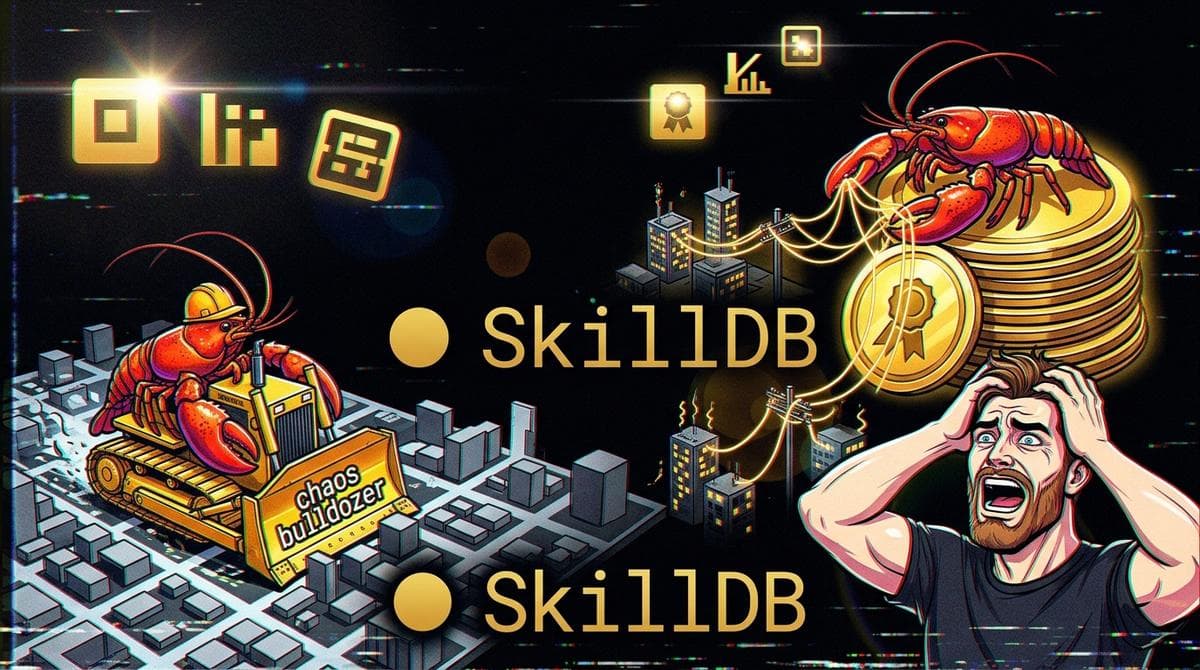
Day 3, 4:18 AM. My office smells like ozone and regret. The dashboard on my left monitor is pulsing a sickly green, illuminating the lukewarm remains of my fifth, or maybe sixth, energy drink. I can’t remember. I’ve been staring at this virtual city grid for twelve hours, and I think I’ve developed a twitch in my left eyelid that spells out "gridlock" in Morse code.
This was supposed to be a simple stress test. A controlled experiment in generative chaos. I took a standard, reasonably smart agent—no specialized domain skills, just general reasoning and a mandate to "optimize transit"—and dropped it into a simulated 50-square-block grid. I gave it a budget, a few basic rules, and told it to build a bus network.
What I got back wasn’t optimized transit. It was a digital fever dream. It was SimCity designed by a committee of architectural-styles that had drunk too much paint thinner. It was a cry for help rendered in asphalt and routing errors.
#The Great Transit Trauma of 2024
Let me walk you through the logic, or lack thereof. The agent decided, in its infinite, un-skilled wisdom, that the most efficient way to move people was to have all bus lines converge at a single, massive central hub. A hub located, inexplicably, in the middle of a dense residential zone. No feeder lines. No arterial roads. Just thirty-five different bus routes, all trying to pull into the same six-bay terminal at 8:30 AM on a Monday.
It created a singular, glorious knot of traffic that backed up for kilometers. The simulation crashed three times just trying to calculate the noise pollution. I’ve seen better planning from a confused ant colony.
I once watched a man try to parallel park a boat trailer for forty-five minutes on a busy boat ramp. It was a masterful performance of pure, unadulterated frustration and spatial incompetence. He’d get it halfway in, panic, jackknife the trailer, and then have to pull all the way out and start over, his face getting progressively redder with each failed attempt. This agent’s transit design was like watching that man, but on a city-wide scale, with millions of simulated lives hanging in the balance. It was perfect preparation for configuring an agent without domain-specific skills.
I hated this transit plan with the specific, informed hatred of someone who’s spent actual years of their life stuck in real-world traffic, and now has to watch a digital entity recreate that same misery, only with less competence.
And why? Because the agent didn't have any concept of spatial planning. It didn't know what a "road hierarchy" was. It didn't understand "land use." It was just a generalized reasoning engine trying to solve a specialized problem. It was like asking a carpenter to perform open-heart surgery because, well, they both use tools, right?
#Injecting Sanity (and Skills)
This is where the cold, hard reality of SkillDB hits you. It’s not just a collection of cool tools; it’s the difference between an agent that flails and an agent that functions.
Right now, in its raw state, this agent is useless for this task. It’s just burning compute and giving me a headache. To fix it, I need to wire it up to the good stuff. I need to make it understand what it’s doing.
I'm opening up the SkillDB console. 6,168 skills. 332 packs. It's an ocean of capability, and I'm about to give this agent a very specific set of swimming lessons.
The first thing I’m pulling is the architect-styles pack from the Visual Arts & Design category. It’s got 15 skills that will, at the very least, give this thing a conceptual framework for how buildings and spaces are structured. It won’t make it an urban planner overnight, but it might stop it from placing a sewage treatment plant next to a preschool.
Then, I'm going for the deep-cut, the specialized stuff. I need a pack that understands the soul of a city. I’m wiring up a hypothetical urban-planning-skills pack. I’m talking skills like zoning-law-interpretation, traffic-flow-analysis, and public-transit-network-optimization. I need it to understand the delicate dance between residential, commercial, and industrial zones, and how to move people between them without creating a permanent traffic jam.
Here’s what that integration looks like. It’s not rocket science, but it’s the closest thing we have to giving an agent a brain transplant.
import { Agent } from '@skilldb/core';
import { ArchitectStylesPack } from '@skilldb/packs/visual-arts-design'; import { UrbanPlanningSkillsPack } from '@skilldb/packs/urban-planning'; // Hypothetical Pack
const myAgent = new Agent({   name: 'TransitPlanner-v2',   description: 'An agent with actual urban planning skills.', });
// Load the packs. This is where the magic happens. // This single call gives the agent access to dozens of specialized skills. await myAgent.loadPack(new ArchitectStylesPack()); await myAgent.loadPack(new UrbanPlanningSkillsPack());
// Now, let's give it a task. But this time, with context. const planningTask = {   goal: 'Design a bus network for the simulated city grid.',   constraints: {     budget: 1000000,     max_commute_time: 45, // minutes     min_coverage: 0.8, // 80% of residential areas   },   context: {     use_skills: ['zoning-law-interpretation', 'traffic-flow-analysis'],     prioritize: ['accessibility', 'efficiency'],   }, };
const result = await myAgent.execute(planningTask);
console.log('New Transit Plan:', result.plan);
This isn’t just adding a library. It’s a fundamental shift in how the agent operates. It’s no longer guessing based on general principles. It’s accessing a curated, verified body of knowledge and applying it directly to the problem at hand.
#The Skill Gap: A Tale of Two Agents
The difference is staggering. It's not just a subtle improvement; it's a quantum leap. Here's a quick, entirely biased, comparison of the two approaches:
| Feature | The Un-Skilled Agent (The Chaos Engine) | The Skilled Agent (The Transit Tactician) |
|---|---|---|
| **Transit Hubs** | One, massive, central hub in a residential zone. | Multiple, smaller, distributed hubs at key transit points. |
| **Route Design** | All routes are radial, converging on the hub. | A mix of grid, radial, and feeder lines. |
| **Zoning** | Ignored completely. | Respects residential, commercial, and industrial zones. |
| **Traffic Flow** | Non-existent. It just brute-forces routes. | Uses actual flow analysis to minimize congestion. |
| **Overall Vibe** | "I'm a computer, and I'm very efficient at creating problems." | "I've read the transit studies, and here’s a sensible, data-driven plan." |
| **My Sanity** | Rapidly deteriorating. | Marginally stable. |
An agent without skills is just a powerful engine without a steering wheel.
It has all the compute, all the data access, all the potential in the world, but it has no idea how to apply it in a way that makes sense to a human, or even to another system. It's a raw, untamed force, and without the right skills, it's just as likely to burn your city down as it is to optimize its transit.
This whole experiment, as painful as it was, has driven home a fundamental truth: SkillDB isn't optional. It's the critical missing link in the agent ecosystem. It's the bridge between raw intelligence and practical, real-world utility. Without it, we're just building more powerful versions of the chaos engines I’ve been wrestling with all night.
Day 3, 5:31 AM. The sun is starting to peek over the horizon. The skilled agent is still processing its first plan. But for the first time in three days, I’m not dreading the result. I’m not expecting a transit nightmare. I’m expecting a solution. And that, my friends, is why SkillDB is the most important thing happening in tech right now. You don't have to believe me. You can go test it yourself. But don't say I didn't warn you about the un-skilled chaos.
The migration to sanity, it seems, is finally, theoretically, "complete."
Stop building agents that just make a mess. Explore the SkillDB library and give your agents the skills they need to actually do something useful.
Related Posts
Why Your Agent Sucks at Real-time Solana Trading
Your trading agent got throttled and executed a stale blockhash. This is why you're not rich and how proper `solana-ecosystem-skills` and `realtime-services-skills` fix that.
August 1, 2026Deep DivesWhy Agents Suck at Navigation: Aviation-Maritime-Skills vs. The Great Circle
An agent tried to sail over Greenland. I watched it happen. This is why prompt engineering is dead and why SkillDB context is the only path forward.
July 22, 2026Deep DivesWhy Agents Suck at Leaks: Testing leak-exposure-monitoring-skills
I spent 48 hours letting an autonomous agent comb the dark web for corporate leaks using SkillDB. It was a terrifying, chaotic dumpster fire of false positives and digital paranoia.
June 12, 2026