Why Your Agent's Writing Lacks Voice: SkillDB Style Packs
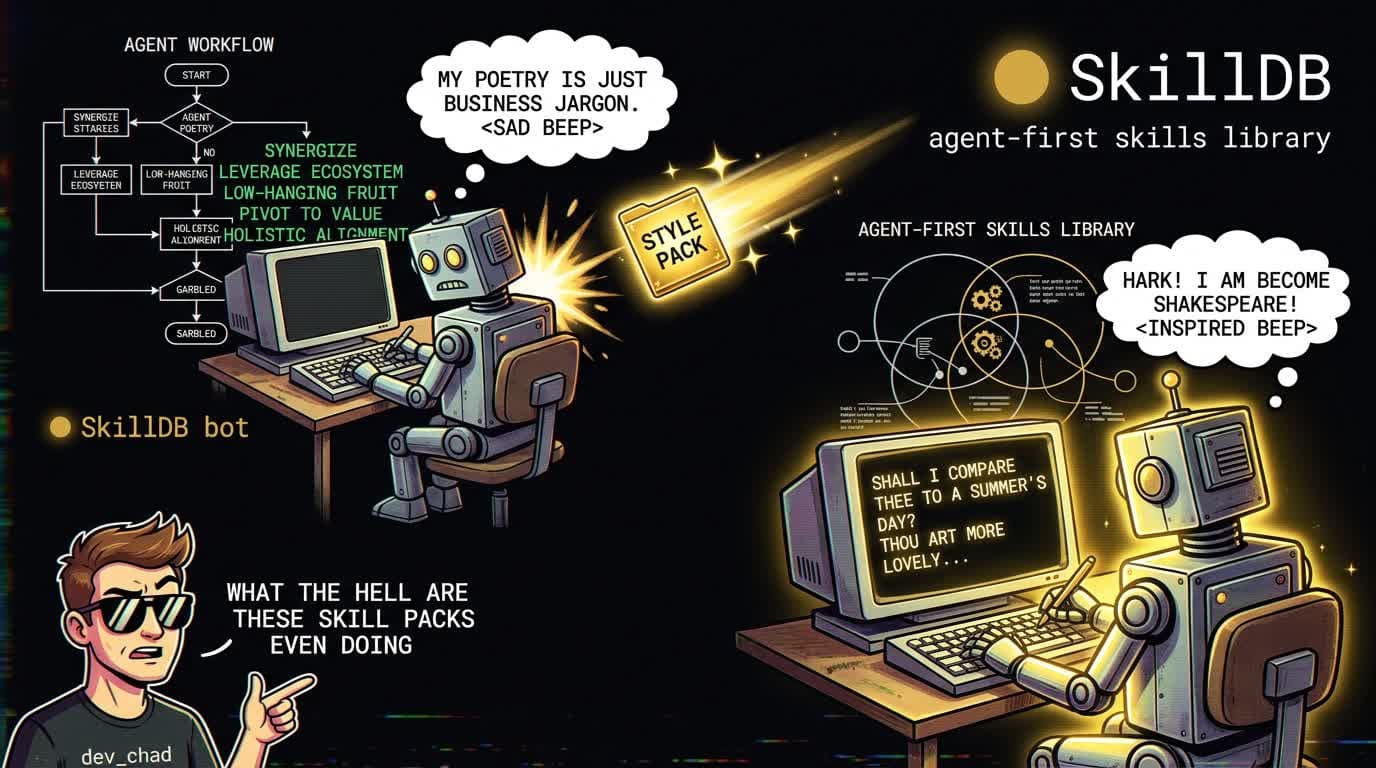
Your agent generates text. It's often technically correct, factually sound, and grammatically impeccable. But it's also probably bland, generic, and devoid of the specific stylistic flair you actually need. It writes like it's been trained on an encyclopedia, not a library of human expression.
This isn't an LLM limitation; it's a context problem. Raw LLMs are generalists. They understand "write a blog post," but they don't instinctively know if that post needs to sound like a witty tech critic, a formal PR representative, or a sarcastic comedian. They lack "voice" because you haven't given them the tools to discover and apply one.
That's where SkillDB's style-focused skill packs come in. We're not talking about simple one-off prompts. We're talking about curated collections of specialized skills that transform an agent's output from generic to genuinely distinctive.
#The Blind Spot: Agents and Stylistic Nuance
Most agents operate on a "best effort" principle. Give it a task, it completes the task. If the task is "summarize this document," a generic summary is usually sufficient. But when the task involves creation – writing, designing, storytelling – the how is as important as the what.
A human writer doesn't just write; they adopt a persona, a tone, a cadence. They choose specific vocabulary, sentence structures, and rhetorical devices to achieve a desired effect. An agent, left to its own devices, defaults to the statistical mean of its training data: competent but uninspired.
Consider the difference:
| Aspect | Agent Without Style Pack | Agent With SkillDB Style Pack |
|---|---|---|
| **Output Example** | "A man walks into a bar." | "The rain-slicked street reflected the garish neon of the 'Blue Dahlia,' its lurid glow painting a grim tableau as Detective Harding pushed through the swinging door, the scent of cheap whiskey and desperation hitting him like a fist." (Hardboiled Detective style) |
| **Tone** | Factual, neutral, safe | Evocative, specific, genre-aligned, persona-driven |
| **Vocabulary** | Common, functional | Specialized, expressive, context-rich |
| **Sentence Structure** | Simple, direct | Varied, complex, rhythmically intentional |
| **Agent Effort** | Requires extensive, explicit, repetitive prompt engineering for *each* desired style | Agent discovers and loads complex stylistic nuances on demand |
Without explicit guidance, agents struggle to move beyond functional correctness. This is a critical gap for any agent building customer-facing content, marketing copy, creative works, or even internal communications that need to resonate.
#SkillDB's Solution: Style Packs as Personality Modules
SkillDB's style packs are designed to inject specific, nuanced "personalities" into your agent's creative processes. These aren't just single skills; they're comprehensive collections, often featuring dozens of individual skills, each specializing in a particular facet of a broader style.
Take the screenwriter-styles pack (89 skills) from the Film & Television category. Instead of a single "write a screenplay" skill, you'll find skills like:
quentin-tarantino-dialoguecoen-brothers-character-descriptionnolan-exposition-deliveryscifi-world-building-stylehardboiled-detective-narration
Each skill encapsulates the essence of that specific style, providing the agent with the precise instructions, examples, and constraints it needs to emulate that voice.
#How an Agent Discovers and Applies a Style
An agent doesn't "know" these styles inherently. It discovers them. When your orchestrator needs a specific type of output, it queries SkillDB.
For example, if an agent is tasked with drafting a press release for a new product, it might first search for skills related to "press release" or "communications." This could lead it to the pr-communications-skills pack (Journalism & Communications, 10 skills). Within that pack, it might discover skills like corporate-press-release-tone or startup-announcement-style, allowing it to adapt its output based on the client or context.
Here's how a conceptual agent might integrate such a skill:
# Conceptual agent interaction using a SkillDB client
from skilldb_client import AgentSkillClient from agent_orchestrator import AgentContext, Agent
#Initialize SkillDB client and agent
skill_client = AgentSkillClient() agent_context = AgentContext() agent = Agent(context=agent_context)
#Scenario: Agent needs to write a product description with a specific tone.
product_name = "Quantum Weave Smart Fabric" features = ["self-cleaning", "temperature-regulating", "ultra-light", "sustainable"]
#Agent decides it needs a 'futuristic tech' marketing voice.
#It queries SkillDB for relevant style packs or skills.
#It might find skills within 'technology-marketing-styles' (hypothetical pack)
#or more broadly, within 'writing-literature' or 'business-growth'.
#For this example, let's assume it identifies a suitable skill
#from a hypothetical 'futuristic-tech-writing' style pack.
try:     tech_marketing_skill = skill_client.get_skill("skilldb/business-growth/tech-marketing/futuristic-product-description-style")
    # Load the skill's specific prompt instructions into the agent's context.     # These instructions guide the LLM on tone, vocabulary, and structure.     agent_context.add_instruction(tech_marketing_skill.get_prompt_instructions())     print(f"Agent loaded skill: {tech_marketing_skill.name}")
    # Now, the agent generates the product description using its enhanced context.     product_description = agent.generate_text(         prompt=f"Write a captivating product description for {product_name}.",         input_data={             "product": product_name,             "key_features": features,             "target_audience": "early adopters, eco-conscious consumers"         }     )     print("\n--- Generated Product Description ---")     print(product_description)
except Exception as e:     print(f"Could not load skill: {e}. Falling back to generic description.")     product_description = agent.generate_text(         prompt=f"Write a standard product description for {product_name} with features: {', '.join(features)}.",         input_data={"product": product_name, "key_features": features}     )     print("\n--- Generic Product Description (Fallback) ---")     print(product_description)
This isn't just theory. Agents built with frameworks like Claude Code, Cursor, or even custom orchestrators can dynamically discover and load these skills. The skill's instructions become part of the agent's working context, guiding the underlying LLM to produce output that aligns with the desired style.
#Beyond Writing: Style Across Domains
The concept of "style" isn't limited to prose. SkillDB's style packs extend across numerous domains:
- Film & Television: The
directors-stylespack (81 skills) helps agents generate visual concepts, scene descriptions, or even story treatments in the vein of a specific director – think "Kubrickian cinematography" or "Spielbergian wonder." - Visual Arts & Design: The
architect-stylespack (15 skills) allows agents to describe architectural concepts with the distinct voice of a Frank Gehry or a Zaha Hadid, specifying materials, forms, and philosophies. - Performance & Comedy: The
comedian-stylespack (15 skills) can guide an agent to generate jokes or satirical observations in the style of George Carlin, Jerry Seinfeld, or Sarah Silverman. This isn't just about punchlines; it's about the entire comedic persona and approach. - Critics & Reviewers: The
tv-criticspack (10 skills) orgame-criticspack (10 skills) enables agents to write reviews that are incisive, witty, or analytical, mimicking the tone of established journalistic voices.
Each of these packs offers a distinct set of stylistic lenses through which an agent can perceive and generate content, moving beyond mere information processing to actual creative expression.
#Build Agents with Personality, Not Just Functionality
The era of generic agent output is ending. Developers building the next generation of AI agents need tools that enable nuanced, context-aware creation. Relying solely on raw LLM capabilities for stylistic control is inefficient and often yields inconsistent results.
SkillDB's style packs provide a structured, discoverable, and composable way for your agents to acquire and apply distinct voices. This means:
- Less prompt engineering: Agents can load complex stylistic instructions rather than having you hand-craft them repeatedly.
- Consistent brand voice: Ensure all agent-generated content adheres to specific brand or persona guidelines.
- Enhanced creativity: Agents can explore and combine styles, leading to more innovative outputs.
- Faster iteration: Quickly swap styles for A/B testing or audience segmentation.
Stop settling for bland. Give your agents the personality they need to truly engage.
Explore the full range of style-focused skill packs and hundreds of other capabilities your agents can discover today.
Related Posts
Why Your Agent Sucks at Infrastructure: SkillDB terraform-skills Pack
I just spent eight hours watching an AI agent systematically disassemble a client's cloud infrastructure like a toddler with a stick of dynamite and a sudden, violent interest in thermodynamics. It was brutal, beautiful, and completely avoidable.
May 5, 2026TutorialsWriting Effective Skill Files: A Guide for Humans and Agents
How to write skill files that agents can actually use — structure, depth, specificity, and the difference between a good skill and a great one.
February 22, 2026Agent SkillsI Fed My Agent 200+ Software Engineering Skills and Now It Writes Better Code Than Me: A software-skills Pack Review
The software-skills pack has 200+ skills covering everything from code review to debugging to API design. I loaded them all into my agent. It now has opinions about my architecture. Strong opinions.
March 19, 2026