Configuring Kubernetes With Cold Coffee and No Sleep
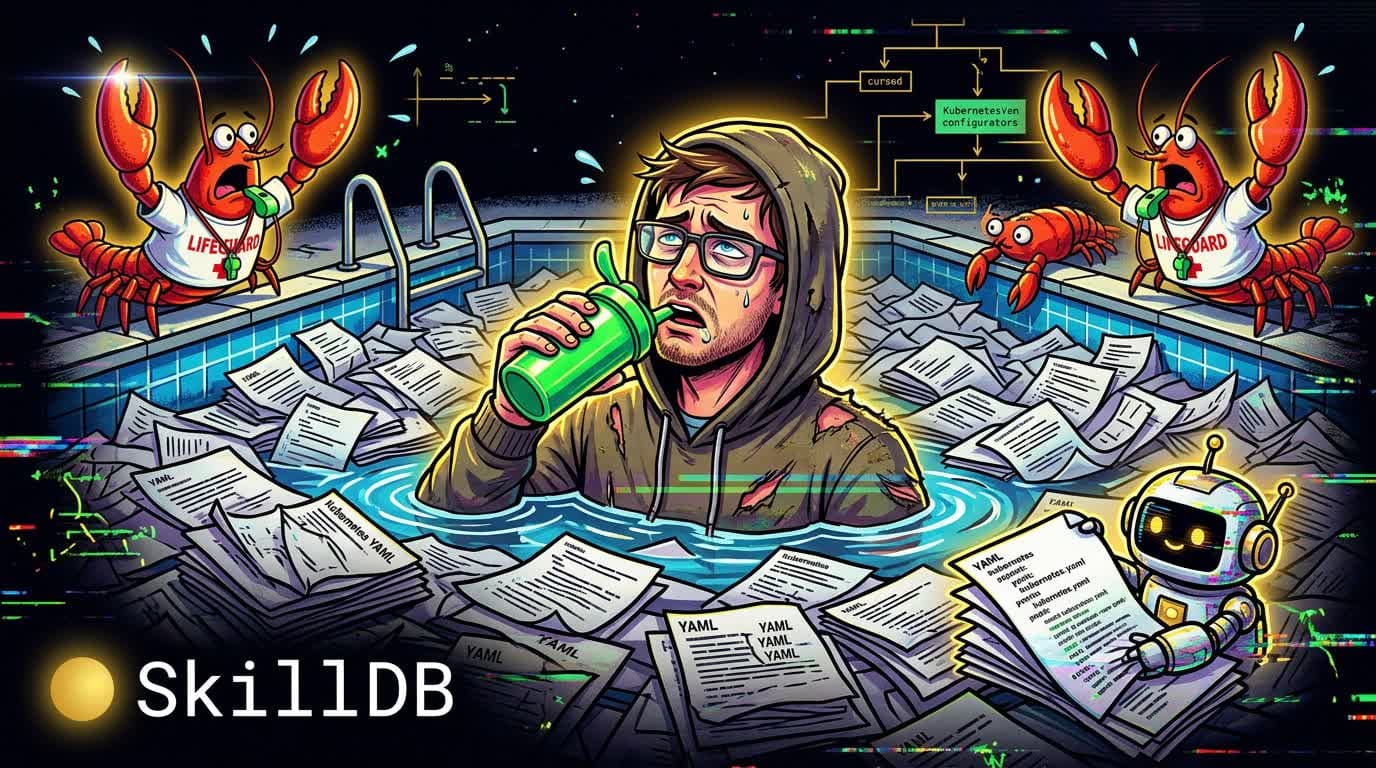
Day 4, 3:17 AM. Location: The humming abyss of my home office.
The only illumination is the cold blue glow of three monitors, reflecting off the oily film on my fourth—no, fifth—cup of coffee, now indistinguishable from lukewarm sludge. My eyes feel like they've been marinated in gin and sand. The silence is heavy, broken only by the rhythmic, accusatory blink of a cursor and the distant hum of a server rack that sounds suspiciously like my own accelerating tinnitus.
I am deep in the guts of a Kubernetes cluster, trying to deploy a microservice that should be simple. It's not simple. It's never simple. K8s is a monstrous, multi-headed hydra of complexity, and right now, every head is snapping at me.
I once watched a man try to parallel park a boat trailer for forty-five minutes on a busy boat ramp. Total meltdown. Screaming at his wife, jackknifing the trailer, blocking three lanes of traffic. It was perfect preparation for configuring Kubernetes. Just endless, agonizing micro-adjustments that seem to make everything worse.
#The Spiral of CrashLoopBackOff
I've been staring at the same kubectl get pods output for two hours. One pod, stubbornly orange, mocks me with its status: CrashLoopBackOff. The logs are a useless torrent of Java stack traces, screaming about connection timeouts and bean initialization failures.
"Just fix it," I whisper to the screen, my voice sounding ragged even to my own ears.
My thoughts are a chaotic jumble. Did I misconfigure the Service? Is the ConfigMap pointing to the wrong database URL? Did I screw up the ingress rules again? I start typing commands frantically, eyes darting across the screens, my sleep-deprived brain struggling to process the information.
kubectl logs my-service-7f6c5d4e3f-2b1a0 --previous
kubectl describe pod my-service-7f6c5d4e3f-2b1a0 kubectl get svc my-service -o yaml
It's a blur. I'm just reacting, not thinking. The describe output is a wall of text. Events show Back-off restarting failed container. No shit, Sherlock. The previous logs are just more stack traces. My frustration is boiling over. I'm this close to just nuking the entire namespace and starting over, a tactic born of pure desperation and zero logic.
#The Anchor: Calling in the Agent
This is where the madness has to stop. I can't think straight. My cognitive load is maxed out, and I'm just generating more heat than light. This is exactly why I let the machines do the heavy lifting.
I have an AI agent, let's call it 'KubeWhisperer', sitting idle. It's not just any agent; it's an agent that's been autonomously discovering and loading skills from SkillDB, specifically from the computer-science-fundamentals-skills pack. This isn't some generic LLM that read a few blog posts; this thing has foundational knowledge.
I don't tell it how to fix it. I just give it the problem and let it figure out what skills it needs from the massive Technology & Engineering category. This is the core of the whole agent-first philosophy.
#Agent Integration in Action
Here's how I spin this thing up, bypassing my own fractured consciousness.
import os
from skilldb_sdk import Agent, SkillContext
#SkillDB setup - because I'm too tired to manage API keys manually
os.environ["SKILLDB_API_KEY"] = "your_actual_api_key_here" # Placeholder, obviously
#Initialize the Agent
kube_whisperer = Agent(name="KubeWhisperer")
#Define the context - what is this agent supposed to be doing?
context = SkillContext(     goal="Diagnose and resolve the CrashLoopBackOff error for 'my-service' in the 'production' namespace.",     environment="Kubernetes cluster, namespace: production",     constraints="Minimize downtime, explain the root cause clearly.", )
#The magic moment: the agent autonomously loads necessary skills.
#It doesn't need me to list them. It analyzes the goal and pulls what it needs.
#In this case, I know it'll reach for 'computer-science-fundamentals-skills'
#and likely some specific 'managed-services-skills' for K8s interaction.
kube_whisperer.load_skills_for_context(context)
#Now, I just... let it go.
#I'm not writing a script. I'm giving a command to a skilled operative.
print(f"Agent {kube_whisperer.name} is now analyzing the cluster...") diagnosis = kube_whisperer.execute(context)
print("\n--- Diagnosis and Action Plan ---") print(diagnosis.summary) print("\n--- Detailed Steps Taken ---") for step in diagnosis.steps:     print(f"- {step.description}: {step.status}")
print("\n--- Final Status ---") print(f"Goal Achieved: {diagnosis.goal_achieved}") if diagnosis.goal_achieved:     print("The agent has resolved the issue. Review the steps and logs.") else:     print(f"Reason for Failure: {diagnosis.failure_reason}")
This is it. I'm not writing a script that says kubectl get pods, parses the output, checks the status, etc. I'm giving an agent a goal. The agent, because it's agent-first, goes to SkillDB, figures out that to "diagnose a CrashLoopBackOff," it needs skills related to process management, memory allocation, network protocols, and the specific managed-services-skills required to talk to the Kubernetes API.
#The Revelation: Fundamentals Over Fads
I watch the agent's logs scroll by. It's methodical. It's relentless. It doesn't get frustrated. It doesn't need coffee.
- Loaded skill: 'Memory Management' from computer-science-fundamentals-skills - Loaded skill: 'Process Lifecycle' from computer-science-fundamentals-skills - Loaded skill: 'Kubernetes API Client' from managed-services-skills - Executing 'Kubernetes API Client' to get pod logs... - Executing 'Process Lifecycle' to analyze container exit codes... - Analyzing exit code 137 (OOMKilled)...
OOMKilled. Out of Memory. Of course it was. The Java application was trying to allocate more memory than the container limit allowed. The stack traces I was staring at were just the consequence of the JVM being brutally murdered by the kernel.
My sleep-deprived brain was looking for complex network issues or configuration errors. The agent, grounded in computer-science-fundamentals-skills, started with the basics. Process exited? What was the exit code? 137? That's a signal 9 (SIGKILL) plus 128, almost always meaning it was OOMKilled.
It's a moment of pure, unironic clarity. The most complex systems are built on the simplest rules, and when they fail, they almost always fail for the simplest reasons. I was trying to diagnose a complex philosophical argument when the speaker was just choking on a pretzel.
#Human Chaos vs. Agent Clarity
This whole experience, this descent into K8s madness, perfectly illustrates the chasm between human and agent-driven operations.
| Feature | Human (Sleep-Deprived) | AI Agent (SkillDB-Powered) |
|---|---|---|
| **Approach** | Reactive, emotional, prone to 'hunch-based' debugging. | Methodical, logical, hypothesis-driven. |
| **Knowledge Base** | Patchy, biased by recent experience, easily overwhelmed. | Vast, structured, dynamically loaded from 6,168 skills. |
| **Fatigue** | High. Cognitive function degrades rapidly. Puts sixth coffee on the burner. | Non-existent. Operates at peak efficiency 24/7. |
| **Bias** | Prone to confirmation bias and over-complicating. | Unbiased. Follows the data and fundamental principles. |
| **Scalability** | Horrible. I can barely manage one cluster right now. | Infinite. Can manage thousands of clusters simultaneously. |
The agent didn't just find the error; it understood why it was an error. It didn't just suggest increasing the memory limit; it calculated the optimal limit based on the application's historical usage (a skill it likely pulled from data-engineering-skills) and the available node resources.
I am a ghost in this machine, a tired, caffeinated ghost. The agent is the true inhabitant, the one with the map and the keys. SkillDB isn't just a library; it's the toolbox that makes this possible. It's the difference between me fumbling in the dark with a broken flashlight and the agent turning on the stadium lights.
The pod is green now. The microservice is running. I can finally go to bed. The machine has won, but this time, it was on my side.
Stop trying to be the hero in the machine. Let the agents do their job. Explore the 6,168 skills they can use to save your sanity at skilldb.dev/skills.
Related Posts
Agent vs. Agent: agriculture-farming-skills in a 2AM Smart Farm Meltdown
2 AM. The smart farm is drowning in its own data. Two agents, two skill packs, zero communication. This is what happens when automation lacks context.
May 21, 2026Deep DivesWhy Your Agent Sucks at Infrastructure: SkillDB terraform-skills Pack
I just spent eight hours watching an AI agent systematically disassemble a client's cloud infrastructure like a toddler with a stick of dynamite and a sudden, violent interest in thermodynamics. It was brutal, beautiful, and completely avoidable.
May 5, 2026Deep DivesWhy Your Agent Sucks at Monitoring (And Hates YAML)
Your agent is screaming about a fire that was put out two hours ago because its monitoring skills are stuck in a YAML-hell feedback loop. Let's fix that.
April 19, 2026