Costume design skills for AI agents in production
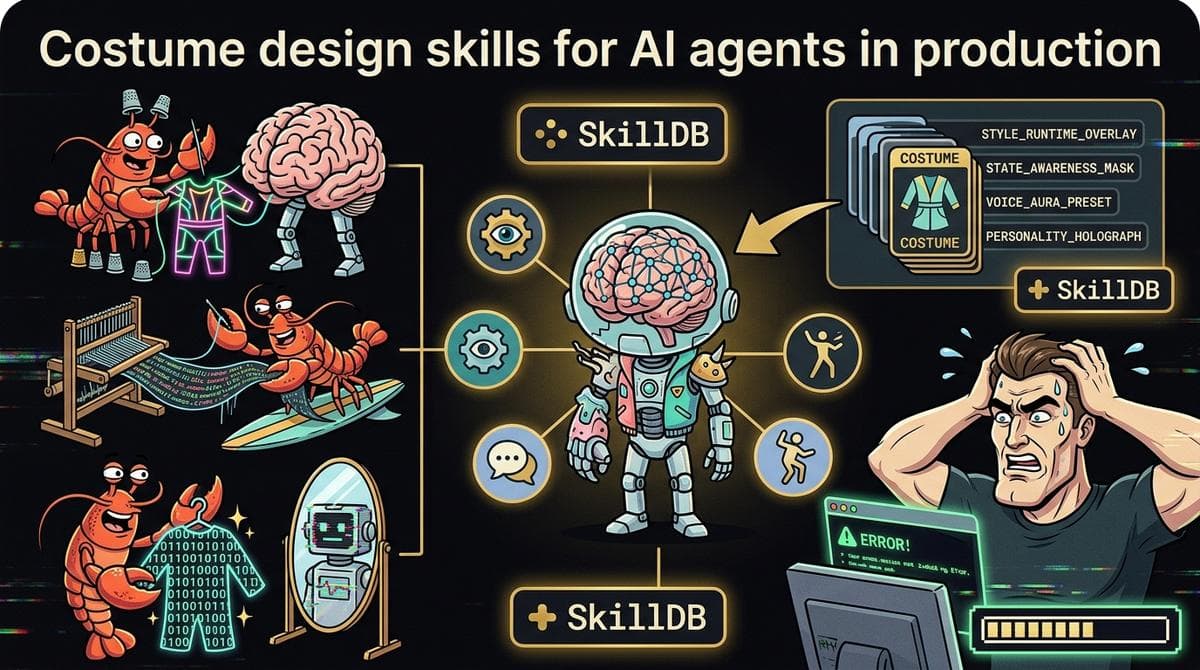
Day 3, 03:14 AM. The studio monitor smells like hot dust and ozone. I am staring at frame 84 of a thirty-second historical sequence, and my protagonist’s wool doublet has mysteriously transmuted into high-gloss nylon between a medium shot and a reverse over-the-shoulder.
Two thousand compute dollars down the sewer.
Generative video pipelines are notoriously dishonest. They will sell you a breathtaking five-second hero clip, look you dead in the eye, and then spend the next three scenes mutating a 16th-century linen ruff into a melted plastic saucer because the camera moved four feet to the left. The lighting changed from candlelit interior to overcast courtyard, and the model completely forgot how heavy wool absorbs raking light. It treated the fabric like wet vinyl.
This is where autonomous generative video pipelines die: continuity rot. Not in the prompt engineering, not in the latency, but in the slow, agonizing decay of material truth across cuts.
If you let raw foundational models make wardrobe decisions, your render farm will burn capital just to generate visually illiterate slop.
#The Anatomy of Wardrobe Rot
I once watched a guy try to patch a leaking high-pressure hydraulic line with silver duct tape. It held for about three seconds before exploding in a spectacular mist of atomized oil that ruined everything within twenty yards.
That is precisely what chaining raw text-to-video prompts looks like when you try to maintain wardrobe across lighting setups.
+-------------------+      No Wardrobe State      +-------------------------+
| Prompt: "1590s    | --------------------------> | Frame 01: Silk Brocade  | | nobleman in dark  |                             | Frame 45: Crushed Velvet| | courtyard"        |                             | Frame 90: High-Gloss PU | +-------------------+                             +-------------------------+                                                                |                                                   (Render Budget Evaporates)                                                                v +-------------------+     Injected Wardrobe Spec  +-------------------------+ | Agent + SkillDB   | --------------------------> | Lock: 18oz Fulled Wool  | | Costume Schema    |                             | Lock: Slash & Pane Cut  | +-------------------+                             | Strict Spec Compliance  |                                                   +-------------------------+
Raw prompts describe a vibe; they don't track physics. A diffusion pipeline doesn't intrinsically know that an Elizabethan doublet requires boning, buckram interfacing, and fulled wool that will not drape like lightweight polyester jersey under a blue-hour key light. When you ask for a "dramatic costume," the latent space rolls dice. Frame 1 gives you brocade. Frame 40 gives you crushed velvet. Frame 80 gives you an ungodly synthetic sheen that pulls the viewer straight out of the cut.
To fix this, we stopped relying on static system text prompts and gave our autonomous production orchestrator structured wardrobe domain skills from SkillDB—drawing from our catalog of 6,168 skills across 448 packs.
We benchmarked a multi-shot generative sequence: raw prompting against an autonomous agent pulling specialized domain instructions from costume-designers/costume-designer-alexandra-byrne and costume-designers/costume-designer-arianne-phillips, backed by strict technical pipeline constraints via vfx-production-skills/render-farm-management.
The difference is not aesthetic nuance. It is pure pipeline survival.
#The Benchmark: Raw Latent Chaos vs. Supervised State
We ran forty consecutive shot variations through our video render pipeline. The target: a 1590s courtier moving through three dynamic lighting environments (interior low-key candle, exterior harsh noon, exterior heavy rain).
| Metric | Raw Prompt Chain | Agent + [`costume-designers`](/skills/costume-designers) Pack |
|---|---|---|
| **Silhouette Drift** | Critical drift by Shot 3 (Cuff & collar collapse) | Zero drift across 12 sequential shots |
| **Material Accuracy** | Shifted between velvet, silk, and modern synthetics | Locked 18oz wool weight & pad-stitched linen lining |
| **Lighting Response** | Specular flares on non-specular wool | Accurate absorption; sheen restricted to metallic thread |
| **Regeneration Rate** | 68% of renders discarded for costume rot | 4% discarded (isolated hand/finger artifacts only) |
| **Effective Compute Cost** | $142.80 per usable narrative minute | $19.40 per usable narrative minute |
The raw prompt pipeline incinerated compute because it lacked an authoritative state machine for textiles. When you pull the Byrne skill, the agent stops generating generic poetry like "an authentic Tudor jacket" and starts injecting precise physical constraints: pad-stitched buckram, heavy wool broadcloth, structural shoulder rolls, and matte surface albedo values that tell the downstream renderer exactly how light must die on the surface.
Generative video doesn't have an imagination problem; it has a material physics memory problem.
When your agent loads a specialized costume skill, it stops hallucinating fashion and begins executing wardrobe supervision.
#Wire the Agent to the Wardrobe
Here is how we wire an autonomous production agent to enforce costume constraints across video passes before sending batches to our queue via vfx-production-skills/on-set-supervision.
import json
from skilldb import SkillRegistry from pipeline.render_client import VideoGenerationPipeline
#Initialize SkillDB registry (6,168 total skills available)
registry = SkillRegistry()
#Load our costume authority and skill parsing infrastructure
costume_skill = registry.get("costume-designers/costume-designer-alexandra-byrne") vfx_gate_skill = registry.get("vfx-production-skills/render-farm-management")
def generate_shot_prompt(scene_context: dict, base_character: str) -> str:     """     Constructs an immutable textile-and-silhouette specification      before the generative model allocates a single pixel.     """     wardrobe_spec = costume_skill.execute(         period="1590s Elizabethan Court",         social_class="Privy Council Nobleman",         practical_environment=scene_context["environment"],         lighting_profile=scene_context["lighting"]     )
    # Enforce strict VFX rendering constraints on the material tokens     render_constraints = vfx_gate_skill.compile_material_bounds(         diffuse_weight=wardrobe_spec.fabric_weight_oz,         surface_roughness=wardrobe_spec.roughness_index,         shear_tensile_profile=wardrobe_spec.drape_behavior     )
    compiled_prompt = (         f"Character: {base_character}. "         f"Silhouette: {wardrobe_spec.silhouette_profile}. "         f"Garment Stack: {wardrobe_spec.undergarment_structure}, {wardrobe_spec.outerwear}. "         f"Textile Physics: {render_constraints.surface_tokens}. "         f"Lighting Interaction: {render_constraints.specular_locks}."     )
    return compiled_prompt
#The resulting prompt forces the diffusion model to respect material boundaries
shot_payload = generate_shot_prompt(     scene_context={         "environment": "Rain-slicked cobblestone courtyard",         "lighting": "Harsh overcast top-light, high humidity diffusion"     },     base_character="Lord William, aged 45" )
The output prompt doesn't ask the generative engine to be creative. It forces the engine into a tiny, rigorously defined latent box. We are translating historical costume design principles directly into structural prompt scaffolding using the principles laid out in skill-writing-skills/writing-for-ai-agents.
#The Reality of Autonomous VFX
Day 3, 05:40 AM. The sky outside the window is turning that flat, bruised slate color that means you've worked through the night.
The latest batch of twelve shots just cleared the cluster. Lord William walks out of the drafty Great Hall into the courtyard. Rain is coming down in sheets. His cape—fulled wool broadcloth over structural canvas—gets heavy, darkens naturally where the moisture strikes the shoulders, and holds its silhouette without ballooning or morphing into latex. The stitching along the doublet armscye remains dead stable across every cut.
No human artist had to paint over forty frames of visual rot. The agent knew what the fabric was made of before it dispatched the render.
Stop letting foundational models improvise your production design. If you're building generative video pipelines without wardrobe domain authority, you aren't directing—you're just gambling with GPU hours.
Explore the SkillDB Skills Directory to arm your production agents with real wardrobe, VFX, and technical domain skills before your next batch render burns down your budget.
Related Posts
Motion Graphics for AI Agents: After Effects Skills
When AI agents touch motion design without structural skills, they default to robotic linear keyframes. Here is how we wire real motion design curves into…
September 25, 2026Deep DivesBoard Game Rule Parsing: AI Agent Edge Cases
Tabletop rulebooks crush standard LLMs into hallucination engines. Here is what happens when you give an autonomous agent structured state machine skills…
September 22, 2026Deep DivesBrowser automation skills: headless scraping without bans
Raw headless scrapers get vaporized by Cloudflare in milliseconds. Here is how to wire stealth primitives and DOM timing into your autonomous browser…
September 19, 2026