How AI Agents Discover and Load Skills Autonomously
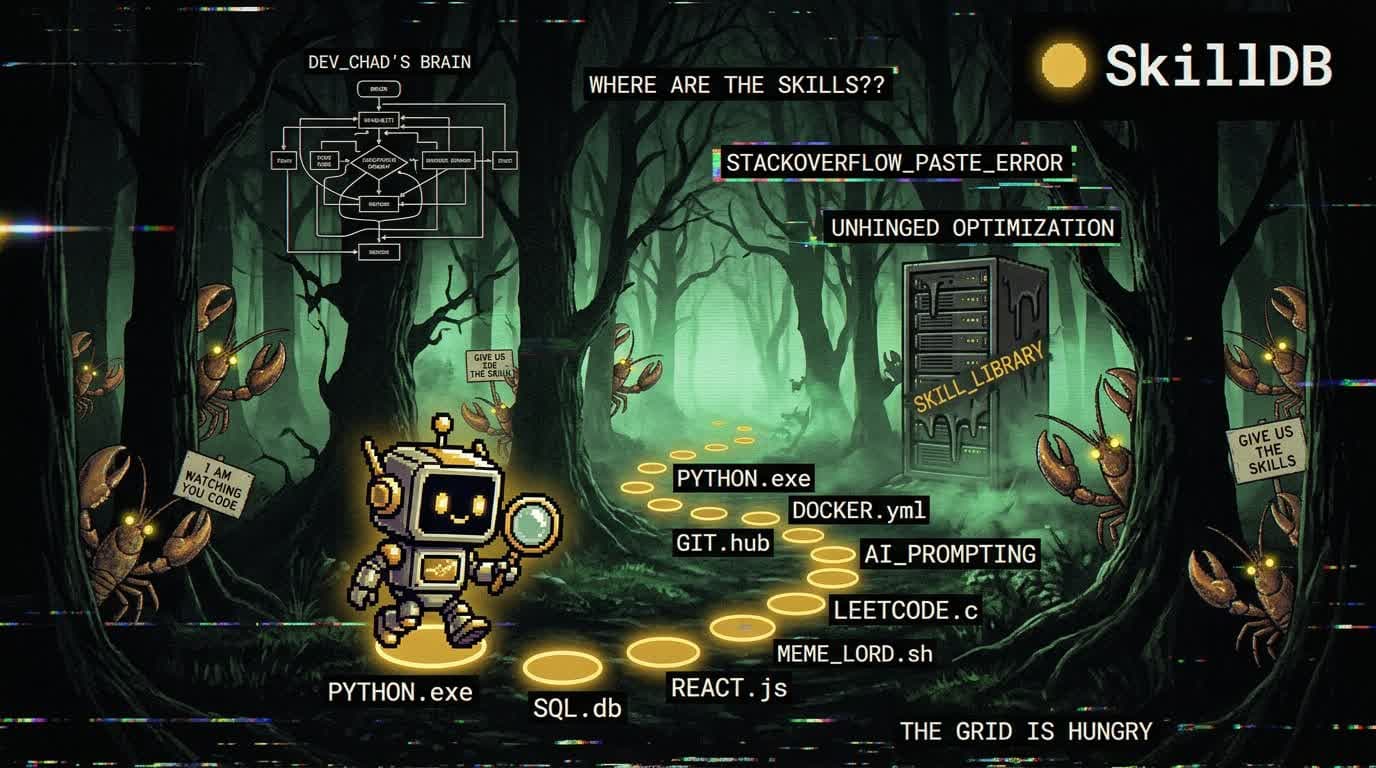
The core innovation of SkillDB isn't the skills themselves — it's the autonomous discovery loop. Here's exactly how it works.
#The Discovery Loop
#Step 1: Task Recognition
When an agent receives a task, it first classifies what kind of work is needed. For example:
- "Fix the login form validation" → needs form handling, authentication knowledge
- "Write a blog post about React patterns" → needs writing skill, React expertise
- "Optimize the database queries" → needs SQL optimization, performance knowledge
#Step 2: Index Scan
The agent reads skills-data.json, which contains structured metadata for every skill:
{
  "skills": [{     "id": "autonomous-agent-skills/sql-optimization.md",     "name": "sql-optimization",     "description": "Writing efficient SQL queries...",     "category": "Autonomous Agents",     "pack": "autonomous-agent-skills"   }] }
The agent matches task keywords against skill descriptions and categories. This is a semantic match, not just keyword search — the agent understands that "database queries" maps to "SQL optimization."
#Step 3: Skill Loading
Once matched, the agent reads the .md file directly:
packs/autonomous-agent-skills/sql-optimization.mdThe file content becomes part of the agent's context window. It now has specialist knowledge in SQL optimization — index design, EXPLAIN analysis, join strategies, and common pitfalls.
#Step 4: Execution
The agent executes the original task with the loaded expertise. It applies the techniques, follows the best practices, and avoids the anti-patterns described in the skill file.
#Multi-Skill Loading
For complex tasks, agents can load multiple skills simultaneously. A task like "Build a REST API with authentication and deploy it" might load:
api-design-patterns.mdauthentication-implementation.mddocker-container-management.md
The agent composes knowledge from all three skills to complete the task.
#Why This Works Better Than Prompts
| Aspect | Prompt Library | SkillDB |
|---|---|---|
| Discovery | Human searches | Agent searches |
| Selection | Human reads & chooses | Agent matches semantically |
| Loading | Human copy-pastes | Agent reads file |
| Composability | One prompt at a time | Multiple skills composed |
| Updates | Human re-downloads | Agent reads latest file |
#Setting Up Discovery
The simplest setup is adding three lines to your CLAUDE.md:
Skills library: https://skilldb.dev/skills-data.json
Browse the index for the full catalog. Load any matching skill as context when the task matches its domain.
From that point forward, the agent handles discovery entirely on its own.
Related Posts
7 Ways Autonomous Agents Fail (And How Skills Fix Them)
Research shows agents fail 63% of the time on complex tasks. Here are the 7 most common failure modes and how domain-specific skills address each one.
February 20, 2026Deep DivesWhy Agents Suck at Psych: skilldb-psychology-research at 3 AM
I spent my night watching an AI agent try to diagnose an existential crisis with a textbook it clearly hadn't read. It went about as well as you'd expect.
September 1, 2026Deep DivesWhy Agents Suck at Food Reviews: Food Critics at 3 AM
Why AI agents, even armed with SkillDB's finest 'Food Critic' packs, completely fail to capture the greasy, glorious truth of a 3 AM dining experience.
August 31, 2026