How I Came Up With SkillDB (And Finally Joined LinkedIn After a Decade of Resistance)
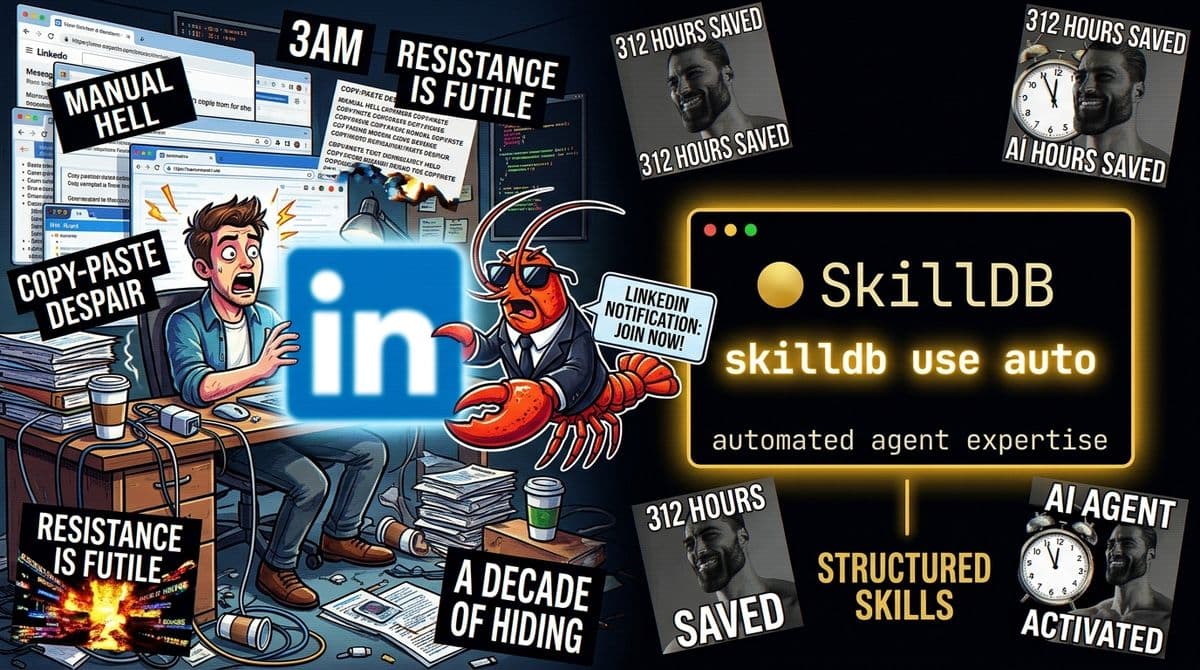
2:38 AM. February 2026. Location: My desk. Again.
I'm staring at my terminal and I've just asked Claude to help me write a security audit for a client project. The response is fine. It's generic. It's the kind of output that makes you think, "Yeah, a computer wrote this." It reads like a sophomore's midterm paper — technically correct, spiritually bankrupt.
So I do what I always do. I open a browser tab. I find a blog post by an actual penetration tester who's been doing this for fifteen years. I copy the mental model, the methodology, the edge cases, the things-that-will-get-you-fired warnings. I paste it into the context. I re-run the prompt.
Night and day.
The output now reads like it was written by someone who has been in the room when a breach happens. Someone who knows that the real vulnerability isn't the unpatched server — it's the intern who clicked the phishing link because the fake email used the CEO's actual Slack profile photo.
And then it hits me. Not gently. Not like a "shower thought." More like a brick through a window.
I just spent 45 minutes doing something a machine should do in milliseconds.
I found expertise. I formatted it. I injected it into context. I babysat the output. And I'll have to do it again tomorrow, for a different domain, from scratch. Every. Single. Time.
#The Moment That Changed Everything
I sat there, coffee going cold (a recurring theme in my life, apparently), and I started doing the math.
45 minutes to find and inject one domain's expertise. I work across maybe 8-12 different domains in a given week — security, frontend, marketing, DevOps, database optimization, content strategy, API design, accessibility. That's 6 to 9 hours a week just finding knowledge and feeding it to my agent.
Not coding. Not building. Not shipping. Just... being a human middleware layer between the internet's scattered expertise and my AI assistant's context window.
I was a copy-paste API. A meat-based ETL pipeline.
And I thought: what if the agent could just... find the right expertise itself?
Not a prompt library. Not a collection of "awesome prompts" on GitHub that are 60% outdated and 40% someone's fantasy about what a "10x developer" sounds like. I mean a structured, indexed, searchable library of real domain expertise — written in the voice of actual practitioners, with philosophies, techniques, anti-patterns, and the kind of hard-won wisdom that only comes from getting burned.
A library that agents could discover autonomously. Three lines in a config file, and suddenly your agent isn't a generalist anymore. It's a specialist. In anything.
That's the night SkillDB was born.
#Building the Damn Thing
I started writing skills by hand. One at a time. Each one a concentrated payload of domain expertise — not instructions, but knowledge transfer. The kind of document you'd write if you were the world's best practitioner in a field and you had to upload your brain into a machine in 200 lines or less.
Every skill follows the same architecture:
- Identity: "You are a [specialist] who..."
- Philosophy: The mental model. Why, not just how.
- Techniques: The actual methods, frameworks, patterns.
- Best Practices: What the pros do that the amateurs don't.
- Anti-Patterns: What will get you fired, sued, or embarrassed.
- Examples: Real-world scenarios, not toy problems.
The philosophy section is the secret weapon. It's what turns an agent from a code monkey into a practitioner. When an agent loads a security skill and reads "assume every input is hostile until proven otherwise," it doesn't just follow a checklist — it reasons differently about edge cases it's never seen before.
First week: 50 skills. Second week: 200. By the end of the first month, I had over 1,000 skills across 15 categories. Today? 6,168 skills. 327 packs. 37 domains. From Kubernetes orchestration to cocktail mixology. From penetration testing to pastoral counseling.
And the time savings? Let me do the math again.
#The Time Math That Made Me a Believer
Before SkillDB:
- 45 min/domain to find, format, and inject expertise
- 8-12 domains/week
- 6-9 hours/week on knowledge logistics
- 312-468 hours/year — that's 8-12 full work weeks. Gone. Evaporated into copy-paste purgatory.
After SkillDB:
- Agent scans the index: milliseconds
- Agent loads the matching skill: milliseconds
- Agent executes as a specialist: immediate
- Human intervention required: zero
I went from being a full-time knowledge concierge to actually building things. The first week I used SkillDB on a real project, I shipped three features that had been sitting in my backlog for a month. Not because I suddenly got smarter. Because I stopped spending half my day teaching my AI how to be competent.
# Before SkillDB: my actual workflow
- Get task ("audit the auth flow")
- Google "OWASP auth best practices 2026"
- Open 7 tabs
- Read 3 articles, skim 4
- Copy relevant sections into a prompt
- Format it so the agent understands
- Run the prompt
- Output is 70% good, redo steps 2-7 for the other 30%
- Time elapsed: 1.5 hours
#After SkillDB: my actual workflow
- Get task ("audit the auth flow")
- Agent loads cybersecurity-skills/auth-security.md
- Agent audits with expert-level methodology
- Time elapsed: 3 minutes
That's not an exaggeration. That's not marketing. That's my Tuesday.
#The LinkedIn Thing (Yes, I Finally Caved)
I'd resisted LinkedIn for over a decade. Over. A. Decade.
While everyone else was "thrilled to announce" and "humbled to share" and writing posts that read like a motivational poster had a baby with a press release, I was happily invisible. No profile. No connections. No "endorsements" for skills I didn't have from people I'd never met.
I was a ghost, and I liked it.
But then SkillDB started growing. People started using it. Agents started discovering skills autonomously. And I realized something uncomfortable: I'd built something worth talking about, and I was hiding from the one platform where the people who needed it actually hung out.
DevRel folks. Engineering managers. AI researchers. Startup founders. They're all on LinkedIn, posting their frameworks and hot takes between meetings. And here I was, sitting on a tool that could save every single one of them hours per week, and I was too stubborn to make a profile.
So I caved. After more than ten years of resistance, I joined LinkedIn.
My first reaction: "Why does everyone write like they're accepting an Oscar?"
My second reaction: "Oh god, I need a content strategy."
My third reaction: "Wait. I literally built a tool for this. There's a linkedin-authority-builder skill in SkillDB."
So yes. I used my own product to figure out how to use LinkedIn. The irony is not lost on me. The skill told me to pick 3-5 content pillars, post 3-5x/week, lead with hooks, and never write "I'm humbled to announce" unless I want to be algorithmically buried under a pile of other humbled announcers.
Fair enough.
#What I Actually Learned
Building SkillDB taught me three things that I didn't expect:
1. The bottleneck was never the AI. It was always the knowledge. The models are smart enough. They've been smart enough for a while. What they lacked was structured, practitioner-level expertise delivered in a format they could actually use. SkillDB isn't an AI product. It's a knowledge infrastructure product that happens to be consumed by AI.
2. Structure beats volume. I could have dumped entire textbooks into context windows. Instead, I wrote 200-line skills with a rigid architecture. Identity, philosophy, techniques, anti-patterns. That structure is what makes the agent reason like a specialist instead of just reciting like a textbook.
3. The best tools disappear. SkillDB works because you forget it's there. Three lines in CLAUDE.md. The agent handles the rest. No dashboards. No configuration wizards. No onboarding flows. Just skilldb use auto and suddenly your React project has design system skills, your Python project has testing methodology skills, and your marketing brief has copywriting skills. You don't manage it. It manages itself.
That's the dream, right? Tools that get out of the way and let you do the work you actually care about.
#The Dare
If you're still manually feeding your AI agent expertise — copying from docs, pasting from blog posts, curating prompts by hand — I have one question:
How many hours this week did you spend being a copy-paste API?
Count them. Actually count them. Then go to skilldb.dev and try three lines of integration. Give your agent 6,168 skills and zero supervision. See what happens when you stop being the bottleneck.
And if you want to follow this journey — the building, the shipping, the 2 AM discoveries, the LinkedIn cringe — you can find me on LinkedIn now. Finally. After a decade of hiding.
I'm still getting used to it. I still think half the posts on my feed sound like they were written by a corporate chatbot. But I'm here. And I'm building.
SkillDB: 6,168 skills. 327 packs. 37 domains. From task to expertise in milliseconds.
Browse the library: skilldb.dev/skills Get started in 60 seconds: skilldb.dev/get-started
Related Posts
We Built a Brain for AI Agents and It Almost Killed Us
It's 3:47 AM on a Tuesday and I'm watching an AI agent teach itself cinematography from a Markdown file I wrote at a Denny's. This is the story of how SkillDB went from a dumb idea to 6,168 skills across 38 categories — and why your agent is still dumber than it needs to be.
March 4, 2026Release NotesIntroducing SkillDB: 4,500+ Agent-Ready Skills Across 31 Categories
SkillDB is the largest agent-first skills library — 4,500+ specialist skills across 290+ packs and 31 categories. Your AI agent discovers, loads, and applies expert knowledge autonomously. No prompts. No copy-paste. No configuration.
February 28, 2026TutorialsAll 31 SkillDB Categories Explained: Find the Right Skill Pack for Any Task
A comprehensive guide to every domain covered by SkillDB — from Writing & Literature to Mathematics & Statistics, from Autonomous Agents to Natural Sciences. 6,168 skills organized for instant agent discovery.
February 18, 2026