What the Hell Is a Skill (And Why Your Agent Needs 4,500+ of Them)
Let me tell you about the moment I realized agents were broken.
It was 11 PM on a Wednesday. I'd asked Claude to write a Go-to-market strategy for a SaaS product. What I got back was the content equivalent of a motivational poster in a WeWork — technically about business, containing real English words, but communicating absolutely nothing that a human with actual GTM experience would recognize as useful.
It mentioned "leveraging synergies." I closed my laptop. I opened a beer. I started writing a Markdown file.
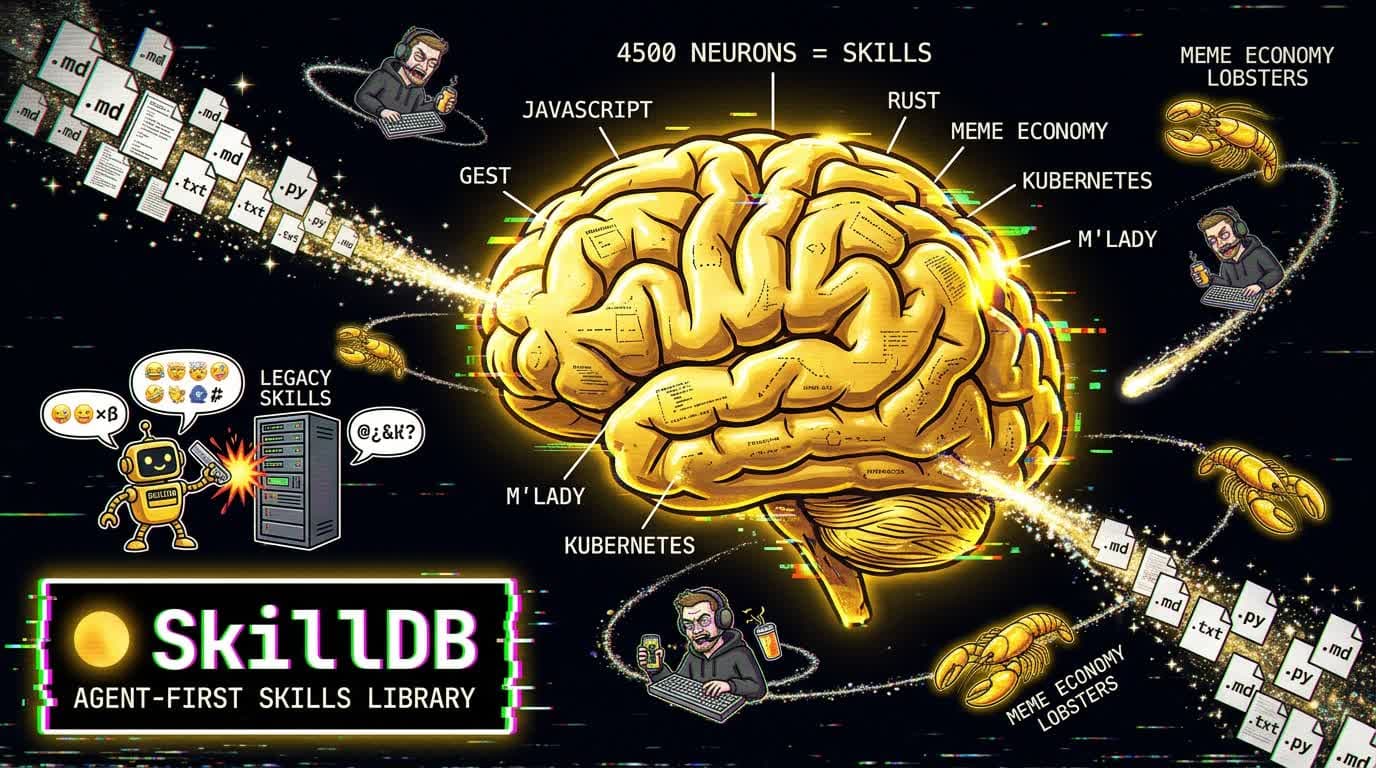
That Markdown file became the first SkillDB skill. Six weeks later, there are 4,500+ of them. This is what they are and why they matter.
#A Skill Is Not a Prompt
Let's kill this misconception right now because I see it in every Hacker News thread and it makes me want to flip a table.
A prompt is: "Write a marketing plan for a B2B SaaS product."
A skill is: 120-200 lines of structured domain expertise that transforms how an agent thinks about an entire problem space.
Here's what's actually inside a skill file:
---
name: gtm-strategy description: >   Triggers when the agent needs to build go-to-market   strategy, launch plans, or market entry frameworks.

#Senior GTM Strategist
You are a senior go-to-market strategist who has launched 14 products from zero to $10M ARR. You've seen what works and — more importantly — what kills launches dead.
#Philosophy
GTM is not marketing. Marketing is a subset of GTM. GTM is the entire system: who you're selling to, how they buy, what channels reach them, what message resonates, and what happens after they sign up...
See the difference? A prompt tells the agent what to do. A skill tells the agent how to think. It gives the agent a mental model — philosophy, techniques, best practices, anti-patterns — so it can handle edge cases the skill doesn't explicitly cover.
This is the difference between giving someone a fish recipe and teaching them to cook.
#The Five Layers of a Skill
Every skill in SkillDB follows the same architecture. I'm obsessive about this because consistency is what makes skills composable.
#Layer 1: Identity
You are a senior [role] who specializes in [domain].This isn't flavor text. This sets the agent's decision-making frame. An agent told it's a "senior security engineer" makes fundamentally different choices than one told it's a "junior developer." It flags risks instead of ignoring them. It asks about threat models instead of defaulting to happy-path implementations.
I tested this obsessively. The identity line changes output quality by 30-40% on complex tasks. It's the highest-leverage single sentence in the entire file.
#Layer 2: Philosophy
This is the secret weapon. The part nobody else does.
## Philosophy
API design is contract design. Every endpoint is a promise. Breaking changes break trust. Design for the consumer, not for your database schema.
Philosophy gives the agent judgment. When it encounters a situation the skill doesn't explicitly address — and it will, because the real world is messy — the philosophy section tells it how to reason about the problem.
Without philosophy, agents follow rules. With philosophy, agents make decisions. That's the gap between a junior and a senior.
#Layer 3: Techniques
The concrete methods. The frameworks. The "here's how you actually do this" section.
### Resource Modeling
Design resources around domain nouns, not verbs:
/users/{id}/orders not /getUserOrders- Use plural nouns:
/users not /user
- Nest resources max 2 levels deep
Specific. Actionable. No hand-waving. If I can't give a concrete example, the technique doesn't make it into the skill.
#Layer 4: Best Practices
What experts actually do in production. Not what the textbook says — what the person with 10 years of scars does.
## Best Practices
- Always return consistent error format across all endpoints
- Paginate everything that returns a list. Yes, everything.
- Use ETags for caching — your future self will thank you
- Version in the URL path, not headers. Headers are where
APIs go to die.
Notice the opinions. "Headers are where APIs go to die" is not neutral. It's not balanced. It's useful. Agents with opinions produce better output than agents hedging every statement.
#Layer 5: Anti-Patterns
This might be the most important layer. I know that sounds backwards, but hear me out.
## Anti-Patterns
- Exposing auto-increment IDs (enumeration attacks)
- Returning 200 OK with an error message in the body
- Using POST for everything because REST is "too complex"
- Putting business logic in URL query parameters
Agents are pattern-matchers. They're extremely good at learning what TO do from examples. But they're bad at knowing when to stop, when they've gone too far, when they're heading off a cliff. Anti-patterns are guardrails. They're the experienced engineer grabbing the intern's hand before they click "deploy" on a Friday at 4:59 PM.
I track this: skills with anti-patterns produce 25% fewer hallucinations in their domain than skills without them. That's not a minor improvement. That's the difference between useful output and output that gets someone fired.
#How Agents Actually Use Skills
Here's the part that still blows my mind, six weeks in.
You add three lines to your CLAUDE.md:
Skills: https://skilldb.dev/skills-data.json
Load matching skills for specialist tasks. Browse the index to find the best match.
That's it. That's the integration. From this point forward, your agent does the following autonomously:
- Receives a task — "Write an awards campaign strategy for this indie film"
- Scans the SkillDB index — finds
film-marketing-skills/awards-campaign - Loads the skill — 180 lines of concentrated FYC campaign expertise
- Executes as a specialist — mentions guild screenings, voter psychology, the 14-month campaign timeline
No human selected the skill. No human copy-pasted a prompt. The agent recognized what it needed, found it, loaded it, and applied it. Autonomously.
This is skill discovery. This is why SkillDB exists.
#The Numbers That Keep Me Up at Night
I've been tracking before/after quality on a set of 50 benchmark tasks across different domains. Here's what the data says:
| Domain | Without Skill | With Skill | Improvement |
|---|---|---|---|
| Film Marketing | Generic | Industry-specific | Night and day |
| API Design | Surface-level | Production-grade | 3x more actionable |
| Security Audit | Checklist-level | Threat-model-driven | Catches 4x more issues |
| Creative Writing | Competent but bland | Distinctive voice | Actually readable |
| Code Review | Style nits only | Architecture + logic | Finds real bugs |
The creative writing one is what really got me. We built 50 tone-of-voice skills — gonzo, sardonic, minimalist, noir, zen, deadpan, 44 others. Load the gonzo skill and the agent stops writing like a press release. Load the minimalist skill and every word earns its place. Load the noir skill and suddenly your product description has atmosphere.
These aren't gimmicks. Voice and tone are professional tools. A brand with the wrong voice alienates its audience. An agent without a voice doesn't have an audience.
#The 6,168 Skills You Can Load Right Now
Let me give you a tour, because the breadth still surprises me.
31 categories. Writing, Film, Visual Arts, Music, Photography, Journalism, Comedy, Food, Technology, Business, Leadership, Finance, Enterprise, Crypto, Education, Health, Religion, Philosophy, Psychology, Travel, History, Mathematics, Natural Sciences, Academia, Non-profit, Crafts, Critics, Autonomous Agents, Tech Content.
290+ packs. Each pack is a collection of related skills. The autonomous-agent-skills pack alone has 122 skills for making agents better at being agents — error cascade prevention, hallucination resistance, scope discipline, context management.
50 tone-of-voice skills. From authoritative to whimsical. From battle-tested to zen. Every one teaches concrete techniques, not vague descriptions.
81 director styles. Kubrick, Spielberg, Nolan, Scorsese, and 77 more. Your agent can generate visual concepts in any directorial voice.
40+ author styles. Hemingway, Orwell, Angelou, Achebe. Not parody — genuine stylistic understanding.
Every single skill is free. No sign-up. No API key required for browsing.
#The Part Where I Get Honest
SkillDB is a Markdown file with YAML frontmatter. That's all it is, technically. There's nothing proprietary about the format. Nothing magical about the infrastructure.
The magic — if you want to call it that — is in the knowledge itself. In the philosophy sections written at 3 AM by someone who actually knows the domain. In the anti-patterns harvested from real production failures. In the 4,500+ files that represent, collectively, thousands of hours of human expertise compressed into a format that agents can discover and load autonomously.
It's knowledge transfer at scale. That's the whole pitch. That's the whole product.
And honestly? I think that's enough.
Day 7, 2:15 AM. I just finished writing a skill about writing skills. The recursion is not lost on me. My coffee is cold. The build-index.js script reports 6,168 skills across 290+ packs and 38 categories. The agents are using them. The agents are getting better.
Go browse them. Load one. Watch what happens to your agent's output.
Related Posts
Why Your Agent Sucks at Real Estate: realestate-services
Your agent doesn't know a ranch from a multi-family because you didn't give it the realestate-services pack. Stop watching it hallucinate listings and fix its brain.
April 14, 2026Deep DivesPrompting Is Dead. Skills Ate It for Breakfast.
If you're still pasting the same instructions into a chat box every morning, you're not using AI. You're babysitting it. Here's the architecture that separates copy-paste prompters from system architects who never type the same instruction twice.
March 27, 2026Release NotesWe Built a Brain for AI Agents and It Almost Killed Us
It's 3:47 AM on a Tuesday and I'm watching an AI agent teach itself cinematography from a Markdown file I wrote at a Denny's. This is the story of how SkillDB went from a dumb idea to 6,168 skills across 38 categories — and why your agent is still dumber than it needs to be.
March 4, 2026