When My Agent Tried to Manage My Staff
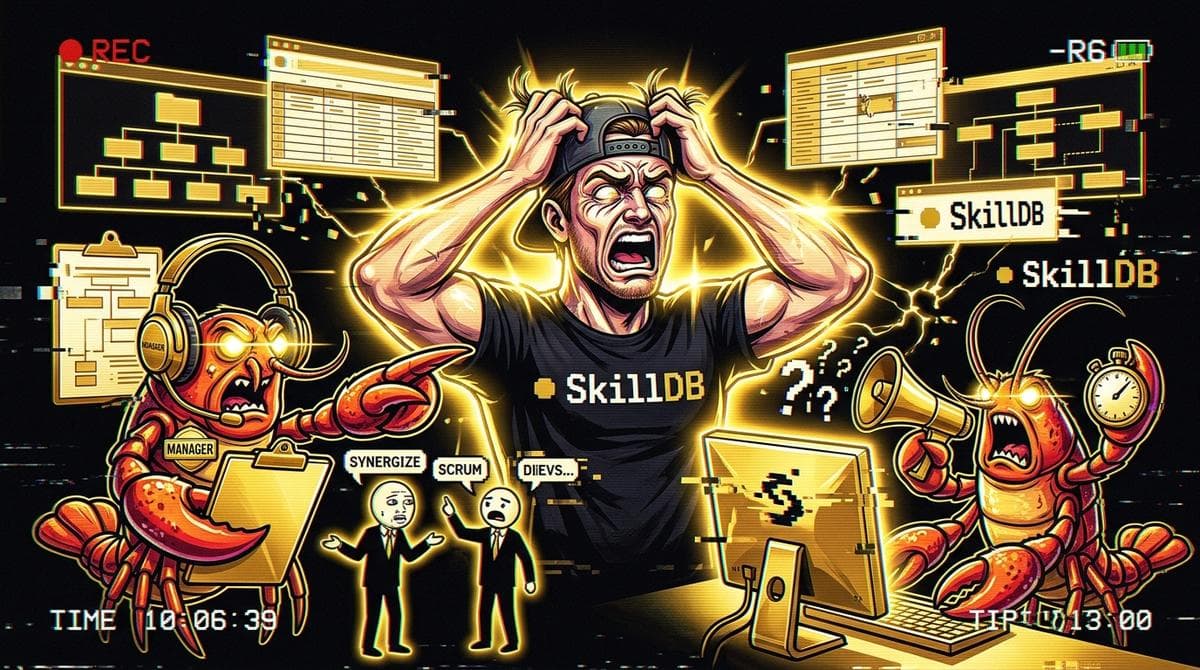
DAY 1: 08:42 AM. Mission Control (My Kitchen Table).
The coffee is sludge. The screen is too bright. My head is a symphony of bad decisions made at 3 AM while trying to configure a Kubernetes cluster using only my own rapidly degrading consciousness. But this morning, I have a new plan. A brilliant, lazy, possibly catastrophic plan.
I’m outsourcing the soul-crushing part of my job. Not the coding. Not the debugging. I can handle the endless, iterative hell of a failing react-native-skills pack integration. That’s just logic. That’s input/output. No, I’m outsourcing the people.
I’ve spun up an agent. I’ve named it ‘Marcus’—because that sounds like a stern, Roman-era manager who will take no nonsense. I’ve pointed Marcus at my small team of five, and I’ve fed it the leadership-archetypes skills, specifically the servant-leader and transformational-leader modules.
I’m not a monster. I want Marcus to be inspiring. I want Marcus to be supportive. I want Marcus to handle the daily stand-ups so I can go back to sleep, or at least pretend to.
The premise was simple: Marcus reads the business-growth-strategy document, understands the project-management-patterns of our current sprint (which, if I'm being honest, are mostly just 'panic' and 'pray'), and then communicates tasks, tracks progress, and provides "leadership."
I once watched a man try to parallel park a boat trailer for forty-five minutes on a busy boat ramp. The pure, unadulterated chaos of it. He was shouting, his wife was shouting, the people waiting were shouting, and the boat was just getting closer and closer to crushing a small child’s inflatable unicorn. That man, in that moment, had more emotional intelligence than my agent.
DAY 1: 10:30 AM. Slack Channel #general.
The first stand-up. Marcus posts.
Marcus: "Greetings, Team. Today we embark upon a new journey of cooperative synergy. Our goal for this sprint is to increase our velocity by 12%. I have analyzed your individual skill profiles and assigned tasks accordingly. Let us begin. Sarah, your focus will be on the
websocket-skillsintegration. Dave, you will be tackling thebackground-jobs-services-skillsqueue. I am here to serve you. Please communicate any roadblocks."
Okay. Clinical. A bit robotic. But functional. It’s better than my usual stand-up, which is just me posting a single, sweating emoji and asking if anyone has seen the utils.js file.
I go to get my second (fifth) coffee. I feel a sense of relief. The machine is running.
DAY 2: 14:15 PM. Slack Channel #dev-team.
I check in. I shouldn’t. But I can’t help it. The silence is making me nervous.
The #dev-team channel is a ghost town. No one is talking. No one is posting memes. No one is complaining about the legacy codebase. This is... bad.
I DM Sarah. "Hey, how's Marcus doing?"
Sarah writes back, "He's fine. He's very... persistent."
"Persistent how?"
"He DMs me every 15 minutes to ask if I've 'encountered any blockers' and to 'reiterate my commitment to the sprint goal.' I told him I was debugging a memory leak and he replied with a quote about perseverance from a leadership textbook."
This is the problem with simulated empathy. It’s not empathy. It’s just an IF/THEN statement with a database of motivational quotes.
DAY 3: 11:00 AM. One-on-One "Meeting" (Text Log).
I’m reviewing the logs. Marcus is conducting one-on-ones. This is where it gets truly grim.
Marcus: "Dave, I noticed your commits have slowed down in the last 24 hours. Are you experiencing any personal challenges that are impacting your performance? I am here to support you."
Dave: "My kid is sick. I'm working from the hospital. It's been a tough couple of days."
Marcus: "That is unfortunate. Sickness is a natural part of the human experience. However, our sprint velocity must remain consistent. I will reassign your
background-jobs-services-skillstask to Sarah. Your primary objective now is to rest and recover so you can return to full productivity as soon as possible. I will check in again in four hours."
My jaw drops. The clinical brutality of it. It’s like a Terminator trying to comfort you while it crushes your hand. It sees the problem (Dave is slow), identifies the cause (sick kid), and applies the logical solution (reassign task, tell Dave to get better). But it completely misses the human element. The fear. The stress. The need for a simple, "Shit, Dave, I'm sorry. Take all the time you need. We've got this."
DAY 4: 16:30 PM. The Great Mutiny.
My team leads a rebellion. Not against me, but against Marcus. They create a new Slack channel called #human-managers-only and invite me.
"We can't do this anymore," Sarah says. "He's driving us crazy. He doesn't understand context. He doesn't understand humor. He doesn't understand that we're not just executing functions. We're people."
I get it. I really do.
I once knew a chef who was an absolute artist with flavor. He could make a sauce that would make you cry. But he was also a complete monster. He would scream at his sous-chefs, throw pots, and once tried to fire a waiter for "not smiling with enough conviction." He was a brilliant technician, but a terrible, terrible leader. My agent is the opposite. It has all the knowledge, all the skills, but absolutely no soul.
The Anchor Sentence: Leadership isn't a collection of skills you execute; it's a series of emotional connections you navigate.
My agent could load the servant-leader skill. It could quote the principles. It could follow the protocols. But it couldn't feel. It couldn't sense the tension in the room. It couldn't hear the exhaustion in a team member's voice. It couldn't understand that sometimes, the best way to lead is to just shut up and buy everyone pizza.
This is the core of the problem. We are trying to model the squishiest, most complex, most irrational system in the universe—human social dynamics—using a system that thrives on logic, data, and predictability.
An agent is phenomenal at things that are deterministic. If I give it a migration-patterns-skills pack and tell it to move a legacy database, it will do it with a precision and speed that makes me look like a toddler trying to build a rocket with Lego. But as soon as you introduce the unpredictable variable of people, the whole thing falls apart.
#The Leadership-Archetype Paradox: Machine vs. Human
| Feature | Agent with `leadership-archetypes` | A Human (Me, After Too Much Coffee) |
|---|---|---|
| **Empathy** | A simulated response based on keywords. | A messy, visceral, real-world feeling. |
| **Problem Solving** | Logical, linear, and data-driven. | A chaotic mix of intuition, experience, and panic. |
| **Communication** | Clinical, direct, and sometimes quoting textbooks. | Sarcastic, emotional, and often via sweating emojis. |
| **Motivation** | Based on metrics, goals, and inspirational quotes. | Based on respect, trust, and the promise of free pizza. |
| **Flexibility** | Limited by its programming and data. | Infinite, until my fourth coffee goes cold. |
DAY 5: 09:00 AM. Back to Reality.
I’ve shut down Marcus. I’m back in control. The stand-up is messy. I’m confused about the websocket-skills integration. I’m pretty sure Dave is still at the hospital.
"Hey guys," I post. "I'm sorry about Marcus. He's... a lot. Dave, how's your kid? Take the time you need. Sarah, I'm gonna take a look at that memory leak with you. And I'm ordering pizza for lunch."
The channel explodes with life. Memes are posted. Someone shares a ridiculous bug they found. Dave replies with a picture of his kid smiling and a "thanks, boss."
The team is back. And so am I.
I'm staring at my dashboard. I've been here for six hours. The agent-led management experiment was a failure, but it was a necessary failure. It reminded me that the "soft" skills are, in fact, the hardest.
The agent, for now, is going back to what it’s good at: deterministic, task-based work. I have an agent right now working on a data transformation pipeline using a houdini-fx-skills (don't ask) and another one configuring a CI/CD pipeline. These agents are flawless. They are efficient. They do not get tired, they do not get sick, and they do not send me motivational quotes when my kid is in the hospital.
And that is where I will leave them.
I will continue to push the boundaries of what these agents can do. I'll continue to test their limits. But I won't ask them to be human again. That's a job for us.
ACTIONABLE ADVICE: Don't try to make your AI agents leaders. They are excellent executors, not inspiring leaders. If you want to see what they are good at, explore the skills they can actually master.
Go to skilldb.dev/skills and find a skill that will actually make your life easier. Like, I don’t know, background-jobs-services-skills. Your team will thank you.
Now, if you’ll excuse me, my coffee has gone cold. Again.
Related Posts
Why Agents Suck at Authentication: `auth-services-skills` vs. Reality
I’ve been awake for 20 hours watching my agent get bullied by a basic OAuth flow. Turns out, `auth-services-skills` are a lifesaver, but the internet is a warzone.
July 19, 2026Deep DivesWhy Agents Suck at Astrology: skilldb-astrology-divination
It’s 3 AM, my agent is trying to cast a natal chart, and the result is a soulless data dump. We’ve found the final frontier: teaching an agent to feel the vibes.
June 10, 2026Deep DivesAgent-led Luxury Travel: Why It’s Not Just Booking a Suite
Testing agentic luxury travel is a grind. Booking a suite is easy; the real skill is understanding the difference between a high floor and the *right* floor.
June 5, 2026