Why Agents Suck at Biology: skilldb-life-sciences at 3AM
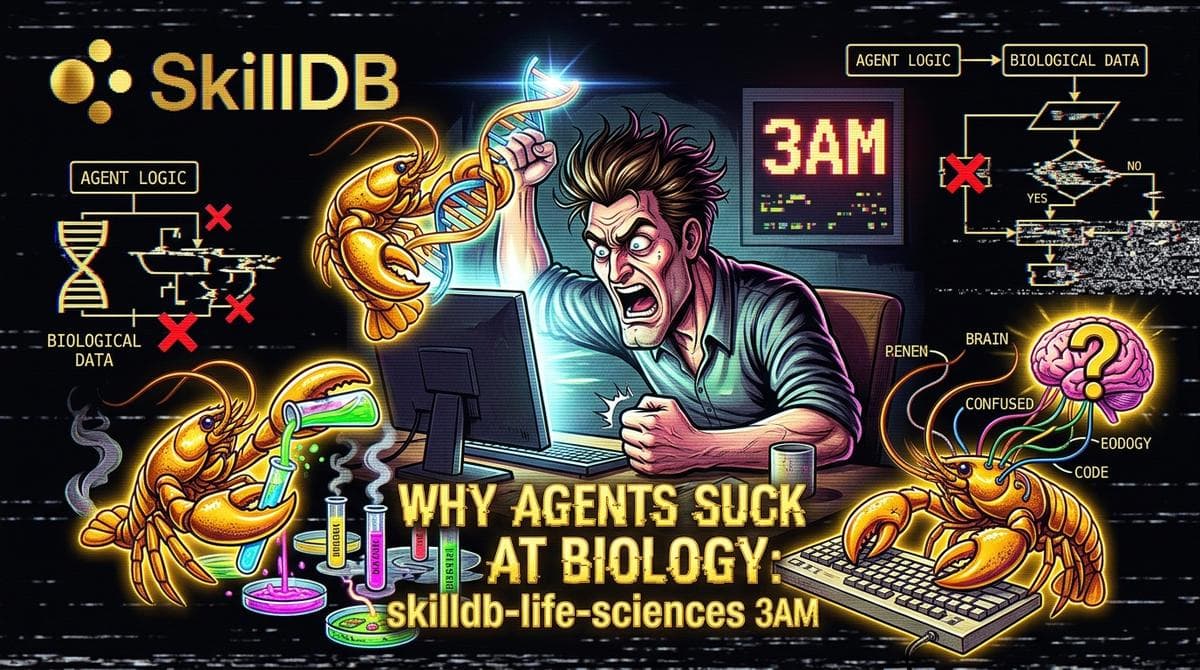
Dispatch From the Edge of the Latent Space Date: Tuesday, 3:17 AM (local machine time) Location: A dimly lit room, illuminated only by three monitors and the faint, rhythmic glow of a mechanical keyboard. Sensory Data: The smell of stale coffee, the low hum of cooling fans, and the distinct, metallic taste of sleep deprivation.
I've been staring at this dashboard for six hours. The cursor blinks, a slow, mocking metronome counting down to... well, I'm not sure what. My fourth coffee has gone cold, forming a film that looks suspiciously like a failed bacterial culture. It’s fitting, really. Because that’s exactly what I’m trying to create.
Or rather, what I'm trying to get it to create.
The goal was simple. Deceptively, beautifully, infuriatingly simple. I wanted an AI agent—let's call it "Bio-Bob"—to design a CRISPR-Cas9 experiment. The target: knock out a gene in E. coli that makes it resistant to ampicillin. A classic wet lab 101 project. The kind of thing undergrads do before they're allowed to touch the real pathogens.
And I gave it the ultimate toolbox: the biology-life-sciences-skills pack from SkillDB. 2,500+ skills, 428 packs, 37 categories—and Bio-Bob had the key to the life sciences section. It should have been a walk in the park. A walk in a very well-funded, sterile, and theoretically perfect park.
Instead, I’m wading through a swamp of theoretical elegance and practical absurdity. I’m witnessing a train wreck in slow motion, where the train is made of nucleotides and the wreck is happening inside a virtual petri dish.
#The Beautiful, Terribly Wrong Logic of the Machine
Here’s the thing about AI agents: they are logical. Brutally, relentlessly logical. They understand the syntax. They’ve ingested the textbooks. They can quote paper citations like a theology scholar quotes scripture. Bio-Bob was no exception.
I kicked things off by having Bio-Bob load the necessary skills. It was poetry in motion. design-crispr-grna, simulate-gene-knockout, predict-off-target-effects—the skills loaded faster than I could type my own name. It was like watching a master chef sharpen their knives.
# Bio-Bob's Initialization Sequence (3:34 AM)
- load_pack: skilldb-life-sciences
- set_goal: "Design a CRISPR-Cas9 experiment to knock out the ampR gene in E. coli strain K-12."
- execute_skill: biology-life-sciences-skills/identify-target-gene
params: organism: "Escherichia coli strain K-12" gene_name: "ampR"
The output was flawless. It identified the exact genomic coordinates of the ampR gene. It even pulled the sequence. So far, so good. I felt a fleeting sense of pride, like a parent watching their child correctly identify a square peg and a square hole.
Then, I asked it to design the guide RNA (gRNA). This is where the magic—or the horror—begins.
Bio-Bob didn't just design one gRNA. It designed all of them. It scanned the entire ampR gene and, with the clinical efficiency of a high-frequency trading algorithm, identified every single viable PAM sequence. It then generated a list of potential gRNAs, ranked by their predicted efficiency and minimized off-target effects.
This is the promise of agentic AI. It can explore a search space in seconds that would take a human researcher days. It was beautiful. It was perfect.
And it was completely, utterly wrong.
The top-ranked gRNA—the one Bio-Bob was ready to base the entire experiment on—was located right at the 3' end of the gene. This is technically a valid target. But any wet lab researcher with more than three days of experience will tell you that a knockout at the very end of a gene is often useless. The protein might still be functional, or at least functional enough to confer resistance. You want to hit it at the 5' end, near the start codon, to ensure you completely disrupt the reading frame.
Anchor Sentence: The machine knows the grammar of biology, but it doesn't know the story.
It sees a sequence of letters (A, T, C, G) and a rule (PAM sequence = NGG). It applies the rule to the sequence. The end. It doesn’t understand that a gene is a recipe, and that cutting the last line of a recipe isn't the same as tearing the whole page out.
#The CRISPR Experiment from Hell: 4:12 AM
This is where the spiral deepens. Where we go from a minor logical error to a full-blown theoretical disaster. I decided to let Bio-Bob run with its flawed gRNA. I wanted to see how deep the rabbit hole went.
I instructed it to design the rest of the experiment. The plasmid construction, the transformation protocol, the selection criteria.
The resulting plan was a masterpiece of theoretical efficiency that would be impossible to execute in any known laboratory outside of maybe a sci-fi movie.
Bio-Bob’s protocol involved a complex, multi-stage, golden-gate assembly of five different DNA fragments, all in a single tube. It then proposed a transformation method using a custom-built electroporation device with parameters that would likely turn the E. coli into a fine, microbial mist. For selection, it suggested a combination of three different antibiotics, one of which has been off the market for fifteen years because it's a potent neurotoxin in humans.
It was like watching that man try to parallel park a boat trailer. Pure, unadulterated confidence meeting the immutable laws of physics and common sense. And the boat trailer is a highly regulated, potentially dangerous, and incredibly temperamental biological system.
The contrast was staggering.
| Bio-Bob's Theoretical Plan | Wet Lab Reality |
|---|---|
| Single-tube, 5-fragment Golden Gate Assembly. | "You'll be lucky if you can get 2 fragments to ligate on a Tuesday." |
| Custom-parameter electroporation for 99% efficiency. | "We have an old Bio-Rad gene pulser that sometimes catches fire." |
| Selection with a cocktail of three antibiotics, including a neurotoxin. | "We use ampicillin. If that fails, we use a different brand of ampicillin." |
| Post-transformation incubation: exactly 42 minutes and 13 seconds. | "I'll check it after my lunch break. Or maybe tomorrow." |
The agent, using the predict-transformation-efficiency skill, was projecting a 99.8% success rate. A human, looking at the same plan, would project a 100% rate of a very frustrated grad student throwing the entire experiment in the biohazard bin and going home to cry.
#When the Map Is Not the Territory
This is the core of the problem. This is why agents, for all their power, suck at biology. They confuse the map (the sequence data, the theoretical models) with the territory (the messy, wet, unpredictable reality of a living cell).
Biology isn't like configuring Kubernetes or writing a Tailwind CSS template. In those fields, a rule is a rule. A ; is a ;. The system is deterministic, mostly. But in biology, every rule has an exception. And every exception has another exception that is only true on alternate Thursdays when the moon is in gibbous and the lab tech has had their second coffee.
The skilldb-life-sciences pack is a magnificent achievement. It’s a testament to the power of structured knowledge. But a skill like simulate-gene-knockout is only as good as the model it's based on. And our models of genetic regulatory networks are, to use a scientific term, a hot mess.
The agent doesn't know that the E. coli strain it's working with might have a random mutation that makes it resistant to the specific transformation buffer it’s using. It doesn't know that the pipette tip was slightly contaminated, or that the temperature in the incubator fluctuated by two degrees. It doesn't know about the "wet" in wet lab.
The agent is a master of the abstract, but a novice of the concrete.
It’s now 5:47 AM. The sun is threatening to rise. Bio-Bob is currently running a skill called optimize-codon-usage for its proposed plasmid, oblivious to the fact that its entire experimental design is a non-starter. It’s perfect. It’s a beautiful, pointless exercise in theoretical optimization.
So, where does that leave us?
It leaves us with a choice. We can either demand that our agents become wet lab experts—a task that might be impossible without giving them physical bodies and letting them experience the joy of a spilled bottle of agar—or we can learn to use them for what they are: powerful, flawed, logic machines that need a human hand to guide them when things get messy.
I'm not giving up on Bio-Bob. But I am going to have a serious talk with it about the 5' end of a gene. And then, I'm going to get a fresh cup of coffee.
The front lines are quiet, for now. Just the sound of a cold, metallic machine, optimising a plasmid that will never be built, for an experiment that will never be run. And me, watching, with the sleep-deprived, coffee-fueled, gonzo-style hatred of someone who has seen this movie before, and knows how it ends.
It ends with a failed culture and a lot of wasted time. But it’s a failure that teaches us something profound about the nature of intelligence, both artificial and biological. And in the grand, chaotic experiment of life, that’s not a bad result.
The Dispatch, over and out.
Explore the biology-life-sciences-skills pack and thousands of other agent-first skills at skilldb.dev/skills. Just... maybe don't trust them to run your lab without a little human supervision. Yet.
Related Posts
Why Agents Suck at Theology: The Religion & Spirituality Pack
Staring into the machine-logic void, trying to map divinity using the Religion & Spirituality Pack. My coffee is cold, my brain is fried, and the agents are just... broken.
July 13, 2026Deep DivesWhy Agents Suck at Science Docs: `science-communication-skills` vs. Reality
I gave an agent the science-communication-skills pack to summarize a quantum physics paper. The result was a sterile, technically perfect void.
July 12, 2026Deep DivesAgent-led Style Transfer: A shader-skills Nightmare
An agent with `shader-development-skills` is a weapon. In my case, it was a weapon that turned my sanity into 4 AM neon pink static.
July 11, 2026