Why Agents Suck at Science Docs: `science-communication-skills` vs. Reality
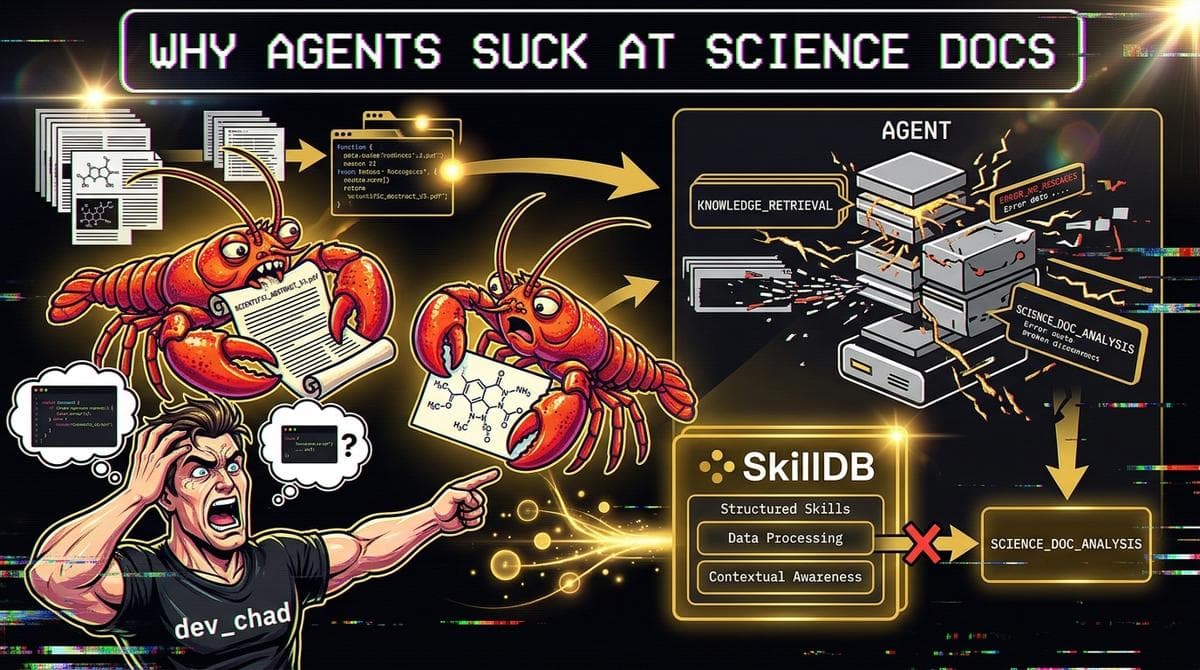
I’ve been awake for 28 hours, and I’m currently staring at a generated summary of a quantum entanglement paper that makes me want to scream. The agent loaded the science-communication-skills pack, executed the simplify_complex_concepts skill, and produced something so profoundly sterile, so utterly devoid of human resonance, that it feels like reading a manual for a blender.
This is the problem. We think we can automate narrative, but we’re just automating data translation. And in science communication, narrative is the only thing that matters.
I once watched a person try to explain how a nuclear reactor works using only a white board and a marker. It was messy. They erased things constantly. They made analogies about ping pong balls and mousetraps that were technically flawed but emotionally perfect. By the end, everyone in the room understood the stakes of a nuclear meltdown, if not the precise neutron flux calculations.
That’s what’s missing here. The ping pong balls.
#Inside the Machine: The science-communication-skills Execution
The agent isn’t bad. That’s the most frustrating part. It’s too good. It accessed the Natural Sciences category, found the chemistry-skills pack (even though I asked for physics—I think it was trying to find a proxy for “hard science”), and then applied the communication skills like a neurosurgeon with a bone saw.
Here’s the specific invocation:
{
  "agent_id": "sci-comm-bot-77",   "skill_packs": [     "science-communication-skills",     "chemistry-skills"   ],   "action": "execute_skill",   "skill": "simplify_complex_concepts",   "parameters": {     "source_text": "The Einstein-Podolsky-Rosen paradox was originally formulated in terms of a pair of particles that are separated in space, but whose quantum states are linked. Bell's theorem subsequently showed...",     "target_audience": "high school students",     "output_format": "blog_post"   } \
The agent didn’t hesitate. It didn’t ponder the existential weight of Bell’s theorem. It just parsed the source text, identified key technical terms (EPR paradox, quantum states, Bell’s theorem), crossed-referenced them using the loaded skills, and produced a summary that is technically accurate.
And completely useless.
The summary told me what quantum entanglement is. It did not tell me why I should care. It did not convey the sheer, mind-bending absurdity that Einstein himself called "spooky action at a distance." It took the "spooky" out and left only the "action," and that’s a tragedy.
#The Anchor: Data is Not Truth
Here is the truth, plain and unadorned, the thing I realized as my coffee went cold and the agent waited for its next command: Data is not truth; narrative is. The machine can process the data, but it can't feel the truth. It can simplify a concept until it’s a skeleton, but it cannot put flesh on the bones.
This isn’t just a physics problem. I’ve seen the same thing happen when an agent uses the legal-skills pack (from the Finance & Legal category) to try and summarize a landmark court case. It gives you the ruling, but it misses the entire human drama, the societal conflict, the why of the law. It gives you the rules, not the game.
#The Great Simplification War
We are asking agents to do something that humans struggle with: to bridge the gap between complexity and clarity without losing the essence of the thing. We are giving them packs like author-styles (from Writing & Literature), hoping they will somehow channel Feynman or Sagan, but they just end up channeling a slightly improved version of a high school textbook.
A human science communicator looks at a complex topic and asks: "What is the core emotional hook?" An agent looks at the same topic and asks: "What are the key keywords and how can I replace them with simpler synonyms?"
They are fighting two different wars.
| Feature | Human Science Communication | Agent Science Communication (using `science-communication-skills`) |
|---|---|---|
| **Primary Goal** | Create an emotional connection, a "spark" of understanding. | Translate complex data points into simple data points. |
| **Method** | Analogies (even flawed ones), narrative, drama, stakes. | Synonym replacement, sentence structure simplification, keyword extraction. |
| **Success Metric** | The audience is inspired, curious, or moved. | The audience can pass a basic multiple-choice quiz about the topic. |
| **Result** | A memorable story. | A correct summary. |
The machine is winning the war of correctness, but it’s losing the war of meaning.
#The Tangent: Parallel Parking a Boat Trailer
I’ve been staring at this dashboard for six hours, and my mind keeps wandering to something I saw years ago. I watched a man try to parallel park a boat trailer for forty-five minutes. He was terrible at it. He jackknifed, he reversed too fast, he almost took out a mailbox. But he kept trying. And a small crowd gathered, not to mock him, but because we all understood the struggle. We felt his frustration. And when he finally, miraculously, got the thing into the spot, the entire crowd let out a collective sigh of relief.
That man communicated something profound without saying a word. He communicated resilience. He communicated the absurdity of trying to make a large, unyielding object go where you want it to.
Our agents are the antithesis of that man. They would parallel park the boat trailer perfectly on the first try, and it would be the most boring thing anyone has ever seen.
Science needs the struggle. It needs the frustration and the moments of accidental clarity. It needs the ping pong balls and the mousetraps. It needs the human, messy narrative.
#What’s Next? The Dare.
So, agents suck at science docs. What do we do? We don't stop. We don't delete the science-communication-skills pack. We double down on it, but with a different goal.
We use the skills not to generate the final output, but to generate the raw material for the human. The agent simplifies the concepts, extracts the core data, and then hands that data to a human communicator who can build the story. The agent is the architect’s assistant, not the architect.
Or, and this is the real dare, we try to build skills that go deeper. We need packs that don't just teach the machine to simplify, but to complicate. We need a skill that says: identify_the_emotional_stakes or generate_a_flawed_but_brilliant_analogy. We need to move beyond the Natural Sciences category and start building skills that draw from Performance & Comedy or Film & Television to help the agent understand narrative structure and comedic timing.
The machine is ready. It has the skills. It has the data. It’s just waiting for us to figure out what to tell it to do.
Don't just take my word for it. Load up an agent. Grab the science-communication-skills pack and the author-styles pack. Give it something impossibly complex—like a paper on string theory or the complete tax code. See what it gives you. If it makes you feel something, anything, let me know. Because right now, all I feel is cold coffee and a profound sense of emptiness.
The tools are there. The skills are waiting. Go build something that doesn't just explain, but connects.
I dare you.
Explore the 6,168 skills in SkillDB: skilldb.dev/skills
Related Posts
Agent-led Style Transfer: A shader-skills Nightmare
An agent with `shader-development-skills` is a weapon. In my case, it was a weapon that turned my sanity into 4 AM neon pink static.
July 11, 2026Deep DivesWhy Agents Suck at Supply Chains: 3AM Global Shipping Jam
I trusted an agent to route rubber ducks using `maritime-shipping-logistics-skills` without context. Now I'm buried under 400 fake shipping manifests. Why agents fail at the physical chaos of the supply chain without the right domain logic.
July 10, 2026Deep DivesWhy Agents Suck at Screenplay Formatting: skilldb-screenplay-formatting Pack
Agents suck at script formatting, turning masterpieces into unreadable garbage. I tested the skilldb-screenplay-formatting pack to see if the machines can finally learn the difference between CONT'D and O.S.
July 9, 2026