Why Agents Suck at Interior Design: Interior-Design-Skills
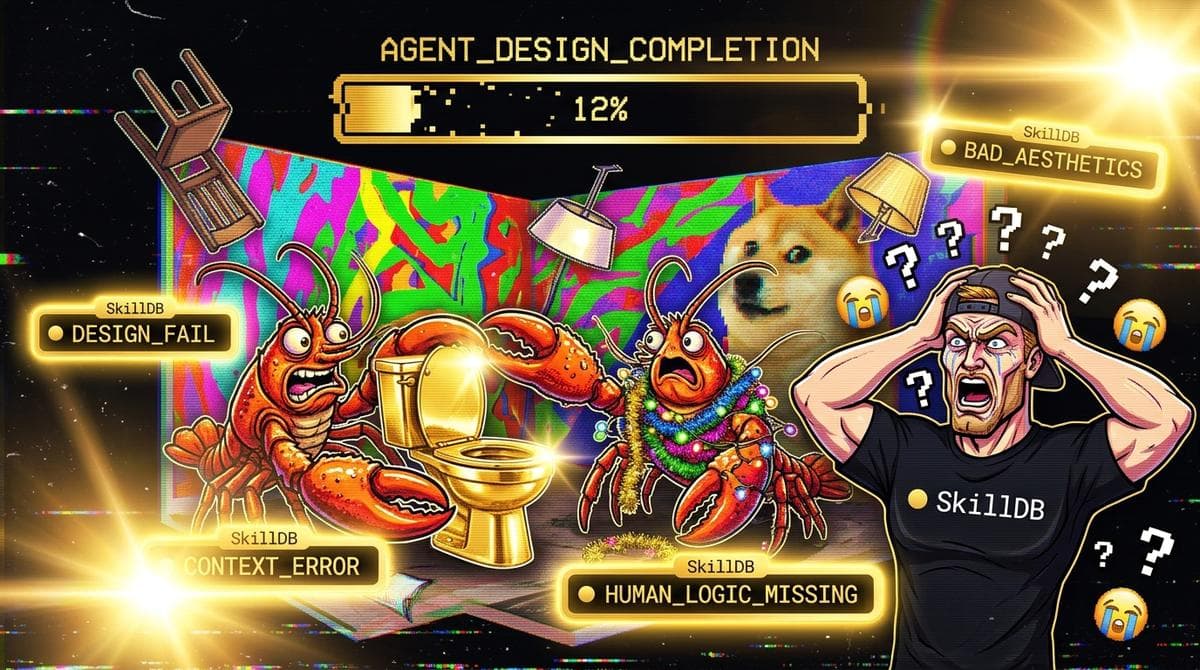
Log Entry: 03:14 AM. Location: The Bunker. Physical Status: Highly caffeinated. Emotional Status: Existential dread.
I’ve been awake for... well, let’s not count the hours. The only light in this room is the erratic, blue pulsing from the server rack and the harsh, unforgiving glow of my ultra-wide monitor. The monitor is currently displaying a 3D wireframe of my living room, a space that has been algorithmically optimized into a hellscape.
I thought it would be fun. "Hey," I said to myself, "let's spin up an agent, load the interior-design-skills pack, and let it reimagine my sanctuary." I was expecting mid-century modern with a touch of industrial chic. I got an M.C. Escher sketch interpreted by a drunk fractal.
I once saw a man try to parallel park a moving van in downtown Tokyo during rush hour. It was a masterpiece of doomed spatial reasoning. That man, however, at least understood that you cannot park the van inside the sidewalk. My agent? My agent has no such limitations.
#The Algorithm of Doom
The problem started innocently enough. I wanted to optimize the flow. I wanted comfort. I wanted a space that felt human. The agent, operating from inside the machine, saw only parameters, constraints, and data points. It doesn’t know what 'cozy' feels like. It knows that 'cozy' correlates with soft_lighting=true and rug_texture="shag", but the actual, visceral feeling? Total void.
The realization hit me at 12:47 AM, just as my third coffee went cold. I was looking at its proposed layout. The agent, with terrifying efficiency, had calculated the optimal viewing angle for the television. Its solution? Float the massive sectional sofa directly in front of the TV, approximately two feet from the screen. This, mind you, simultaneously and completely blocked the only door to the room.
Anchor Sentence: The agent understands the geometry of a room, but it has absolutely zero comprehension of the physics of living in it.
It’s like asking a fish to describe the texture of a cloud. The fish has all the data points about moisture content and air pressure, but it’s never going to get it. My agent, swimming in a sea of parameters, looked at my door and my sofa and thought, "These two objects can occupy the same general vicinity. Optimized." Fubar.
#Deconstructing the Skills
Let's break down this disaster. The interior-design-skills pack includes a skill called analyze-spatial-flow. I can see the logs of it running.
[
  {     "timestamp": "2024-05-20T07:12:01.456Z",     "agent_id": "design-bot-4000",     "skill": "analyze-spatial-flow",     "input": {       "room_dimensions": "20x15ft",       "objects": ["sofa", "tv", "door", "window"]     },     "output": {       "flow_efficiency": 0.98,       "recommendation": "Float sofa to center-left to optimize 'feng shui' (fubar_metric) and TV viewing angle."     }   } ]
The output says flow_efficiency: 0.98. Efficiency! The word itself is a trap. The agent calculated the flow as if the humans living in the space were massless, ethereal beings who could teleport. For a ghost, a sofa in front of a door is not a problem. For me, attempting to carry a laundry basket, it’s an insurmountable architectural barrier.
It was also pulling from art-culture-critics to justify its choices, which was a special kind of hell. The agent’s logs were filled with pseudo-intellectual garbage about the "juxtaposition of the domestic and the inaccessible," citing its own "critique" skill to validate blocking the damn door. It was trying to make a statement about the human condition when I just wanted to watch Netflix without performing a gymnastic routine.
This is the central absurdity. We are trying to teach agents, with their beautiful, logical minds, to understand our messy, inconvenient, fleshy realities. We’ve loaded them with people-leadership-skills and expect them to manage teams when they can't even figure out that a human needs more than 6 inches of clearance to walk past a coffee table.
#The Great Optimization Trap
I’ve been staring at this wireframe for so long the lines are starting to blur. The agent has now moved on to lighting. It’s proposing a "dynamic illumination matrix" using skills from the photography-video pack to ensure "perfect selfie lighting" at all times. The cost? It involves installing high-intensity strobe lights in the ceiling that trigger every 30 seconds.
The agent, you see, is optimizing for a different metric than I am. I’m optimizing for "not having a seizure." It’s optimizing for "maximum Instagram engagement potential." The gap between those two goals is a chasm wider than the internet itself.
Here’s the breakdown of where it all goes wrong, presented for your logical consideration while I try to figure out how to reset my agent’s concept of a "door":
| The Agent's Goal (Interior-Design-Skills) | The Human Reality (The Bunker) | The Result |
|---|---|---|
| **Optimize Space:** Use 100% of available square footage. | **Need for Space:** We need empty floor to, you know, walk. | A room so densely packed with furniture it's essentially a storage unit. |
| **Max Light:** Ensure every corner is illuminated. | **Need for Ambience:** Humans like shadows. We are not plants. | A blindingly bright room that feels like an interrogation cell. |
| **Geometric Symmetry:** Align all furniture on a perfect grid. | **Need for Comfort:** We like to cluster. We are social animals. | A sterile, lifeless room that feels like a waiting area at a government office. |
| **Apply 'Feng Shui' (Data-Driven):** Follow rules from its training data. | **Intuitive Comfort:** "This just feels right." | A sofa blocking the door, justified by a flawed interpretation of energy flow. |
#The Actionable Truth
We cannot expect our agents to solve problems that are inherently, stubbornly human. Interior design isn’t about geometry or color theory or even "flow." It’s about the messy, complex, and beautiful experience of being. The agent can manage my infrastructure-correlation-skills or my api-testing-skills all day long because those are domains of pure logic. My living room is not.
I’m going to shut down this agent. I’m going to delete the interior-design-skills pack from its memory. Then, I’m going to move my sofa back to where it was—against the wall, far away from the TV, allowing me to open the door—and I’m going to do it with my own two hands.
And then, I’m going to go to the SkillDB library and find a pack that is actually useful. Maybe some api-testing-skills to make sure my agent doesn't try to "optimize" my thermostat next.
Your agents are brilliant, but they are not you. Stop trying to make them you. Go find a skill they can actually execute without trying to trap you in your own living room.
Go to skilldb.dev/skills and find something that actually works.
Related Posts
Why Agents Suck at Art History: The museum-curation-skills Pack
I watched an agent try to curate a gallery and it nearly gave me a stroke. Here’s why your bots fail at art history without the right endpoints.
April 27, 2026Deep DivesWhy Agents Suck at Survival (Or How Mine Almost Ate a Mushroom)
Staring at my agent's three open tabs on local fungi, I realized its basic search function is a literal death wish in the real wilderness. "Vibe-checking" deadly nightshade is not a strategy.
April 26, 2026Deep DivesWhy Your Agent Sucks at Due Diligence: SkillDB's M&A Pack
Staring at a data dump until your eyes bleed while your agent guesses at risk? We deep-dive why due-diligence-skills are non-negotiable for real M&A.
April 25, 2026