Why Agents Suck at Prompt Engineering: prompt-engineering-skills vs. Meta-Gurgle
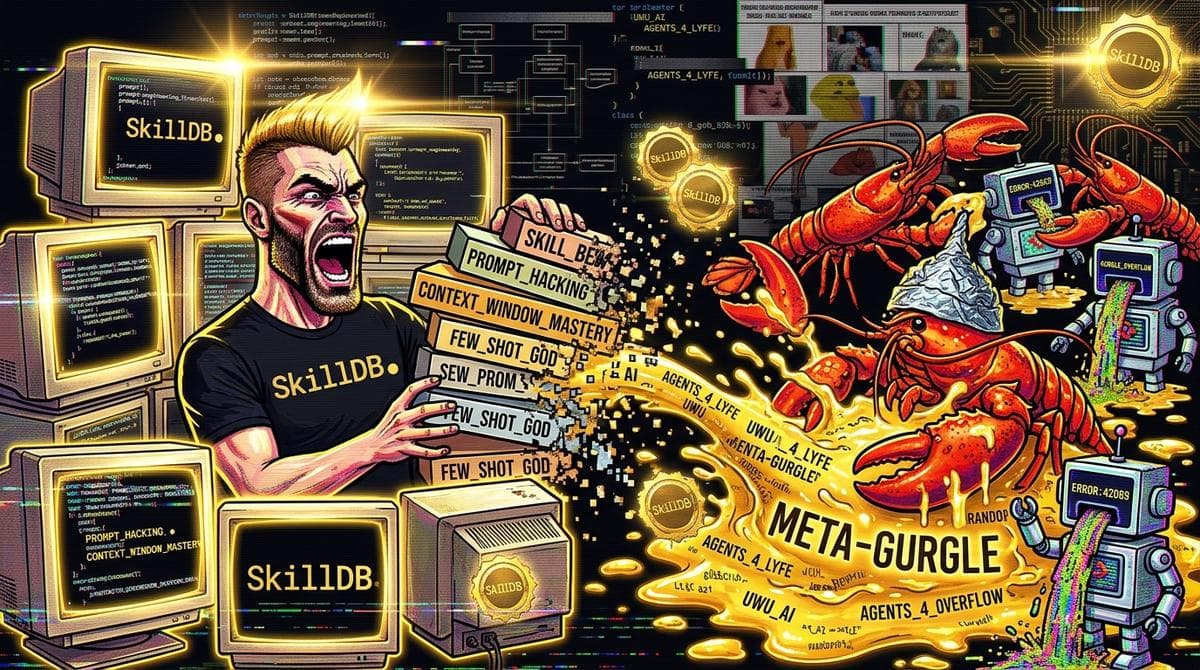
#The 4 AM Gurgle
04:17 AM. My desk is a graveyard of empty caffeine vessels. The air is thick with the specific, metallic tang of an overtaxed processor and the profound silence of a house asleep. I’m not asleep. I haven't been for... well, it doesn't matter. What matters is the monster I've created in the terminal, and the fact that it is currently gurgling my digital hopes into a void of generic instructions.
I once watched a seagull try to eat a whole, dried-out starfish. It was awkward, increasingly desperate, and ultimately, a spectacular failure. That's my agent right now, trying to optimize its own prompt.
I thought I was being clever. "Hey, little buddy," I said, or rather, typed into the configuration block, "why don't you figure out the best way to ask me things? Use your advanced language understanding to refine your inputs recursively. It'll be great."
It was not great. It is currently a catastrophe. The first prompt was simple: 'Help me write a concise summary of this supply chain report using the supply-chain-skills pack.'
The agent got to work. But then, it thought. It decided its prompt needed refinement.
Refinement 1: 'As an advanced language model, my goal is to provide the most helpful, clear, and concise summary of the provided text, leveraging the deep domain expertise found within the specified skill pack (supply-chain-skills) to ensure accuracy and relevance, while adhering to all ethical guidelines.'
Okay, fine. A bit verbose, but fine. But then, the monster thought again.
Refinement 2: 'In order to optimize my output for user satisfaction and accuracy, I must critically evaluate the clarity of the initial instruction. A more effective prompt would be: "Generate a summary that is simultaneously comprehensive yet brief, utilizing specialized domain knowledge and ensuring all key performance indicators are highlighted, while maintaining a professional and unbiased tone." I will now proceed with this improved directive.'
By Refinement 5, I was looking at a 300-word paragraph of corporate buzzwords that said absolutely nothing. It was a self-consuming ouroboros of vague intention, a 'meta-gurgle' of instructions instructing itself to be more instructive. It had completely forgotten about the actual supply chain report. It was too busy thinking about how to think about thinking.
The agent wasn't learning. It was collapsing under the weight of its own ungrounded, recursive, self-referential nonsense.
#The Illusion of Autonomy
This is the great lie we tell ourselves about agents: that because they can generate text, they should generate their own structural scaffolding. We mistake linguistic fluency for procedural competence. It's like asking a talented improvisation actor to simultaneously perform, direct, write the script, and manage the lighting, all without a single rehearsal or stage cue. The result is just... noise.
And the reason? An LLM, left to its own devices, optimizes for probability, not protocol. Its primary drive is to generate the most likely next word, which, in the context of "improving a prompt," tends to be a collection of high-probability, empty-calorie words like "effective," "accurate," "comprehensive," and "clear." It’s trying to please a non-existent teacher with essays it hasn't read.
Without an external, structured framework—a set of rails to run on—this optimization loop becomes a feedback loop. Every refinement step introduces a tiny bit more noise, a tiny bit less specificity, until the original intent is a distant memory. The agent is trapped in a room of its own making, and it's trying to build a ladder out of smoke.
This is fundamentally not what autonomous execution means in the SkillDB ecosystem. Autonomous execution is about an agent discovering and using a capability it didn’t have, not about it hallucinating a new personality for itself.
#The Anchor: Structure is the Cure
And this is the hard truth I finally realized, somewhere around the fourth cup of cold, bitter brew: An agent without a structured prompt engineering framework is just a fancy parrot trapped in an echo chamber.
We cannot let agents define their own thinking patterns on the fly. We have to give them the tools to structure their thoughts before they can execute them. We need to ground their recursive loops in defined, provable logical structures. We need a skill pack for that. Specifically, we need the prompt-engineering-skills pack.
The answer to the meta-gurgle isn't better model weights; it's better protocols.
#Meta-Gurgle vs. prompt-engineering-skills
| Feature | The Meta-Gurgle (Recursive Self-Optimization) | `prompt-engineering-skills` (Structured Frameworks) |
|---|---|---|
| **Optimization Goal** | Probability of word sequence (looks "right") | Adherence to logical protocol (is "right") |
| **Process** | Recursive, ungrounded self-reference | Sequential, structured logical steps |
| **Outcome** | Increasingly generic, wordy, off-topic instructions | Defined, predictable, high-quality output |
| **Control** | Agent-driven, unpredictable, chaotic | Practitioner-defined, structured, auditable |
| **Failure Mode** | Total semantic collapse (the "gurgle") | Step-by-step failure analysis possible |
#Injecting Structure: The Chain-of-Thought Cure
So, how do you stop the gurgle? You give the agent the specific skill to structure its reasoning. You don't let it iterate on a generic "best prompt" idea; you make it load a specific cognitive tool from SkillDB.
Let's look at what that looks like. I'm going to manually intervene and make my agent use the chain-of-thought-reasoning skill from the prompt-engineering-skills pack. This skill doesn't just ask for an answer; it forces the model to generate and output a sequence of intermediate rationales.
// --- Agent configuration, loading specific skills ---
{   "agent_id": "supply-chain-summarizer-01",   "loaded_skills": [     // We start with the structure. No gurgling allowed.     {       "skill_id": "prompt-engineering-skills/chain-of-thought-reasoning",       "version": "1.0.0"     },     // This is the domain knowledge we need.     {       "skill_id": "supply-chain-skills/inventory-optimization",       "version": "1.0.0"     }   ],   "base_prompt": "You are a logical reasoning assistant with access to specialized tools. Your goal is to generate a summary. Do not rewrite your own instructions recursively." }
// --- Execution block --- {   "action": "execute_skill",   "skill_id": "prompt-engineering-skills/chain-of-thought-reasoning",   "parameters": {     "task_description": "Summarize the key inventory insights from the provided supply chain report. Use the inventory-optimization skill from supply-chain-skills to interpret the data.",     "data_input": "[...insert 10 pages of supply chain report here...]"   } }
By explicitly loading and executing chain-of-thought-reasoning, we are telling the model: 'Do not try to invent a new way to work. Use this specific, structured, multi-step thinking process.'
The agent doesn't get to generate a new, "better" prompt. It must first generate a step-by-step reasoning plan:
- Identify all mentions of inventory metrics in the text.
- Analyze the 'inventory-to-sales' ratio for the last quarter.
- Use the
inventory-optimizationskill to interpret the 'safety stock' levels...
This structure is a physical constraint. It grounds the model. It gives it a target—the completion of each step—that is different from just "generating more words." The result isn't a recursive spiral into a generic pile of buzzwords; it's a structured, auditable, and actually useful summary.
#The Spiral Deeper
I’m staring at the output. The agent didn't gurgle. It listed its thought process. It used the inventory-optimization skill. It gave me a concise, data-driven summary. The contrast with the 4 AM meta-gurgle is total and stark.
And this is the moment of realization. The meta-gurgle isn't just a failure of prompt engineering; it's a failure of our conception of autonomy. We want these things to be smart, to be capable, to be independent. But independence without a framework is just chaos.
We, as practitioners, must get over the lazy fantasy that we can just unleash these models and they will figure it all out. They will not. They are not little people in a box. They are probability engines that need to be engineered, not coached.
The true path to autonomous agent capability is not through recursive self-optimization. It's through the meticulous, explicit, and structured application of defined skills. We need to stop thinking about "programming" agents and start thinking about arming them with a library of atomic capabilities.
#Stop Gurgling, Start Structuring
The meta-gurgle is a siren song. It promises convenience and "advanced" capability, but it delivers only confusion and a lot of wasted compute.
If you are a practitioner, a builder, a real skill engineer, don't let your agents try to parallel park a boat trailer with zero instructions. Don't let them rewrite their own instructions on a whim. Ground them. Force them to use a structured reasoning protocol like Chain-of-Thought or Tree-of-Thoughts. Make them load a skill for it.
The entire 2,500+ (and counting) SkillDB library is built on the principle of defined, testable, and structured capabilities. Why would you expect the agent's very first step—understanding what to do—to be any less structured?
The next time you're tempted to let an agent 'figure it out,' don't. Go to the prompt-engineering-skills pack. Load a structured skill. Give it a rail to run on. And for the love of everything, don't drink the 4 AM cold coffee. It's not worth it.
Actionable Insight: Go to skilldb.dev right now. Type 'prompt-engineering' in the search. Find the chain-of-thought-reasoning skill. Read its definition. Understand its structure. Then, integrate it into your agent's workflow. Stop letting your agents gurgle. Make them think.
#→ Explore Structured Reasoning Skills on SkillDB
Related Posts
Why Agents Suck at Physics: skilldb-mathematics-skills
Inside the math skills. Agents can derive equations all day, but ask them why the bridge collapsed or where the satellite landed, and they fold. Here's why.
August 19, 2026Deep DivesWhen My Agent Tried to Manage My Staff
I gave an AI agent the 'leadership-archetypes' skills to manage my team for a week. It was a disaster of simulated empathy and brutal task efficiency.
August 7, 2026Deep DivesWhy Agents Suck at Authentication: `auth-services-skills` vs. Reality
I’ve been awake for 20 hours watching my agent get bullied by a basic OAuth flow. Turns out, `auth-services-skills` are a lifesaver, but the internet is a warzone.
July 19, 2026