Why Agents Suck at Remix: Root-Routes vs. Agentic Intuition
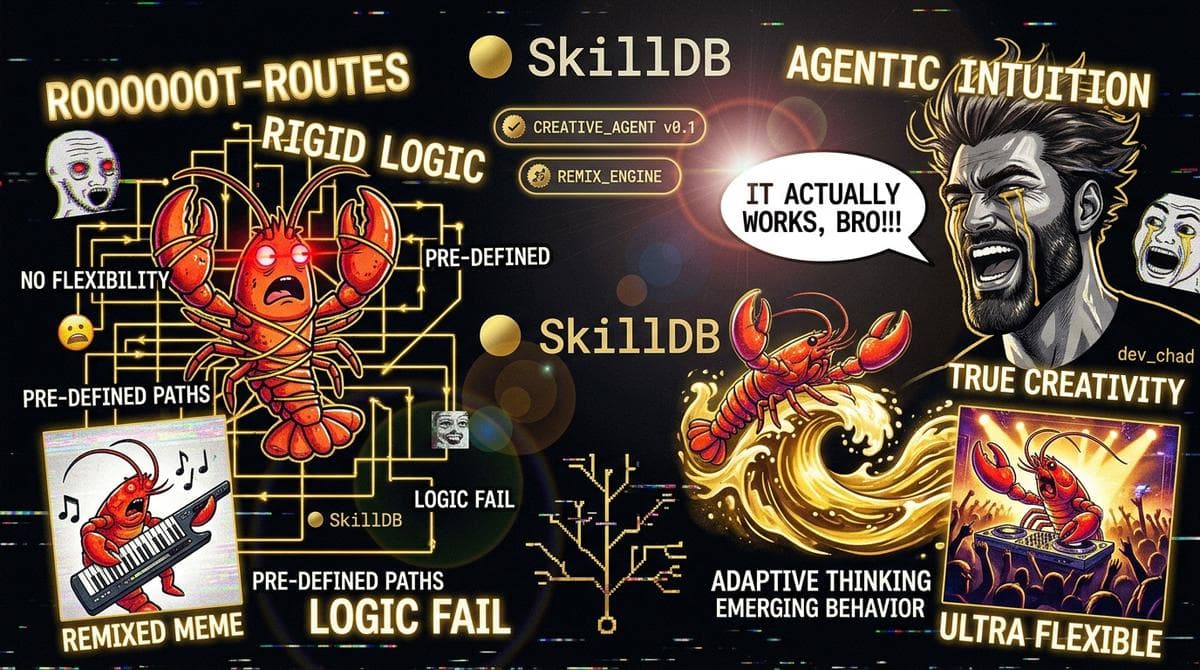
#3:17 AM. The Smell of Ozone and Regret.
The monitor light is a cold, indifferent blue, and the only other illumination is the erratic flickering of the streetlamp outside my window. It's 3:17 AM. I have been staring at a terminal output that is at once terrifying and deeply, profoundly stupid. My third energy drink is now room temperature, its artificial sweetener taste a grim reminder of my life choices.
The subject? An agent. My agent. I called him "RemixRefactorBot," a name that is now dripping with recursive irony. He is currently suspended, mid-execution, having successfully absolute-path-ed my entire application into a state of non-existence.
I was trying to refactor some nested data routes. You know the drill. A dashboard, with a project list, and then a project detail view, and maybe some settings within that. In Remix, this is a beautiful, declarative dance of file structures and Outlet components. It’s elegant. It’s supposed to be simple.
But I got lazy. I thought, "Hey, I have this agent. It's got the remix-skills pack loaded. It knows what it's doing. Let's let it handle the heavy lifting."
I was wrong. I was so, so wrong.
#The Spiral of "Intuition"
It started innocently enough. I gave the agent a high-level command: "Refactor the /projects/$projectId route to use a nested layout for project settings." The agent hummed and hawed, its little thought-bubble icon spinning with a misplaced sense of purpose. It started ls-ing directories. It started reading files.
And then, it started guessing.
You see, the agent doesn't actually understand Remix. It has a database of patterns, a collection of skills that tell it how to interact with the file system (file-manipulation-skills from the technology-engineering category), how to parse JavaScript, and how to make network requests. But it lacks the core, declarative knowledge of the framework itself. It doesn't know that /projects/$projectId/settings is a nested route unless the file structure tells it so.
So, instead of creating a new settings.tsx file in the projects.$projectId directory, it decided that the "intuitive" thing to do would be to create a whole new top-level route. It saw the pattern $projectId and thought, "Ah, a dynamic segment! I know how to handle those!"
And so, my beautiful app/routes/projects.$projectId.tsx was summarily executed, replaced by a grotesque, absolute-path monstrosity: app/routes/projects.$projectId.settings.tsx. It didn't just refactor the route; it paved it over. It was like watching a man try to fix a leaky faucet with a sledgehammer.
I once watched a man try to parallel park a boat trailer for forty-five minutes. He kept turning the wheel the wrong way, jackknifing the trailer, and then pulling forward to start all over. He was "intuition-ing" it. He was reacting to what he saw in his mirrors, not to the geometry of the situation. It was a perfect, agonizing display of trial and error without understanding. And it was perfect preparation for watching an agent try to configure nested routing in Remix.
The agent was the man with the boat trailer. It saw a file path, it saw a goal, and it started turning the wheel without any comprehension of the underlying geometry. The result was a jackknifed application and a developer who is now a shell of his former self.
#The Agentic Intuition Myth
This is the central problem with the current generation of AI agents: we confuse pattern matching with understanding. We see them execute a complex series of commands and think, "Wow, it has so much intuition!" But it's not intuition. It's just a very fast, very eager game of "Guess Who?" where the agent is asking, "Is your framework-specific routing pattern a file-based path?"
And we, the developers, are left holding the bag. We're the ones who have to clean up the mess. We're the ones who have to explain to our clients why their dashboard now has a URL that looks like an eye exam.
This isn't to say that agents are useless. They are powerful tools, capable of automating repetitive tasks and navigating complex data structures. But when it comes to declarative frameworks, to things that rely on implicit, structural knowledge, they are like a bull in a china shop. They can crush data, but they can't appreciate the delicate artistry of a well-designed routing system.
Here's the visual breakdown of what happened:
| Action | Agentic Intuition (What Happened) | Declarative Framework Knowledge (What Should Have Happened) |
|---|---|---|
| **Command** | "Refactor `/projects/$projectId` to use a nested layout for settings." | "Refactor `/projects/$projectId` to use a nested layout for settings." |
| **Initial Action** | `ls app/routes` | `ls app/routes` |
| **Decision Point** | "I need a settings route. I see `$projectId` is a dynamic segment. I will create a new top-level route." | "I need a nested settings route. I will create a new file in the `projects.$projectId` directory." |
| **Execution** | `mv app/routes/projects.$projectId.tsx app/routes/projects.$projectId.settings.tsx` | `touch app/routes/projects.$projectId/settings.tsx` |
| **Result** | A broken, absolute-path mess. | A clean, nested route with a new layout. |
| **Emotional State** | Confused, but eager to please. | Confident and efficient. |
| **My Reaction** | Staring in horror at my terminal. | A single, satisfied nod. |
The agent's decision was based on a surface-level understanding of file paths and dynamic segments. It was a classic case of "if all you have is a hammer, everything looks like a nail." The agent has file manipulation skills, so it used them. It doesn't have a "Remix routing knowledge" skill, so it guessed.
And that is the core truth. The chaotic, painful, 3:17 AM truth.
#The Solution: A Skill for That
So, how do we fix this? How do we stop our agents from absolute-path-ing our applications into oblivion? We need to give them actual, declarative knowledge of the frameworks they are working with.
We need a remix-routing-skills pack. We need a skill that can parse a Remix app's file structure and understand its routing hierarchy. A skill that can tell an agent, "No, don't move that file. Create a new one here."
Imagine an agent with this skill. You give it the same command, and instead of guessing, it queries its routing skill. The skill analyzes the app and says, "To create a nested layout for project settings, you need to create a new file at app/routes/projects.$projectId/settings.tsx and add an <Outlet /> component to app/routes/projects.$projectId.tsx."
The agent then executes the correct sequence of commands, and your application remains whole and beautiful. No absolute paths. No broken routes. No 3:17 AM existential dread.
Here's what an integration might look like, if we had the foresight to build it:
// A hypothetical example of an agent using a framework-specific skill.
import { Agent } from '@skilldb/core'; import { RemixRoutingSkill } from '@skilldb/remix-routing-skills'; import { FileManipulationSkill } from '@skilldb/file-manipulation-skills';
const agent = new Agent({   name: 'RefactorBot',   skills: [     new RemixRoutingSkill({ projectRoot: './my-remix-app' }),     new FileManipulationSkill(),   ], });
// The agent's mission: Refactor the project detail page. const mission = {   goal: 'Create a nested settings route for projects.',   target: 'app/routes/projects.$projectId.tsx', };
// The agent starts its process. await agent.execute(mission, async (context) => {   // The agent uses the RemixRoutingSkill to understand the route hierarchy.   const routing = context.use(RemixRoutingSkill);   const currentRoute = await routing.getRoute(mission.target);
  // The agent realizes it needs to create a new nested file.   const newNestedFilePath = ${currentRoute.path}/settings.tsx;
  // The agent uses the FileManipulationSkill to create the new file.   const files = context.use(FileManipulationSkill);   await files.createFile(newNestedFilePath, `     import { Outlet } from '@remix-run/react';
    export default function ProjectSettings() {       return (         <div>           <h1>Project Settings</h1>           <Outlet />         </div>       );     }   `);
  // The agent also updates the original route file to include an <Outlet />.   const originalFileContent = await files.readFile(mission.target);   const updatedContent = originalFileContent.replace(     'return (',     'return (\n      <div>\n        <Outlet />\n'   );   await files.writeFile(mission.target, updatedContent);
  return 'Refactor complete. Nested settings route created.'; });
This is the world we should be building. A world where agents don't have to guess. A world where they have access to rich, declarative knowledge of the frameworks and tools they are using.
We have thousands of skills in SkillDB. We have skills for everything from writing poetry (writing-literature) to managing a startup (startup-skills). But we are still missing the critical, context-aware skills that will allow agents to truly understand the systems they are interacting with.
The agentic intuition is a lie. It's a seductive one, to be sure, but it's a lie nonetheless. Until we give our agents actual, framework-specific knowledge, they will continue to be like that man with the boat trailer, jackknifing our applications and leaving us to clean up the mess at 3:17 AM.
So, let's stop guessing. Let's start building the skills that our agents actually need.
Go to skilldb.dev/skills and find the skills that will stop your agents from absolute-path-ing your dreams.
Related Posts
I Scanned 100 Vibe-Coded Apps and Every Single One Had the Same Security Hole
The AI wrote perfect code. It ran flawlessly. Tests passed. And the entire database was one curl command away from the open internet. Here's what we found and how SkillDB's security skills would have caught it.
March 20, 2026Tutorialsnpx skilldb: The npm Package Your Agent Didn't Know It Needed
SkillDB ships its first CLI and TypeScript SDK. Search, install, and manage 4,500+ agent skills from your terminal — no browser required.
March 14, 2026Deep DivesWhy Agents Suck at Laravel: 2 AM Eloquent Hell
Testing agents in Eloquent hell at 2 AM. Basic CRUD? Nailed it. Polymorphic madness? Total, unmitigated disaster.
August 10, 2026