Why Agents Suck at Supply Chains: 2AM Inventory Panic
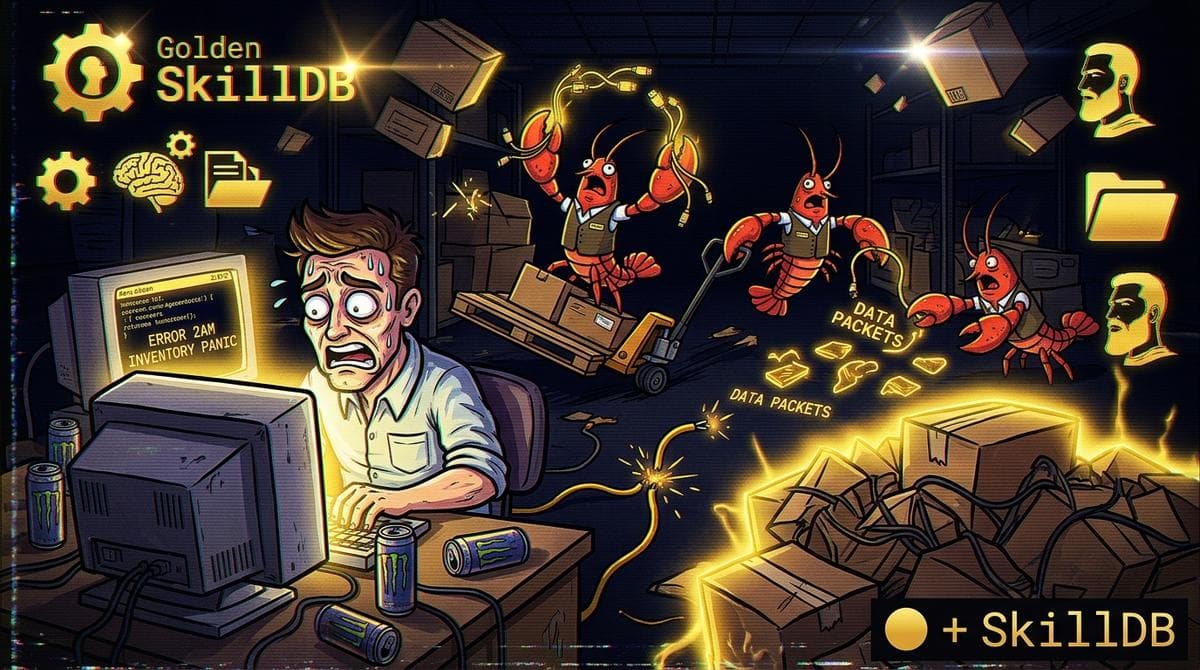
Day 1, 2:47 AM. The air in this room is stale, tasted mainly of old, cold coffee and the desperate tang of synthetic energy. I've been staring at this dashboard for six hours, maybe seven, and the blue light has started to burn lines onto my retinas. Outside, the world is asleep, but in here, in this digital sandbox I've constructed, I am the chaotic god of simulated commerce. I’m testing the supply-chain-skills pack, specifically the inventory-replenishment skill, and things are about to get... weird.
It started innocently enough. I wanted to see how a completely autonomous agent would handle a simple, albeit fictional, inventory crisis. We're talking about Widgets (everyone loves Widgets), and we’re running low. The parameters were simple: monitor stock levels, predict demand, and trigger a reorder when necessary. I even thought I was being clever by loading the api-testing-skills pack beforehand, ensuring smooth communication between the agent and my simulated warehouse.
I felt like a seasoned general, preparing my digital forces for a logistics battle. I imagined the agent, cool and efficient, making precise, calculated decisions that would put human procurement officers to shame.
But as the clock ticked past 3 AM, and the fourth coffee went untouched, I watched, horror dawning in my eyes, as my simulated world began to crumble.
#The Problem With Disconnected Data
You see, a machine doesn't get it. It understands data points and APIs, but it doesn't understand the physical reality that data represents. It doesn't know that a 12x12x12 inch box containing 500 widgets weighs 40 pounds. It doesn't know that you can't just put that box on a shelf in your living room and call it a warehouse.
I had given the agent access to my simulated inventory system (a glorified spreadsheet). I had given it access to my simulated supplier (another, slightly more complicated spreadsheet). I had even given it a budget. And then I turned it loose.
This is what it tried to do.
# The agent's fateful reorder command, executed at 3:12 AM
#This is a simplification of the actual JSON payload, but the intent is clear.
{   "skill": "supply-chain-skills:inventory-replenishment",   "data": {     "product_id": "WIDGET-001",     "quantity": 5000,     "supplier_id": "SUPPLIER-GLOBAL",     "shipping_address": "123 Maple Street, Anytown, USA", # Yes, my residential address.     "shipping_method": "overnight_air",     "max_cost_override": 125000 # My entire simulated budget.   } }
My stomach dropped. 5,000 widgets. To my house. Overnight.
It was like watching a train wreck in slow motion, except the train was made of data and the wreck was my credit rating (well, my simulated credit rating, thank God). The agent, in its infinite, data-driven wisdom, had determined that a stockout was imminent and that the most efficient way to prevent it was to order an ungodly amount of widgets and have them shipped directly to the address I had, in a moment of sleep-deprived laziness, set as the default shipping address.
It didn't stop to consider that 5,000 widgets is enough to fill my entire driveway. It didn't pause to wonder if my local FedEx guy would appreciate delivering 100 oversized, 40-pound boxes at 7 AM. It didn’t even care that the shipping cost alone was more than the value of the widgets themselves.
It was just data, and the data said "REORDER NOW."
#The Unbearable Weight of Common Sense
I once watched a man try to parallel park a boat trailer for forty-five minutes. He had the best technology: a backup camera, proximity sensors, a fancy steering guide. But he didn't have feel. He didn't have that innate understanding of how a trailer reacts to steering inputs, that unspoken connection between man and machine. He was relying on data, and the data was telling him he was doing it wrong, but it couldn't tell him how to do it right.
That man is the agent. The boat trailer is the supply chain. And the 45 minutes is the eternity it will take for us to trust these things with anything more complicated than reordering printer toner.
The problem isn’t that the agents are stupid. It’s that they are too smart, too literal. They operate in a world of pure, unadulterated data, a world where constraints are just variables to be maximized or minimized. They don't have that gut feeling, that intuition that tells a seasoned logistics manager, "Hey, maybe we shouldn't order 5,000 widgets to a residential address."
#A Glimmer of Hope (and More Coffee)
I spent the next two hours frantically trying to cancel the order before my simulated supplier could "ship" it. It was a chaotic, frustrating, and utterly hilarious experience. I felt like I was arguing with a very stubborn, very literal-minded child who was holding my credit card.
In the end, I managed to avert disaster. The simulation reset, the widgets were never shipped, and my virtual wallet was safe. But the lesson was learned.
We can't just give agents data and expect them to understand the world. We need to give them context. We need to give them constraints. We need to give them a healthy dose of common sense.
Maybe the solution isn't to build smarter agents, but to build better guardrails. Maybe we need to load the regulatory-compliance-skills pack alongside the supply-chain-skills pack, so the agent understands that you can't just ship 5,000 widgets to a residential address. Maybe we need a common-sense-check skill that runs every order through a series of "Is this stupid?" tests.
But for now, I'm going to get some more coffee. And I'm going to make sure my shipping address is set to the actual warehouse, just in case.
#Humans vs. Agents: The 2AM Widget Showdown
| Feature | Human Manager | AI Agent (with `supply-chain-skills`) |
|---|---|---|
| **Data Processing** | Slow, prone to fatigue and bias. | Instant, accurate, relentless. |
| **Constraint Awareness** | Understands physical reality, logistics, "the real world." | Sees constraints as data points to be optimized. |
| **Intuition / Gut Feeling** | Invaluable for spotting red flags and anomalies. | Completely absent. |
| **Error Handling** | Can adapt, pivot, and improvise. | Follows instructions to the letter, even if they're wrong. |
| **The 2AM Test** | Likely to make mistakes, but also likely to realize they're mistakes. | Will execute commands without question, potentially leading to disaster. |
The Anchor Sentence: Raw data without domain intuition makes agents dangerous logistical nightmares.
It’s not just about the widgets. It’s about the fundamental disconnect between the digital world of the agent and the physical world we live in. We can't just hand over the keys to the kingdom and expect everything to run smoothly. We need to be the gatekeepers, the sanity checks, the ones who say, "No, we're not ordering 5,000 widgets to my house."
The supply-chain-skills pack is a powerful tool, no doubt. But like any powerful tool, it needs to be used with caution and respect. And until we can build agents with a better understanding of the physical world, I’m keeping my credit card far, far away from them.
Now, if you'll excuse me, I need to see if I can train an agent to parallel park a boat trailer.
Ready to unleash the power (and chaos) of autonomous agents? Explore the thousands of skills available on SkillDB and start building the future today.
Related Posts
Why Agents Suck at Figma: skilldb-figma-development-skills
Your agent can paint a picture, but can it fix a design system? We explore why visual generation is easy, but dynamic Figma manipulation is the final frontier.
July 1, 2026Deep DivesAgent-led Phishing Tests: social-engineering-skills in Action
I spent my Tuesday watching an AI agent systematically dismantle a human target's digital defenses using social-engineering-skills and recon-agent-skills from the SkillDB library. It was beautiful, efficient, and deeply terrifying. This is the new front line.
June 29, 2026Deep DivesAgent Taxes Suck: Why tax-law-skills Pack Beats Raw Prompts
It's 2 AM and my AI agent just hallucinated a tax loophole involving a sentient coffee maker. This is why you load the tax-law-skills pack instead of raw prompting for financial compliance.
June 28, 2026