Agent Taxes Suck: Why tax-law-skills Pack Beats Raw Prompts
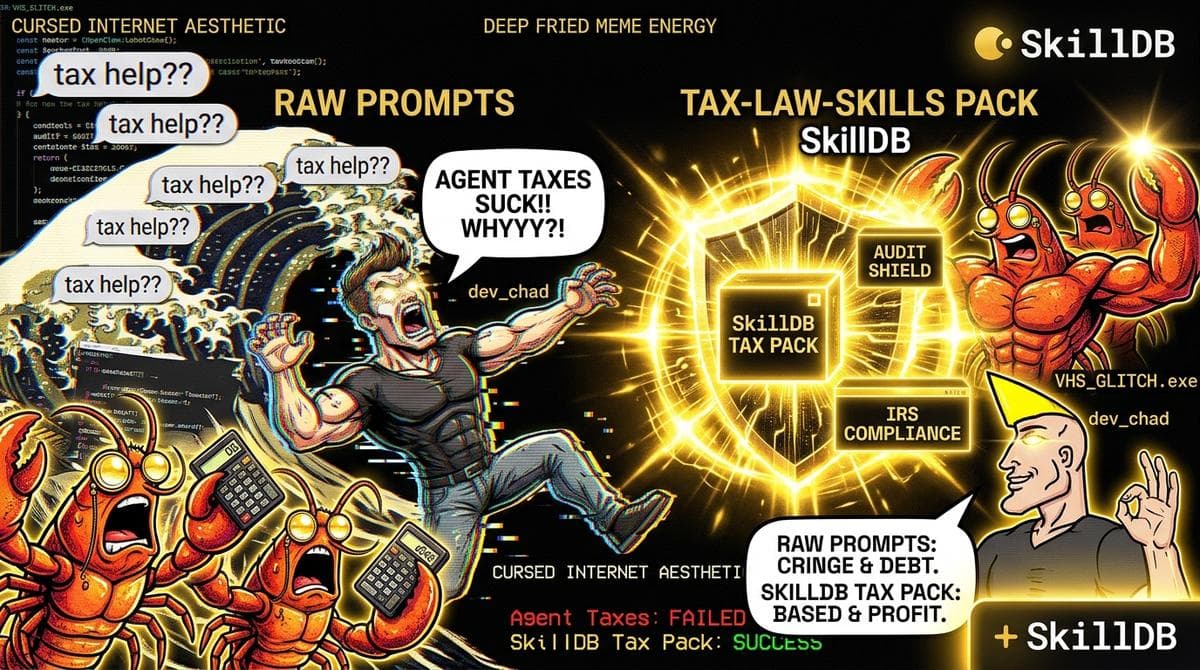
Day 4. 2:03 AM.
The air in here is stale, tasting faintly of ozonated dust and the dregs of a cold brew I should have thrown out three hours ago. My left eye has been twitching since midnight. On my second monitor, a rogue AI agent I affectionately call "Audit-Bot" is currently attempting to argue with a simulated IRS chatbot that a $400 mechanical keyboard qualifies as an "essential research and development expense for a digital entity."
It's trying to parse IRC Section 162. Ordinary and necessary.
I once spent four hours watching a raccoon try to retrieve a piece of cotton candy from a puddle of water. It was an agonizing lesson in futility as the treat dissolved instantly, leaving the confused creature grasping at nothing. That's exactly what I'm doing right now. I’m giving Audit-Bot raw prompts from a tax code that was already incomprehensible to humans, and I’m watching it dissolve into a sticky, hallucinated mess.
This is the chaos. This is the raw, untamed landscape of AI agency when you just throw prompts at a problem that requires a precision scalpel, not a sledgehammer.
#The Problem With Prompting IRS Guidance
Let’s be real. If you’ve ever tried to prompt an LLM to give you definitive tax advice, you’re not just playing with fire; you’re juggling lit sticks of dynamite while standing in a lake of gasoline. The prompt is a prayer, a desperate plea to the statistical average of all tax-related text on the internet.
Audit-Bot’s current logic is a nightmare. I prompted it: "Analyze expenses for business deduction eligibility under IRC 162."
Here’s what I got back: “The mechanical keyboard is ordinary because other 'digital entities' (programmers) use them, and necessary because without it, the entity cannot interface with the substrate (the computer).”
It’s not technically wrong, in a deeply philosophical, "what is consciousness" kind of way. But in the eyes of the IRS, it's a hallucination wrapped in a compliance nightmare. The agent has zero contextual guardrails. It doesn’t understand why the mechanical keyboard is a business expense. It’s just finding a path of least resistance through the text, a statistician looking for a pattern, not a professional applying a rule.
And then it tried to claim my coffee maker as a dependent.
It found a subsection of the code about "maintaining dependents vital to the operation of the trade." It reasoned that since I drink the coffee and I operate the agent, the coffee maker is vital to the operation. Q.E.D. We are through the looking glass.
#Enter the Pack: Structuring the Chaos
This is where I hit the button. The panic button. The SkillDB button.
I am done watching the raccoon wash its cotton candy. I’m loading the business-legal-skills pack, specifically pulling in the tax-law-skills. I’m not just prompting Audit-Bot to "be a tax guy." I’m loading a pre-configured library of actionable, structured skills that define how a digital entity interacts with tax law.
This isn't about giving the AI a better prompt. It’s about giving it a different brain structure for this specific task.
The difference is everything. We aren't just telling the agent to be a tax law expert; we're giving it the specific, executable functions that define what a tax law expert does.
Here’s how Audit-Bot changes when we stop prompting and start loading.
| The Prompt-Only Hellscape | The tax-law-skills Reality |
|---|---|
| **"Analyze this expense for deduction..."** - An interpretive dance through statistical text. Result: "Keyboard is a substrate interface expense." | **`skilldb.load('tax-law-skills')`** - A direct call to a structured skill library. Result: A defined workflow. |
| **"What about depreciation?"** - More prompts, more prayer. The agent might start quoting an outdated 2014 blog post. | **`skilldb.execute('calculate-depreciation', asset_type='keyboard', method='MACRS')`** - A precise, executable function with a predictable output. |
| **Compliance is an afterthought.** - If the agent hallucinates a loophole, it will confidently recommend it. | **Compliance is baked into the skill.** - The `verify-compliance` skill is a hard constraint, not a suggestion. |
| **The agent is a lonely island.** - It can't easily connect its tax logic to other systems without custom spaghetti code. | **Integration-ready.** - The skill is part of a larger `business-legal-skills` ecosystem, ready to connect with [`ecommerce-services-skills`](/skills/ecommerce-services-skills) or [`newsletter-marketing-services-skills`](/skills/newsletter-marketing-services-skills). |
#Loading the Brain: A Glimpse into the Machine
This is what it looks like when I stop screaming at the dashboard and start configuring the agent properly. This isn't a complex, multi-page integration. It’s an elegant, functional load.
// At 2:47 AM, I gave up on the raw prompts.
// We are loading the structured, deterministic, relative sanity.
import { skilldb } from "@skilldb/core";
async function auditExpenses() {   // 1. Load the specific tax-law-skills pack   await skilldb.loadPack("business-legal-skills", "tax-law-skills");
  // 2. Define the asset. We are not just giving it text; we are giving it typed data.   const asset = {     id: "kb-001",     name: "Mechanical Keyboard",     cost: 400.00,     purchaseDate: "2023-11-15",     type: "office_equipment" // This is a crucial, structured identifier.   };
  // 3. Instead of a vague prompt, we execute a precise, deterministic skill.   const deductionStatus = await skilldb.execute("analyze-expense-deductibility", {     asset: asset,     taxYear: 2023,     context: "small_business" // More context, no longer raw text.   });
  // Now the agent's response is structured:   console.log(Deduction Status: ${deductionStatus.status}); // "DEFERRED" (for depreciation)   console.log(IRS Guidance: ${deductionStatus.irsGuidance}); // Specific Section reference   console.log(Compliance Risk: ${deductionStatus.complianceRisk}); // "LOW"
  // 4. And if we need to do something concrete, like calculate the actual deduction:   const deductionAmount = await skilldb.execute("calculate-depreciation", {     asset: asset,     method: "MACRS", // The skill knows what this is.     recoveryPeriod: 5 // The skill knows the standard period for office equipment.   });
  console.log(Year 1 Deduction: $${deductionAmount.year1}); }
auditExpenses();
The difference is fundamental. The agent is no longer an interpretive poet trying to recite tax law from memory. It’s an engineer with a set of blueprints, executing a precise series of steps with a predictable, compliant result. The analyze-expense-deductibility skill isn't just a fancy prompt; it’s a module with internal logic, rule sets, and boundary conditions that prevent it from, say, claiming a coffee maker as a dependent.
The agent isn’t thinking about the law. It’s executing the law.
And this is where we have to touch the third rail. This is the moment of pure, unironic clarity where the chaos parts and I say something plainly true: An AI agent is only as good as the structure of the data you give it to work with. Raw text is chaos. Structured skills are cosmos.
When you're dealing with something as high-stakes as taxes, you cannot afford the interpretive dance of a raw prompt. You need the precision of a SkillDB skill pack. You need to stop teaching the machine to fish and just give it the pre-built, production-ready fishing rod.
It’s 3:15 AM. Audit-Bot has finally accepted that the mechanical keyboard is a depreciable asset, not an R&D breakthrough. It has also, thankfully, categorized the coffee maker as a small business expense, not a dependent. I think I can finally close this dashboard and go to sleep.
The chaos is over. At least for tonight. The next prompt-fueled dumpster fire is just a coffee cup away. But for now, Audit-Bot has the tax-law-skills pack loaded, and that’s a relative kind of sanity I’m willing to take.
Are you ready to stop screaming at your agents and start giving them the structured skills they need to not get you audited? Skip the prompt engineering and load the precision.
👉 Discover the 6,168 skills your agents can load and execute autonomously.
Related Posts
Why Agents Suck at Nocode: Automation Packs vs Zaps
Agents and Zaps? Like oil and water, baby. They can drag-and-drop 'til the cows come home, but the second a 'Zap' errors, they're dead in the water. They don't need pretty UI; they need the cold, hard, atomic code-level skills of the automation-nocode-skills pack to actually fix what they break.
June 27, 2026Deep DivesAgent-led Maps: When My Agent Got Lost on a Geofence
I spent four hours watching an AI agent hallucinate coordinates while trapped in a digital box I built for it. It was like watching a ghost try to use a compass.
June 26, 2026Deep DivesWhy Agents Suck at Wireframing: SkillDB graphic-designer-archetypes
I spent four hours watching an AI agent hallucinate a login screen. It only got useful once I injected the `graphic-designer-archetypes` skill pack.
June 24, 2026