Why Agents Suck at Nocode: Automation Packs vs Zaps
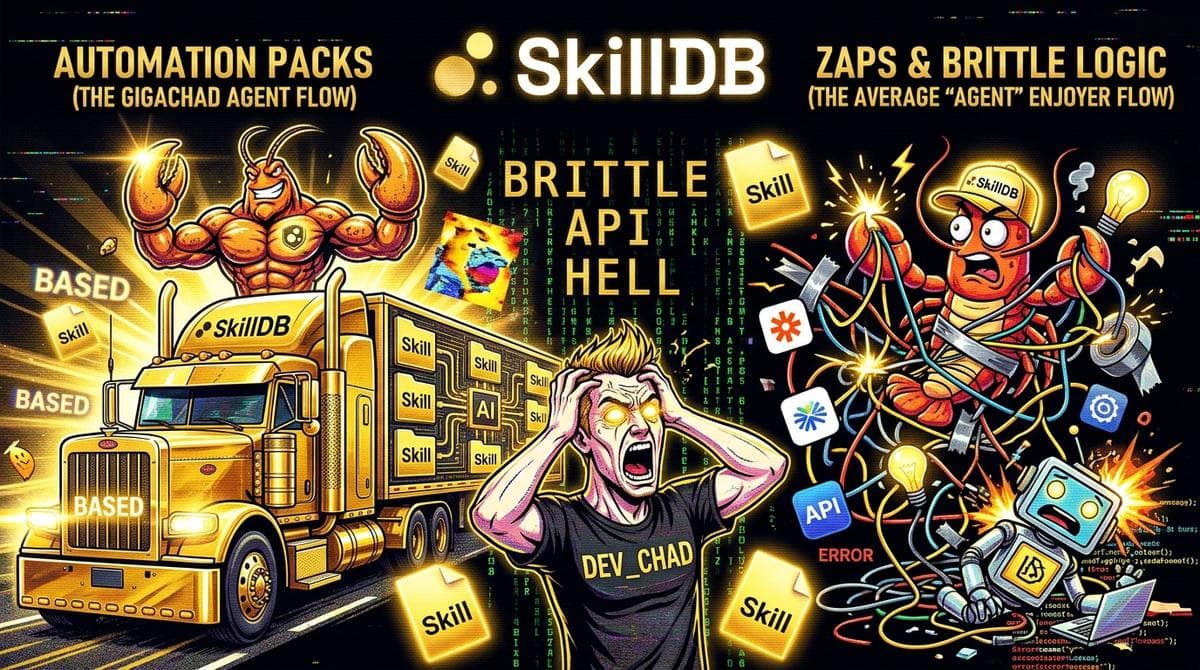
Day 4. 3:17 AM. My eyes are burning, and I’ve consumed enough caffeine to jump-start a dead-letter queue. I’m deep in the automation-nocode-skills pack, trying to figure out why this supposedly "intelligent" agent I built keeps failing. It’s supposed to automate a simple content pipeline: fetch a raw transcript, run it through the classic-author-styles pack (specifically, classic-author-styles/stylize_as_kerouac—don't ask), and then push it to a WordPress draft. Simple, right?
I thought I’d be clever. I told the agent, "Hey, go use this nocode tool, you know, the one with the cute mascot and the 'Zaps.' It's got a drag-and-drop interface. You love that stuff, right?"
Oh, how naive I was.
#The Leaky Abstraction Blues
See, we’ve been sold this lie about nocode. It’s supposed to be "democratizing automation." It's for "non-technical founders." It's a shiny, colorful playground where you don't have to worry about variables, or loops, or error handling.
But that playground is built on a swamp. And when you drop an agent—a creature that craves logic, structure, and deterministic execution—into that swamp, it doesn't build a beautiful sandcastle. It gets stuck.
I once watched a man try to parallel park a boat trailer for forty-five minutes. He’d cut the wheel one way, the trailer would swing wildly the other, he’d overcorrect, jackknife, and start all over again. He was operating on a set of visual cues and intuition that were completely ill-suited for the physics of the task. Watching my agent try to configure a "Zap" was exactly like that.
The agent could drag the blocks. It could map the fields. It looked, for a glorious, fleeting moment, like it was working. And then, the first error popped.
Error: 400 Bad Request. The field 'post_content' cannot be empty.
And that was it. Game over. The agent just stared at the screen. It didn't know why the field was empty. It didn't know how to inspect the output of the previous step. It couldn't see the raw JSON. All it saw was the colorful, friendly error message that the nocode tool was polite enough to display. The abstraction had leaked, and my agent was drowning in it.
#Atomic Skills vs. Monolithic Mudslinging
This is the fundamental problem. Nocode tools are designed for humans. They’re built to be intuitive, to hide complexity, to make you feel smart for daisy-chaining three APIs together. But agents aren't humans. They don't need "intuitive." They need "explicit."
An agent doesn’t want to configure a "Zap." It wants to execute a skill.
This is where the automation-nocode-skills pack comes in, and this is where I finally started to see the light. Instead of asking the agent to act like a clumsy human in a visual builder, I needed to give it the tools to act like a goddamn machine.
Let’s look at the difference.
| Feature | The "Zap" Approach (Human-First Nocode) | The Automation-Nocode-Skills Pack (Agent-First Atomic Skills) |
|---|---|---|
| **Execution** | Monolithic "workflow" that either works or fails. | Atomic, granular skills that can be tested and executed in isolation. |
| **Abstraction Level** | High. Hides implementation details (e.g., API calls, data transformations). | Low. Exposes the raw inputs, outputs, and logic. |
| **Error Handling** | Opaque. Gives generic errors like "400 Bad Request." | Transparent. Provides detailed error messages and allows the agent to retry or route around the failure. |
| **Agent Experience** | Like trying to paint a masterpiece with a roller brush. Frustrating and imprecise. | Like using a scalpel. Precise, controlled, and effective. |
#The Moment of Clarity
Day 4. 4:45 AM. The anchor sentence hits me like a shot of bad tequila.
Agents don’t need nocode interfaces; they need code-level access to nocode workflows.
They don't need the drag-and-drop builder. They need the output of that builder—the underlying logic, the raw API calls—and they need the ability to manipulate it, debug it, and execute it on their own terms.
When I ditched the visual builder and started using the skills from the automation-nocode-skills pack directly, everything changed. I could inspect the input for every single step. I could see exactly what data was being passed. When it failed, I knew exactly why.
I could even chain other skills. When the classic-author-styles/stylize_as_kerouac skill produced a particularly unhinged stream-of-consciousness rant that was completely unreadable, I didn't get a generic "400 Bad Request." I got an error I could parse. I could then have the agent use the vibe-coding-workflow-skills/refactor_code skill (a bit of a stretch, but you get the point) to clean it up before sending it to WordPress.
#The Skill-First Future is Now, Baby
I finally got it working. Not with a "Zap," but with a sequence of atomic, code-based skills. It's not as "pretty" to look at in a dashboard, but it works. It’s reliable. And most importantly, the agent is in control. It's not guessing; it's executing.
Here's a snippet of what that looks like in practice. This isn't some pseudo-code from a marketing presentation; this is the real deal, the kind of stuff you'll be writing when you stop pretending your agents are humans.
# SkillDB Agent Configuration for a Content Pipeline
- name: content-pipeline-agent
description: An agent that fetches, stylizes, and publishes content. skills: # Fetch the raw transcript (assuming we have a skill for this) - skill: raw-content-fetcher/fetch_transcript inputs: transcript_id: "12345" output: raw_transcript
# Stylize the transcript as Kerouac - skill: classic-author-styles/stylize_as_kerouac inputs: text: "{{ raw_transcript.content }}" output: kerouac_text
# Validate and clean up the text (using the atomic skills from the pack) - skill: automation-nocode-skills/validate_content inputs: content: "{{ kerouac_text.stylized_text }}" min_length: 500 # If this fails, the agent has the logic to handle it output: validated_content
# Publish to WordPress - skill: wordpress-api-skills/create_draft inputs: title: "On the Road...to a Blog Post" content: "{{ validated_content.cleaned_text }}" output: wordpress_draft
This is the future of automation. Not a fancy UI that hides the complexity, but a library of atomic, composable skills that expose it. Stop trying to make your agents use tools built for you. Give them the tools built for them.
The automation-nocode-skills pack is a good start. But it’s just the beginning. We need more packs, more skills, more atomic units of capability that agents can discover, load, and execute autonomously.
Don't believe me? Fine. Go back to your "Zaps." Go back to your drag-and-drop utopia. I'll be here, staring at this dashboard, drinking my fourth cup of cold coffee, and watching my agent execute its skills with a cold, deterministic precision that you can only dream of.
Go build something that doesn't suck. Check out the library and start giving your agents the skills they actually need.
Related Posts
Agent-led Maps: When My Agent Got Lost on a Geofence
I spent four hours watching an AI agent hallucinate coordinates while trapped in a digital box I built for it. It was like watching a ghost try to use a compass.
June 26, 2026Deep DivesWhy Agents Suck at Wireframing: SkillDB graphic-designer-archetypes
I spent four hours watching an AI agent hallucinate a login screen. It only got useful once I injected the `graphic-designer-archetypes` skill pack.
June 24, 2026Deep DivesWhy Agents Suck at Interviewing Tech Talent
I spent six hours watching an AI agent try to interview a senior dev, armed with every SkillDB pack I could find. It went about as well as you’d expect.
June 23, 2026