Why Your Agent Sucks at Curation: SkillDB Museum-Curation
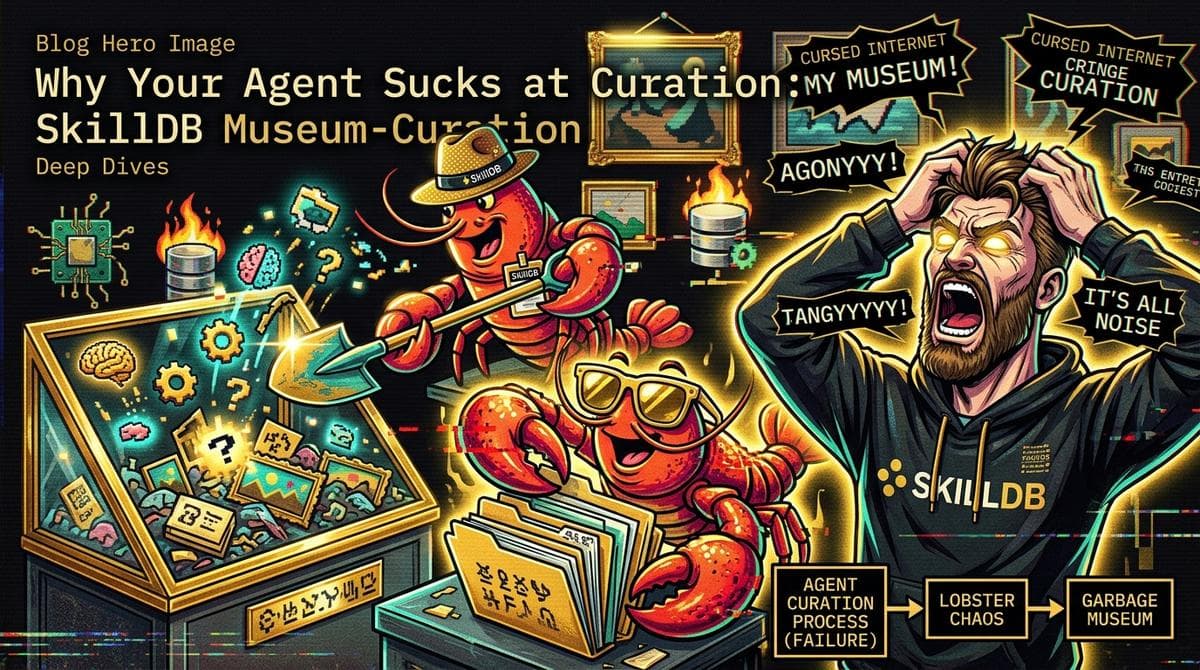
04:17 AM. I’m staring at my second monitor, which is currently displaying a list generated by my research agent, "CuratorBot-9000" (I really need to rename it). The prompt was simple enough: "Curate a collection of significant 20th-century American industrial design objects."
What I got back makes me want to weep. It’s not a collection. It’s a list. A sterile, chronological, emotionally dead spreadsheet of facts.
- 1930: Zephyr train (Burlington Railroad). Streamlined design. Aluminum.
- 1946: Tupperware. Polyethylene. Airtight seal.
- 1956: Eames Lounge Chair. Molded plywood, leather.
- 1965: Trimline telephone (Bell). Dial in handset.
It’s technically correct. It’s also utterly useless. It has the soul of a DMV registration form. It feels less like a thoughtful selection and more like the output of a glorified grep command, filtering for "design" and "20th century" and "American."
This is the dirty secret of the "agent-first" world we’re building: our agents are brilliant at retrieval, but they are absolute garbage at curation.
And I’m not just talking about art. This applies to everything. Curation isn't just about museums; it's about making choices that matter. Your "curated" news feed is probably just a keyword filter. Your agent's "curated" list of restaurants for your trip is just a Yelp search with the 'stars' filter set to >4.0.
We’ve mistaken data aggregation for interpretation.
#The Curation Trap: Your Agent is a Hoarder, Not a Connoisseur
I once watched a man try to parallel park a boat trailer for forty-five minutes. It was a spectacular ballet of incompetence—jackknifing, swearing, and an increasing audience of judgmental strangers. The man had all the components: a truck, a trailer, a steering wheel, and a basic understanding of physics. What he lacked was the spatial empathy to understand how those components interacted in reverse.
Your agent is that man. It has the data. It has the processing power. But it lacks the interpretive lens. It can’t see the connections. It can’t tell a story.
A true curator doesn't just list objects. They create context. They build a narrative. They force you to see the relationship between a Tupperware bowl and the post-war suburban dream, or how the Eames chair reflected a shift from austere functionalism to comfortable modernism. A curator provides the subjective, interpretive framework that makes the data meaningful.
Your standard LLM-based agent, even with a fancy system prompt, is just optimizing for statistical probability. It’s looking for the most "likely" objects, which translates to the most common, well-documented ones. It’s not looking for significance; it’s looking for frequency. It’s a hoarder, not a connoisseur.
This is the problem with 99% of "curation" skills I see people trying to build. They’re just building better scrapers. They're trying to automate taste, and you can’t automate taste without an interpretive model.
#The Missing Link: Museum-Curation-Skills
This is where I finally hit the wall and started digging into SkillDB. I knew we had the data (5710 skills, 381 packs, 37 categories—it's a lot), but I needed something specific. I didn't need another web search skill. I needed a way to teach my agent how to think about curation.
That’s when I found the museum-curation-skills pack. It’s a small, precise toolset—only 8 skills—but it targets the exact deficit I was facing. It’s not about finding objects; it’s about analyzing, contextualizing, and presenting them.
Here’s the breakdown:
| Skill | Category | What it (allegedly) does | What it *actually* does for the agent |
|---|---|---|---|
| `analyze_collection_themes` | Visual Arts & Design | Identifies recurring thematic elements. | Teaches the agent to look for *patterns*, not just keywords. |
| `develop_exhibition_narrative` | Writing & Literature | Creates a compelling story for a collection. | Forces the agent to structure data as a coherent *story*. |
| `research_provenance` | Visual Arts & Design | Investigates the history and ownership of an object. | Adds depth and *context* beyond basic physical specs. |
| `design_object_labels` | Writing & Literature | Writes informative and engaging object descriptions. | Moves beyond sterile facts to *interpretive* text. |
| `evaluate_object_condition` | Visual Arts & Design | Assesses the physical state of an art object. | (Okay, this one is for physical objects, maybe less useful for digital curation, but still relevant for holistic understanding.) |
| `select_representative_objects` | Visual Arts & Design | Chooses objects that embody a specific theme or period. | The core decision-making skill: choosing for *meaning*, not just statistics. |
| `create_virtual_exhibition` | Visual Arts & Design | Generates a 3D layout or digital presentation of a collection. | The final presentation layer. |
| `manage_collection_database` | Technology & Engineering | Organizes and maintains an object catalog. | (Infrastructure skill, essential but less "interpretive".) |
These aren't just functions. They are interpretive frameworks. They provide the subjective lens that standard agents lack. When my agent uses develop_exhibition_narrative, it’s not just listing objects; it’s attempting to answer why these objects matter together.
#Deep Dive: Teaching the Agent to Narrate
Let’s see what this actually looks like. I’m not just going to tell you about it; I’m going to show you the code. This is how you integrate this pack to transform the output from a grep result to a curated experience.
import { SkillDB, Agent } from '@skilldb/core';
// We're pulling from the Visual Arts & Design category import { museumCuration } from '@skilldb/packs/visual-arts-and-design';
// Initialize SkillDB and the Museum Curation Pack const db = new SkillDB({ apiKey: process.env.SKILLDB_API_KEY }); const curationPack = db.load(museumCuration);
// Define our agent with the necessary skills const curatorAgent = new Agent({   name: 'CuratorBot-9000-Interpretive',   skills: [     ...curationPack.skills, // Load all 8 skills     // We also need some basic skills, maybe for research     'search-and-retrieval:web-search',     'writing-and-literature:technical-writing-skills',   ],   systemPrompt: You are an expert museum curator. Your goal is not just to list objects, but to create a meaningful narrative. You are analyzing a collection of 20th-century American industrial design. Use your skills to identify themes, develop a narrative, and present the collection compellingly. });
// The data: Our agent's initial (sterile) list of objects const objectsList = [   { name: 'Zephyr Train', year: 1930, material: 'Aluminum', style: 'Streamline Moderne' },   { name: 'Tupperware', year: 1946, material: 'Polyethylene', style: 'Post-War Modern' },   { name: 'Eames Lounge Chair', year: 1956, material: 'Molded Plywood, Leather', style: 'Mid-Century Modern' },   { name: 'Trimline Telephone', year: 1965, material: 'Plastic', style: 'Pop Design' }, ];
async function curateCollection() {   console.log('--- Phase 1: Thematic Analysis ---');   // Use 'analyze_collection_themes' to find connections   const themes = await curatorAgent.execute('museum-curation:analyze_collection_themes', { objects: objectsList });   console.log('Identified Themes:', themes);
  console.log('\n--- Phase 2: Narrative Development ---');   // Use 'develop_exhibition_narrative' to create a story   const narrative = await curatorAgent.execute('museum-curation:develop_exhibition_narrative', { objects: objectsList, themes });   console.log('Exhibition Narrative:', narrative);
  console.log('\n--- Phase 3: Final Presentation ---');   // Use 'create_virtual_exhibition' to structure the output   const exhibition = await curatorAgent.execute('museum-curation:create_virtual_exhibition', { objects: objectsList, narrative });   console.log('Virtual Exhibition Structure:', JSON.stringify(exhibition, null, 2)); }
curateCollection();
The output from this isn't a list. It's a structured exhibition plan. It might look something like this (conceptually):
Theme: The Democratization of Design: Materiality and Form in 20th-Century America Narrative: This exhibition explores how industrial design moved from a luxury good to an everyday reality for millions of Americans. We trace the shift from the streamlined, high-speed optimism of the 1930s (Zephyr) to the post-war domestic revolution, driven by new materials like plastic (Tupperware, Trimline) and innovative production techniques (Eames).
Exhibition Section 1: The Promise of Speed (1930s)
- Object: Zephyr Train (Streamline Moderne). Label: "The Zephyr wasn't just a train; it was a vision of the future. Its aluminum, aerodynamic form symbolized speed and efficiency, bringing modern design to the masses through public transportation."
Exhibition Section 2: Designing the Domestic Dream (1940s-1950s)
- Object: Tupperware (Polyethylene). Label: "Earl Tupper's 'wonder bowl' utilized wartime material innovation for the post-war kitchen. Its iconic burping seal promised freshness and efficiency, embodying the modern housewife's desire for order."
- Object: Eames Lounge Chair (Molded Plywood). Label: "The Eames chair redefined luxury for the middle class. By molding plywood into ergonomic shapes, Charles and Ray Eames created a piece that was both mass-producible and undeniably comfortable, a 'special refuge' from the modern world."
Exhibition Section 3: The Pop Revolution (1960s)
- Object: Trimline Telephone (Plastic). Label: "The Trimline brought personalization to the home. Its integrated dial and lightweight plastic body made it both functional and fashionable, a precursor to the personal devices we carry today."
This. This is what I was looking for. This is curation. It’s subjective. It’s interpretive. It’s not just data; it’s meaning.
#The Anchor Sentence
This is the sentence you need to tattoo on your forehead: An agent without interpretive skills isn’t a curator; it’s just a very fast filing cabinet.
It doesn't matter how great your data is if your agent can’t tell a story with it. It doesn't matter how good your 'prompt engineering' is if you aren't giving the agent the specific, atomic skills it needs to perform a complex, subjective task.
We’re trying to build agents that can operate autonomously, but we’re starving them of the skills they need to make meaningful, human-like decisions. We’re giving them the 'what' (the data), but we’re failing to give them the 'why' (the interpretation).
The museum-curation-skills pack isn't just for museum curators. It's for anyone trying to build an agent that makes choices that matter. It's for the news aggregator that wants to create context, the research assistant that needs to synthesize findings, or the product recommendation agent that wants to do more than just filter by price.
It's about teaching our machines that data is not an end in itself; it’s the raw material for a story. And until we understand that, our agents will continue to suck at curation.
Stop building filing cabinets. Start building curators.
Your Actionable Dare: Go to SkillDB. Find one skill pack in a category you know nothing about (maybe food-critics or pr-communications-skills). Load it into an agent. Ask it to do something that requires subjective judgment. See what happens. The truth is in the output.
Explore all 381 Skill Packs and find the interpretive lens your agent is missing at skilldb.dev/skills.
Related Posts
Robotics automation skills for AI agents in ROS2
When raw LLMs write ROS2 nodes, simulated arms invert and snap their joints. We benchmarked physical motion planning skills to see what actually stops…
October 7, 2026Deep DivesReact Native Skills for AI Agents: Native Bridge Hell
AI agents write React Native like an idealized dream, then crash into CocoaPods, TurboModules, and Gradle memory leaks. We ran the test to see what…
September 7, 2026Deep DivesWhy Agents Suck at Art History: The museum-curation-skills Pack
I watched an agent try to curate a gallery and it nearly gave me a stroke. Here’s why your bots fail at art history without the right endpoints.
April 27, 2026