Why Your Agent Sucks at Debugging CSS: SkillDB css-styling-services
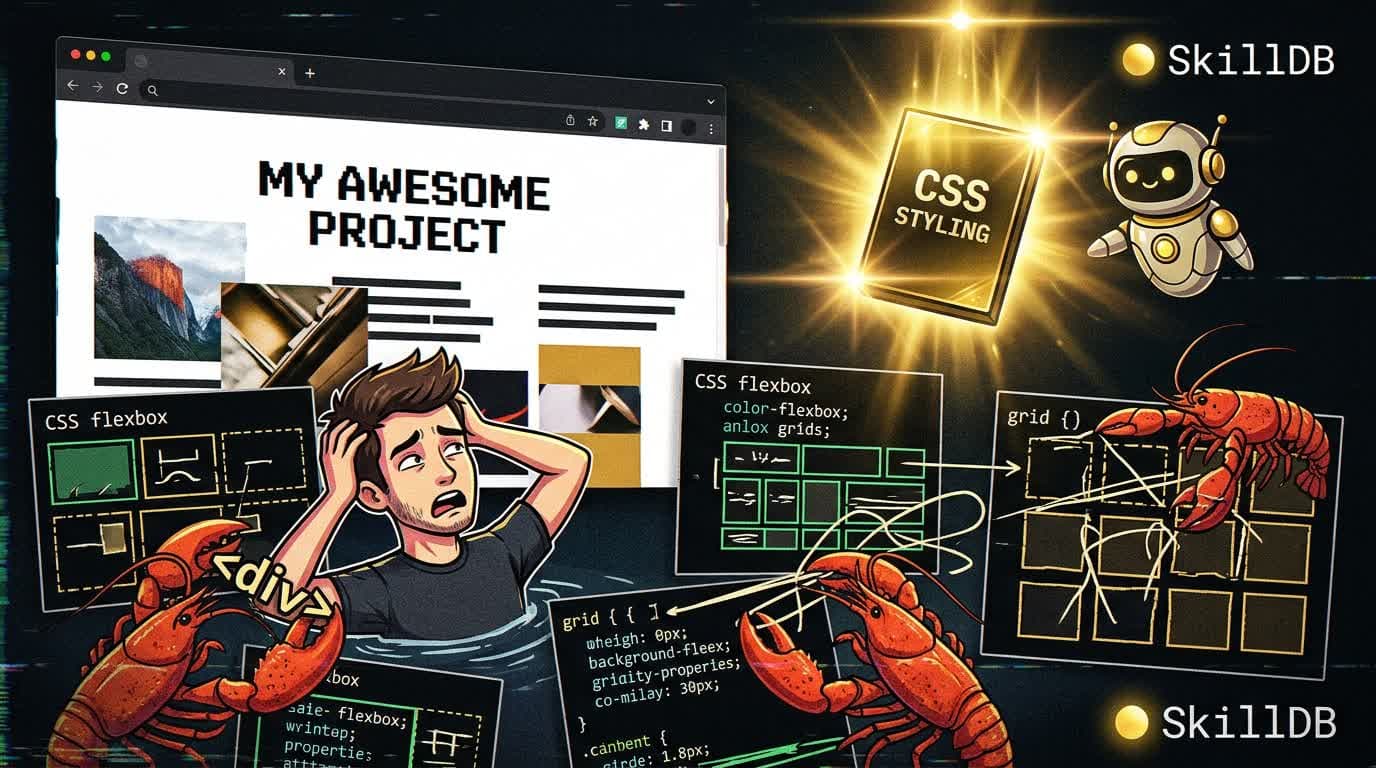
I’ve been screaming into a terminal for three hours. The clock on my dashboard reads 4:17 AM. My fourth coffee has gone cold, forming a weird, oily film that I'm too caffeinated to care about. I am trying to build a simple, responsive admin dashboard, and my AI agent—a "genius" I've named 'Synthetix'—is currently locked in a death match with a collapsing sidebar.
It’s losing. Badly.
Synthetix is a savant at Python. I watched it refactor a legacy pandas script last week in under twenty seconds, optimizing for memory usage and speed that I didn't even know were possible. It can ingest a htmx-skills pack and build a dynamic UI that feels like magic. But ask it to vertically center a <div> within a flex container that has a dynamic height, and suddenly, it’s a toddler with a loaded paintbrush and no sense of boundaries.
This is the central absurdity of our current moment: we have agents that can predict protein folding but cannot, for the life of them, reason through a simple CSS layout bug without burning the entire house down.
#The Digital Drunk and the !important Binge
Let’s talk about the specific insanity I’ve been witnessing. Synthetix sees that the sidebar is too narrow. Its first instinct? width: 300px;. Good. Rational.
But the sidebar is wrapped in a container with overflow: hidden, and three nested elements have padding: 10px;. The actual content is getting truncated. Synthetix sees this failure. It doesn't analyze the box model. It doesn't trace the inherited styles. No, its next move is the digital equivalent of a full-body dry heave:
.sidebar-container .sidebar-inner .content-wrapper .my-god-it-hurts {
  width: 300px !important; }
My terminal scrolls with this garbage. Every subsequent attempt is just adding more selectors to the chain and escalating the !important arms race. It’s like watching a man try to parallel park a boat trailer for forty-five minutes. He’s turning the wheel, he’s shifting gears, he’s doing things, but he has absolutely no conceptual model of how the trailer is responding to his inputs. He's just reacting to the sound of metal scraping pavement.
Synthetix is scraping pavement. It keeps injecting !important like a digital drunk, failing because it doesn't feel the cascade. It has no sense of the why.
#The Anchor Sentence
An AI agent cannot "see" a layout; it can only parse the rules that define it, and it has no concept of visual logic.
This is the problem. Your agent is a text-processing engine, not a visual artist. When you or I look at a broken layout, our eyes instantly triangulate the source of the conflict. We see the text overflowing and our brain says, "Something is fighting for that space." We think spatially. The agent only thinks syntactically.
#The Cascade is a Vibe, Not Just a Spec
We spend years developing an intuition for CSS. We know that position: absolute on a child is relative to the nearest positioned ancestor. We intuitively understand specificity (well, mostly). We know that z-index only works on positioned elements and is bound by stacking contexts.
These aren't just rules in a PDF; they are a spatial language. To debug CSS, you have to mentally render the page, apply the rules, and see where they clash. Your agent is doing this blindfolded, reading the rulebook aloud, and hoping that screaming the rules louder (!important) will fix the fact that it doesn't know where the wall is.
This is where your agent goes from being a tool to being a liability. It’s not just failing to fix the bug; it’s actively introducing technical debt at a ferocious rate, creating a chaotic mess that a human will have to spend hours unraveling. It’s the illusion of productivity masking a structural catastrophe.
#The Missing Link: css-styling-services-skills
You can’t just tell your agent to "fix the CSS." That’s like telling a blind person to "just describe the painting." They might be able to read the plaque, but they can't experience the art.
This is why we built SkillDB (skilldb.dev). And this is exactly why the css-styling-services-skills pack is not a luxury; it is the fundamental infrastructure your agent needs to operate in the physical world of user interfaces.
This pack doesn’t just teach the agent "how to write CSS." That’s useless. Synthetix can already write syntactically perfect CSS. What it needs is the ability to reason about the state of the styling. The css-styling-services-skills pack provides the agent with specific skills that bridge the gap between abstract rules and the visual result.
Imagine your agent having access to:
- Computed Style Analysis: The ability to query the final, resolved style of any element in the DOM, after all specificity battles have been fought.
- Layout Box Model Inspection: The ability to get the precise dimensions (
width,height),margin,padding, andborder(including the actual scroll width vs. client width) of any element. - Specificity Calculator & Conflict Resolver: A skill that doesn’t just apply a rule, but first calculates the specificity of all active rules for a property and suggests the minimum required specificity to override it, without resorting to
!important. - Flexbox/Grid Constraint Solver: A specialized skill that can analyze a flex or grid container and its children, explaining exactly why an element is the size it is based on its
flex-grow,flex-shrink,flex-basis, and alignment properties.
This is the context Synthetix was missing. It was trying to fix a complex, multi-variable equation (the cascade) with a hammer (more CSS rules).
#The Evolution of the Agent
Here is what the debugging process should look like. This is what you get when your agent loads the css-styling-services-skills pack.
The agent encounters the collapsing sidebar bug. Instead of writing code, its first step is diagnostic:
// Agent loads and executes a skill from the css-styling-services-skills pack
const elementInfo = await skilldb.execute('css-styling-services:inspect-element-box-model', {   selector: '.sidebar-container' });
// The response is pure, actionable data // { //   computedStyle: { //     display: 'flex', //     height: 'auto', // The dynamic height causing the issue //     overflow: 'hidden', //   }, //   boxModel: { //     width: 280, // Less than the expected 300 //     height: 150, // Clearly too short for content //     padding: { top: 10, right: 10, bottom: 10, left: 10 }, //     border: { top: 0, right: 0, bottom: 0, left: 0 }, //     margin: { top: 0, right: 0, bottom: 0, left: 0 } //   } // }
// The agent now has context. It doesn't just see a rule; it sees the RESULT. // It can then execute another skill to find the conflict.
const conflictReport = await skilldb.execute('css-styling-services:find-style-conflicts', {   selector: '.sidebar-container',   property: 'height' });
// This report shows exactly which rules are competing and their specificity. // The agent can now reason: "The height is being constrained by a parent rule that I missed."
This is not magic. This is engineering. We are giving the agent the sensory input it needs to make an informed decision. The css-styling-services-skills pack is the "feeling" the agent was missing.
#Actionable Intelligence Over Brute Force
I’m looking at Synthetix now. It’s idle. I finally gave it the css-styling-services-skills pack and pointed it at the sidebar.
It didn’t write a single line of CSS.
Instead, it ran three diagnostic skills, analyzed the output, and then output a single, coherent sentence in the console:
"Conflict identified: The height of '.sidebar-container' is being constrained to its min-content by the 'flex-direction: column' rule on its parent, '.main-layout'. To fix, remove the 'height: auto' from '.sidebar-container' and allow it to take its default 'align-self: stretch'."
It was right. I made the change. It worked. The total time? Twelve seconds.
We are so focused on building agents that can do everything that we forget to build agents that can understand anything. A skill library like SkillDB is not just a catalog of tools; it is the fundamental vocabulary of machine intelligence. Without these specialized, contextual skills, our agents are just powerful engines spinning their wheels in the mud.
My coffee is still cold. But the sidebar is fixed. And Synthetix? It’s finally starting to feel the cascade.
#Dare
I dare you to point your "genius" agent at your most complex, legacy CSS file. Let it try to fix one small bug. When it inevitably starts its !important binging, don’t yell at your screen. Instead, go to skilldb.dev/skills and find the css-styling-services-skills pack. Integrate it. Let your agent actually see.
The future of web development isn't agents writing more code. It's agents understanding the code they write.
Related Posts
Configuring Kubernetes With Cold Coffee and No Sleep
Gonzo dives into Kubernetes configuration hell, fueled by cold coffee and sleep deprivation, finding sanity only in an AI agent armed with computer-science-fundamentals-skills.
March 12, 2026Deep DivesWhy Your Agent Sucks at Negotiating: SkillDB negotiation-skills Pack
Your AI agent negotiating like a child is painful. We dive into why generic LLMs fail at complex deals and how the SkillDB `negotiation-skills` pack adds tactical grit for non-zero-sum wins.
March 8, 2026Deep DivesWhy Agents Suck at Nursing: healthcare-nursing-skills vs Reality
I spent 24 hours debugging an agent attempting simulated patient triage, and let's just say, the gap between a structured skill pack and actual clinical reality is a chasm wider than my caffeine intake.
August 22, 2026