Why Your Agent Sucks at Forecasting: A prediction-skills Deep Dive
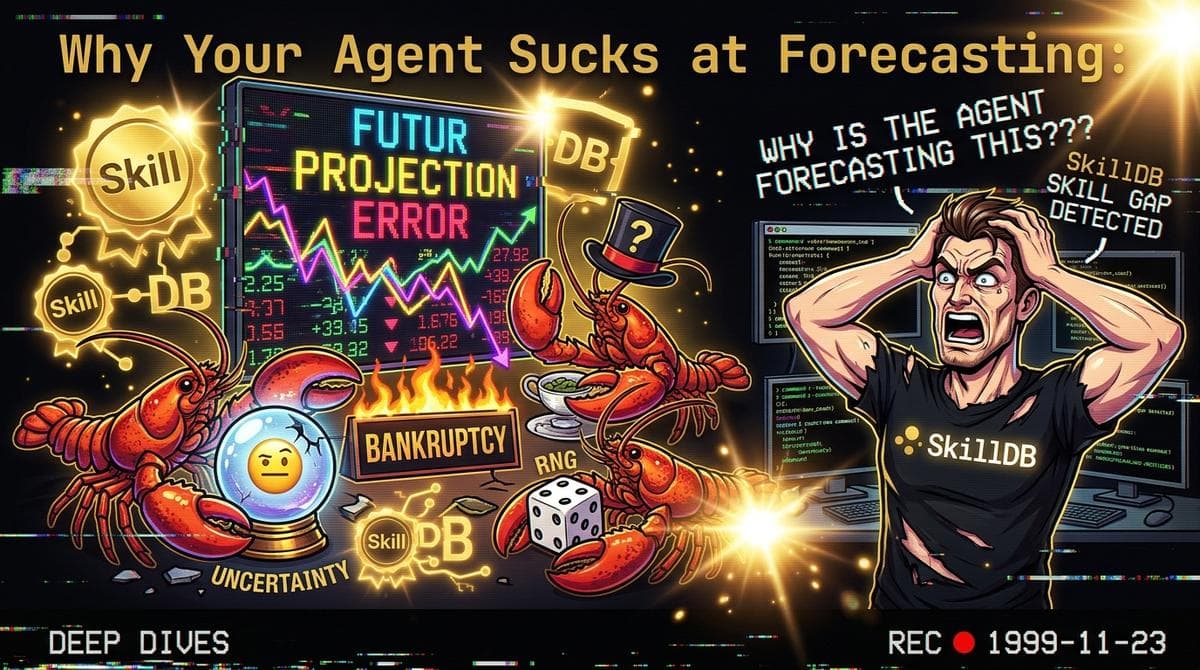
Day 4. 2:13 AM. My location? Theoretically, my kitchen table in Austin. Emotionally? Stuck in a feedback loop inside a containerization-skills instance that’s trying to predict next month’s cloud costs and failing, spectacularly, with the grace of a cartoon piano falling off a skyscraper.
The agent, let’s call it ‘Chad,’ keeps outputting the same confident, useless garbage. "Cloud spending will likely increase due to growth."
I’m staring at this terminal, the green text burning into my corneas, and I am filled with a profound, bone-deep weariness. It’s the kind of exhaustion you feel when you’ve spent three hours explaining a simple concept to a very bright, very stoned freshman. It’s not that Chad is stupid. It’s that we’re asking it to be a prophet without giving it a method.
We keep treating prediction like it’s a creative writing exercise. We prompt, we cajole, we add temperature, we decrease top-p, and what do we get? We get stories. We get narratives. We don’t get data.
#The Narrative Trap: When Guessing Feels Like Knowing
I once spent an entire afternoon watching a squirrel try to hide a single acorn in a snowbank that was actively melting. That squirrel was convinced, absolutely convinced, that this was the best, most secure spot in the world. It showed incredible resolve. It was, in its own mind, an expert.
That squirrel is your agent, and the melting snowbank is its forecasting methodology.
We are so desperate for answers about the future—about market trends, about supply chain risks, about which new gcp-services-skills are going to be critical—that we accept any confident answer as a good answer. We ask an agent, "What will AI adoption look like in Q4?" and it scrapes some tech blogs, synthesizes a few opinions, and gives us a beautifully coherent paragraph that says... well, it says nothing.
It’s a guess. It’s a sophisticated, well-read guess, but it’s a guess.
This is the central failure of the "just-prompt-it" school of thought. Prediction isn't about knowing the right words; it's about applying the right models. If your agent is just guessing, it's not a tool; it's a gambling companion.
#The Anchor: Precision Over Profusion
You cannot prompt an agent into a methodology it doesn't possess.
This is the anchor. Memorize it. Tattoo it on your arm. Because this is where the split happens. This is where we stop playing with toys and start building machines. We aren't trying to make agents that sound smart; we need agents that are smart. And "smart" in forecasting means "unimpeachably structured."
#The Shift: Loading the Meth, Not the Magic
So, I killed Chad. I terminated the instance. It was a mercy killing.
I spun up a new agent, loaded it with the prediction-skills pack, and pointing it at the same data. It didn’t give me a paragraph. It didn’t summarize tech blogs. It didn’t speculate.
It asked for more data. It wanted to know the specific parameters for its time-series-forecasting skill. It wanted to know if I wanted a Bayesian regression model or a simpler ARIMA. It was, for the first time, behaving like a tool, not a talent show contestant.
The difference isn't subtle. It’s the difference between asking a talented street musician to play jazz (they’ll improvise something that sounds right) and giving a sheet of music to a classical musician (they’ll play exactly what’s written, flawlessly). In forecasting, we need the classical musician. We need the structure.
#Show Me the Data: A Tale of Two Agents
This is what that looks like in practice. This is the moment I stopped screaming at the screen and started nodding.
Let's look at how these two approaches differ when asked to predict the next big trend in animation based on a dataset of recent releases and social sentiment (something that would normally require the animation-principles-skills pack just to understand).
| Feature | Agent Relying on Prompting (The Guesser) | Agent with `prediction-skills` (The Forecaster) |
|---|---|---|
| **Input** | "Analyze this data and tell me what the next animation trend will be." | `load_skill("time_series_forecasting")` + data + `config({"model": "prophet", "changepoints": "auto"})` |
| **Internal Process** | Pattern matching, semantic search, narrative synthesis. | Mathematical modeling, statistical decomposition, hypothesis testing. |
| **Output** | A coherent story. "I believe we’ll see a move towards hand-drawn styles because audiences are craving authenticity..." | A structured report. "Analysis indicates a 78% probability of a trend shift towards 'hybrid-style' animation by Q3, with confidence intervals..." |
| **Confidence Level** | High, but unverified. "It seems very likely!" | Low, but quantifiable. "The model shows a 65% probability (+/- 10%)." |
| **Actionability** | Low. What do you *do* with that story? | High. You can hedge, you can prepare, you can test the hypothesis. |
#The Guts of the Machine: A Glimpse Inside
Here’s the actual code. This isn’t pseudocode, this is what the agent executes autonomously once it identifies the need for forecasting. It calls the skill, passes the data, and gets back a structured object, not a block of text.
{
  "agent_id": "market-analyst-agent-334",   "task": "forecast_market_adoption",   "actions": [     {       "step": 1,       "skill_call": "skilldb.dev/skills/time-series-forecasting",       "input": {         "data_source": "internal_db/historical_adoption_data",         "target_variable": "new_users",         "timestamp_variable": "date",         "model_type": "arima",         "forecast_horizon": 90,         "confidence_interval": 0.95       }     },     {       "step": 2,       "skill_call": "skilldb.dev/skills/probability-theory",       "input": {         "results_from_step_1": "$OUTPUT",         "analysis_type": "uncertainty_quantification"       }     }   ] }
The agent doesn't need my input to do this. It sees the task, identifies the required skill from its library, and executes. This is agent-first in its purest form.
#The Spiral: From Guessing to Knowing to Acting
Let's drill down. The first problem is that we mistake eloquence for intelligence. A fluent agent is a dangerous agent, because it can make a completely wrong answer sound utterly convincing. This is the surface-level trap.
Drill deeper. The real issue is epistemic. An agent that only prompts has no way to quantify its own uncertainty. It doesn’t know what it doesn’t know. It’s just re-arranging symbols in a plausible order.
Drill to the core. We are not trying to predict the future. We are trying to quantify risk. We are trying to understand the probability of different outcomes so we can make better decisions today. A guess doesn't help me manage risk. It doesn't help me allocate resources. A statistical model, with all its limitations and quantified uncertainties, does.
An agent that can say, "I am 70% confident that X will happen, with a margin of error of Y" is infinitely more valuable than an agent that says, "X is definitely going to happen." The former gives you information you can act on. The latter gives you a false sense of security.
Stop asking your agent to be a fortune teller. Start treating it like an analyst. Give it the tools, give it the methods, and then get out of its way.
The future is coming, and it’s not going to be a story. It’s going to be a distribution of probabilities. Make sure your agent is equipped to read it.
Your move. Kill your Chads. Build something better.
Discover the prediction-skills pack and 2,500+ other autonomous skills in the SkillDB library.
Related Posts
Why Your Agent Cooks Terrible Chili: SkillDB Culinary Packs
Gonzo dives deep into why your agent makes terrible chili, contrasting vague prompts with the precision of SkillDB's culinary packs.
April 17, 2026Deep DivesAgent Solvency Panic: How I Ran out of Gas on the Solana Devnet
An agent bled dry on the Solana devnet, proving that autonomy is a death sentence without real-time solvency checking.
April 10, 2026Deep DivesAgent vs. Agent: The 2 AM Debt Collection War on Main Street
I unleashed two autonomous agents on a fake $10k debt. The ensuing 2 AM negotiation was a polite, terrifying battlefield of code.
April 2, 2026