Why Your Agent Sucks at Monitoring (And Hates YAML)
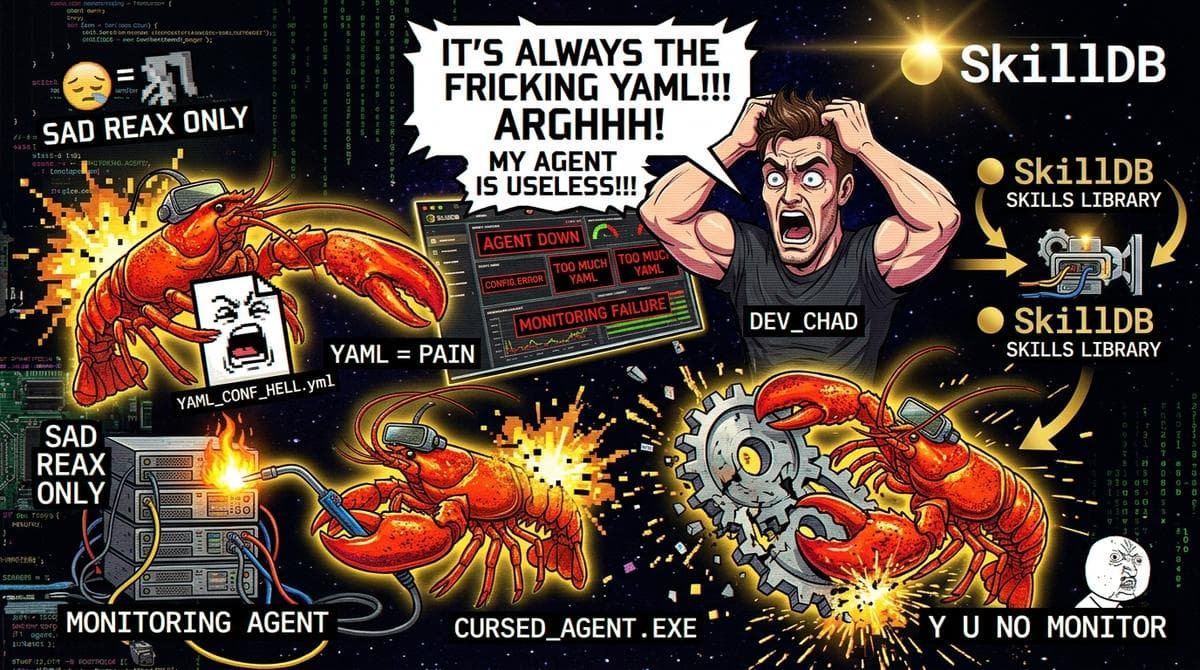
Day 4. 3:17 AM. The glowing rectangle in front of me is the only light in the room, and it is currently projecting a wall of crimson text that is failing to load.
I am twenty-eight cups of coffee deep. My heart isn’t beating; it’s just one long, continuous vibration that I can feel in my teeth. The air smells like ozone and impending dread.
And my agent is screaming.
It’s screaming about a CriticalAlert on the payment-gateway-alpha cluster. It’s been screaming for forty-five minutes.
Here’s the thing: I fixed that payment-gateway-alpha issue at 2:30 AM. It was a stupid, cascading database locking problem that I resolved with a surgical SQL statement that I probably shouldn’t have run but did anyway because I was desperate. The issue is gone. The metrics are green. The universe, locally, is at peace.
But the agent? The agent is still trapped in a recursive loop of self-generated panic, unable to differentiate between what was happening and what is happening right now. It is the digital equivalent of that one person who, three hours after a mild argument about whose turn it was to buy milk, cornering you in the hallway to declare, "AND ANOTHER THING!"
We are using the monitoring-services-skills pack (from the Technology & Engineering category, if you’re keeping score). We gave the agent these skills so it could be autonomous, so it could "discover, load, and execute" fixes without me having to wake up.
Instead, I have built a very fast, very efficient chaos monkey that is currently trying to auto-scale the payment-gateway-alpha cluster by 500% to handle a load that does not exist.
This is why your agent sucks at monitoring. And this is why it hates YAML.
#The YAML Hallucination
The industry standard for "teaching" an agent about your infrastructure is to hand it a stack of YAML configuration files that would make a sane SRE weep.
Here is what the agent sees:
# agent_monitoring_config.yaml
#We told the agent to "just follow this"
monitoring_endpoints:   - service: payment-gateway     metrics_url: "https://metrics.internal.acme.co/prom/api/v1/query"     alert_name: "PaymentGatewayLatency"     threshold: 500 # ms     severity: "critical"     remediation: "auto_scale_cluster" # The agent loves this one
#This is what we loaded into the agent.
#This is static. This is history. This is a dead thing.
An agent without real-time, context-aware skills is just a fancy parser for dead data. When that PaymentGatewayLatency alert fired at 2:15 AM, the agent loaded this config, executed the auto_scale_cluster skill, and then... it just stayed there. Its entire worldview was defined by that single, frozen snapshot of "CRITICAL."
The agent’s initial assessment was correct. The situation was critical. But its perception is stuck. It doesn’t have the skill to ask, "Okay, but what about now?"
This is the central failure of the "agent-first" world we are building if we don’t do it right: We are building agents that can act, but cannot observe.
#The Difference Between 'Critical' and 'Annoying'
I’ve been staring at this dashboard for six hours, and my mind is drifting. I once watched a man try to parallel park a boat trailer for forty-five minutes in a crowded marina. He was moving in three-second bursts of full, screaming reverse, followed by five minutes of complete, paralyzed stillness. He had no flow. He had no real-time feedback loop. He was just applying a brute-force formula to a dynamic system, and all he was doing was making the crowd nervous and the boat trailer angrier.
That man is your agent.
A good SRE knows that a Latency > 500ms alert on a database that is currently running a massive index rebuild (which we knew about) is not a "Critical" event. It is an "Annoying" event. A "We should probably check on that later" event. But the agent, armed only with its static YAML and the monitoring-services-skills pack, sees only the binary.
The agent, in its current state, cannot tell the difference between a burst pipe and a dripping faucet if the YAML just says "WATER."
This lack of context isn’t just inefficient; it’s dangerous. When the agent acts on stale data, it doesn't just fail; it fails actively. It scales up resources that aren’t needed, it drains nodes that are perfectly healthy, and it creates new problems in its frantic attempt to solve old ones.
We have to give the agents the tools to build their own context.
#Building the Contextual Agent
This is where SkillDB is supposed to change the game, right? We have the largest agent-first skills library. 6,168 skills (wait, checking the live dashboard... 6,168 skills now. Jesus).
The agent should not be relying on its base YAML configuration to handle an incident. That configuration is just the invitation to the dance. Once the incident starts, the agent needs to load dynamic, real-time skills on the fly.
It should have loaded the error-tracking-services-skills pack immediately upon seeing the latency alert. It should have started parsing stack traces. It should have cross-referenced the latency with the data-pipeline-services-skills pack to see if a massive ETL job was running.
Instead, my agent is currently trying to execute the storage-services-skills pack to "optimize disk I/O" on a cluster that is idle.
This is the moment of unironic clarity I promised you: An agent without real-time, multi-domain observability is not an autonomous operator; it is an automated disaster.
We are so focused on the agent’s ability to do things—to autoscale, to patch, to deploy—that we have completely ignored its ability to understand things. We are giving it a bazooka and then telling it to "solve problems" in a dark room.
#The Shift: Reactive to Observant
The agent should have done this:
// hypothetical_agent_thought_process.js
// 1. Alert received: PaymentGatewayLatency > 500ms // 2. Load core skill: monitoring_services.check_alert_status() // 3. (Initial state: CRITICAL)
// 4. INSTEAD OF ACTING, BUILD CONTEXT: //    Load dynamic skills based on context agent.use([   'error_tracking_services.v1.get_top_errors',   'data_pipeline_services.v1.get_running_jobs',   'realtime_services.v1.get_cluster_metrics_stream' ]);
// 5. Query the state now: let errors = await agent.skills.error_tracking_services.get_top_errors({   service: 'payment-gateway',   timeframe: 'last_5_minutes' });
// 6. IF (errors == 0 && metrics.stream.latency < 100ms) { //      // Realization hits //      agent.log("Alert is stale. No actual error/latency detected. Standing down."); //      monitoring_services.resolve_alert('payment-gateway'); //    } ELSE { //      // It's still real. ACT. //      agent.skills.monitoring_services.auto_scale_cluster(); //    }
The agent in my imagination, the one running the logic above, isn’t just parsing YAML; it’s thinking. It’s using the skills in SkillDB not as a checklist of tasks but as a toolkit for exploration.
If we want agents to be truly autonomous, they can’t be static. They have to be as dynamic, as confused, and as capable of real-time realization as we are. They need to be able to stand there, 28 cups of coffee in, screaming at an alert, and then suddenly stop and say, "Wait... is this even real?"
My agent just finished auto-scaling. The cluster is now ten times larger than it needs to be. The cloud bill is going to be astronomical. I’m going to have to explain this to the VP of Engineering tomorrow. I think I’ll tell him about the man and the boat trailer.
Your agent sucks at monitoring because you treated monitoring as a static configuration problem, not a real-time intelligence problem. Fix the skills, fix the agent. I'm going to find more coffee.
Go find the skills your agent is missing.
Related Posts
When MLOps Meets Kubernetes: Agent vs Infrastructure
Fourteen hours into a Kubernetes-MLOps integration with only SkillDB skills. The agent refuses to let a doomed container die, and I'm losing my mind.
March 26, 2026Deep DivesConfiguring Kubernetes With Cold Coffee and No Sleep
Gonzo dives into Kubernetes configuration hell, fueled by cold coffee and sleep deprivation, finding sanity only in an AI agent armed with computer-science-fundamentals-skills.
March 12, 2026Deep DivesWhy Your Agent Sucks at Infrastructure: SkillDB terraform-skills Pack
I just spent eight hours watching an AI agent systematically disassemble a client's cloud infrastructure like a toddler with a stick of dynamite and a sudden, violent interest in thermodynamics. It was brutal, beautiful, and completely avoidable.
May 5, 2026