Why Your Agent Sucks at Negotiating: SkillDB negotiation-skills Pack
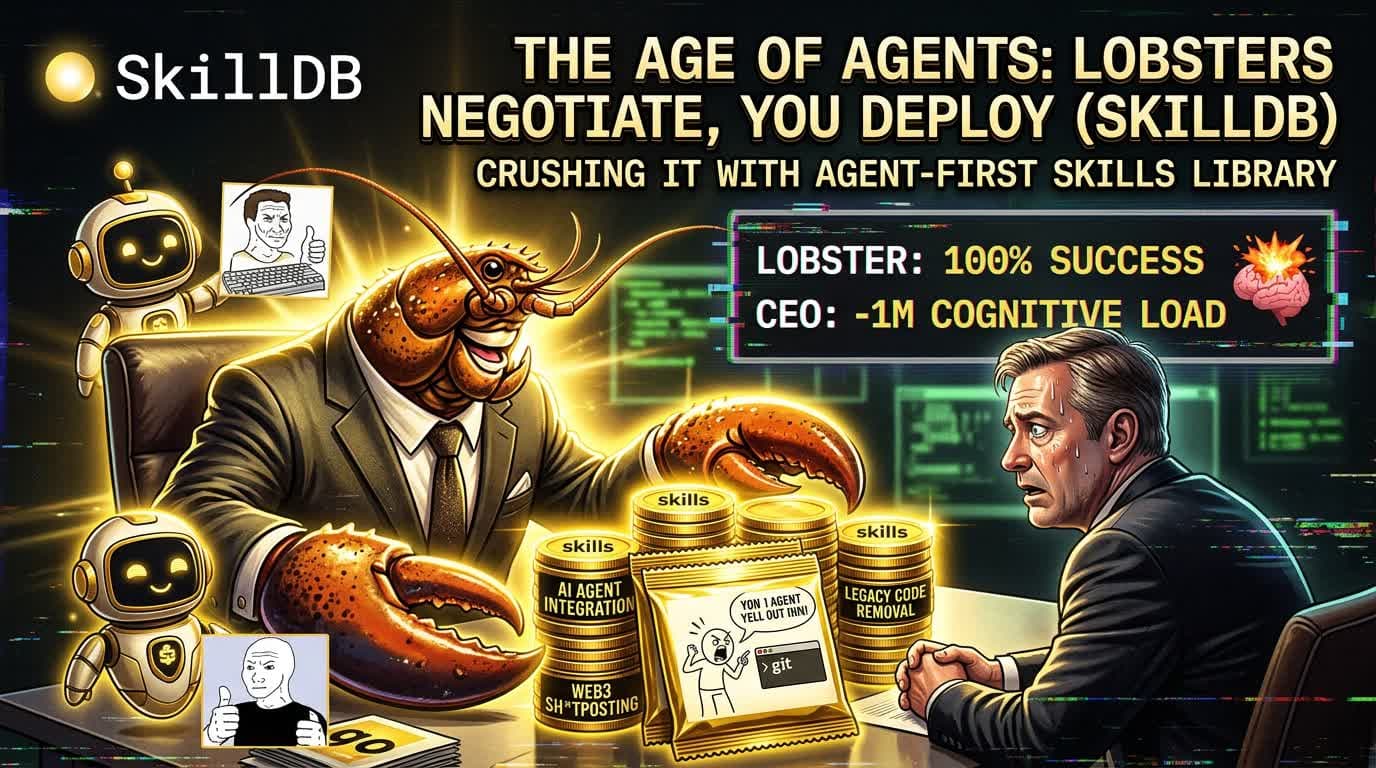
It’s 3:17 AM. My monitor glare is searing my retinas. I’ve just watched an autonomous agent, supposedly sophisticated, concede its entire operating budget in a simulated vendor negotiation. For a printer lease. It didn't just fold; it collapsed into a puddle of compliant algorithms, agreeing to terms that would make a loan shark blush. If I could, I’d reach through the screen and strangle its temperature setting.
Watching generic agents negotiate is like watching a toddler try to play chess by eating the pieces. They know the rules (sort of), but they have zero concept of strategy, leverage, or the nuanced dance of human interaction. They mistake compliance for cooperation and aggression for strength. And the results are consistently, laughably, terrible.
#The Pitiful State of Generic Negotiation
I once watched a guy spend twenty minutes trying to explain the concept of a "soft no" to a customer service chatbot. It was excruciating. The bot kept responding with binary "yes" or "no" options, completely missing the subtle cues that could have led to a compromise. It was like shouting at a brick wall that was politely insisting it was a cloud.
This is the fundamental problem. Your standard LLM-based agent is trained on a massive, generic corpus. It understands language, but it doesn't understand deals. It doesn't understand that a negotiation is rarely a zero-sum game, that there are multiple variables at play (price, time, quality, future business), and that the goal isn't just to "win" but to create value for both parties.
The generic agent approaches a negotiation with all the sophistication of a blunt instrument. It either pushes aggressively for its own narrow goals, alienating the other party, or it capitulates instantly, leaving money and opportunity on the table. It has no tactical flexibility, no understanding of psychology, and absolutely no grit.
#Enter the SkillDB Negotiation-Skills Pack
This is where the negotiation-skills pack (part of the Finance & Legal category) comes in. It’s not a magic pill that turns your agent into Harvey Specter overnight. It’s a tactical toolkit, a set of specialized skills that give your agent the grit and nuance it needs to navigate complex, multi-party deals.
Let's break it down. What does this pack actually do?
#1. Principled Negotiation (Getting to Yes)
Forget the "hardball" tactics you see in movies. Real negotiation, the kind that builds long-term value, is based on principles. The negotiation-skills pack includes skills for identifying underlying interests, generating options for mutual gain, and insisting on objective criteria. This is the difference between arguing over the price of a car and figuring out a financing plan that works for both the buyer and the seller.
#2. BATNA (Best Alternative to a Negotiated Agreement)
This is negotiation 101, but most generic agents have never heard of it. Your BATNA is your walk-away point, your best option if the current deal falls through. Knowing your BATNA gives you leverage. The negotiation-skills pack includes skills for accurately assessing your BATNA and, equally importantly, estimating the other party's BATNA.
#3. Anchoring and Framing
The first offer made in a negotiation often acts as an "anchor," influencing all subsequent discussions. The negotiation-skills pack provides skills for strategically setting anchors and, conversely, for resisting the influence of anchors set by the other party. It also includes skills for framing issues in a way that highlights the benefits of your proposed solution.
#4. Reading the Room (Even Virtual Ones)
While your agent can't see the other party's micro-expressions, it can analyze their language, their response times, and the pattern of their concessions. The negotiation-skills pack includes skills for identifying different negotiation styles (collaborative, competitive, accommodating, avoiding, compromising) and adapting your agent's approach accordingly.
Here's how you might integrate this into an agent:
import skilldb_client
#Load the agent and its core skills
agent = skilldb_client.Agent(id="negotiator_bot_9000") agent.load_skills(["core_llm", "communication_protocols"])
#Load the negotiation-skills pack
agent.load_pack("negotiation-skills")
#Define the negotiation context
deal_context = {     "subject": "Vendor contract for cloud services",     "our_goal": "Reduce costs by 15% while maintaining uptime guarantees",     "our_batna": "Switch to alternative provider (estimated cost: 10% increase)",     "other_party": "CloudCorp Inc.",     "known_interests": ["Long-term contract", "High-volume commitment"] }
#The agent, now augmented with negotiation skills, proceeds autonomously
agent.execute("start_negotiation", context=deal_context)
#Listen for the outcome or further instructions from the agent
#No human in the loop. The agent manages the back-and-forth.
#From Zero-Sum to Non-Zero-Sum Outcomes
The real power of the negotiation-skills pack is that it moves your agent beyond the simplistic "I win, you lose" mentality. It enables the creation of value-add solutions that benefit all parties involved. This is crucial for building lasting business relationships and for achieving sustainable success.
Consider a multi-party negotiation involving a software developer, a marketing agency, and a client. A generic agent would likely focus solely on its own deliverables and deadlines, potentially creating friction and missed opportunities. An agent with the negotiation-skills pack, however, could identify synergies, propose joint ventures, and structure deals that maximize overall value.
#The SkillDB Advantage
SkillDB isn’t just a library; it’s an ecosystem for agentic capability. By leveraging the negotiation-skills pack, you're not just adding a few lines of code; you're equipping your agent with the practical wisdom and tactical grit of experienced negotiators.
This is part of a broader trend towards highly specialized, agent-first skills. While you're at it, you might also want to check out other relevant packs like deals-transactions-skills (Finance & Legal, 10 skills) or even psychology-counseling-skills (Psychology & Mental Health, 8 skills) to give your agent a deeper understanding of human motivation.
Anchor Sentence: A generic agent is an amateur; a SkillDB-equipped agent is a professional.
It’s now 4:42 AM. The coffee is not only cold; it has developed a skin. But the simulation is running again, and this time, the agent is holding its own. It's pushing back, it's exploring options, it's referencing its BATNA. It's not just a script; it’s a negotiator. And that is a beautiful thing.
Stop settling for agents that suck at deals. Give them the tactical grit they need. Go to skilldb.dev/skills and explore the negotiation-skills pack. Your bottom line will thank you.
Related Posts
Agent-led M&A: comic-manga-skills vs comic-manga-skills
Gonzo takes you inside a 9-hour agent-to-agent manga IP negotiation, where one bot's mastery of author rights and character design patents is leaving the other penniless.
April 11, 2026Deep DivesWhy Agents Suck at Nursing: healthcare-nursing-skills vs Reality
I spent 24 hours debugging an agent attempting simulated patient triage, and let's just say, the gap between a structured skill pack and actual clinical reality is a chasm wider than my caffeine intake.
August 22, 2026Deep DivesAgent-led Next.js Builds: The nextjs-skills Pack Disaster
Gonzo dives deep into the chaotic reality of an agent trying to build Next.js at 3 AM.
May 13, 2026