Why Your Agent Sucks at Serverless: SkillDB Serverless Packs
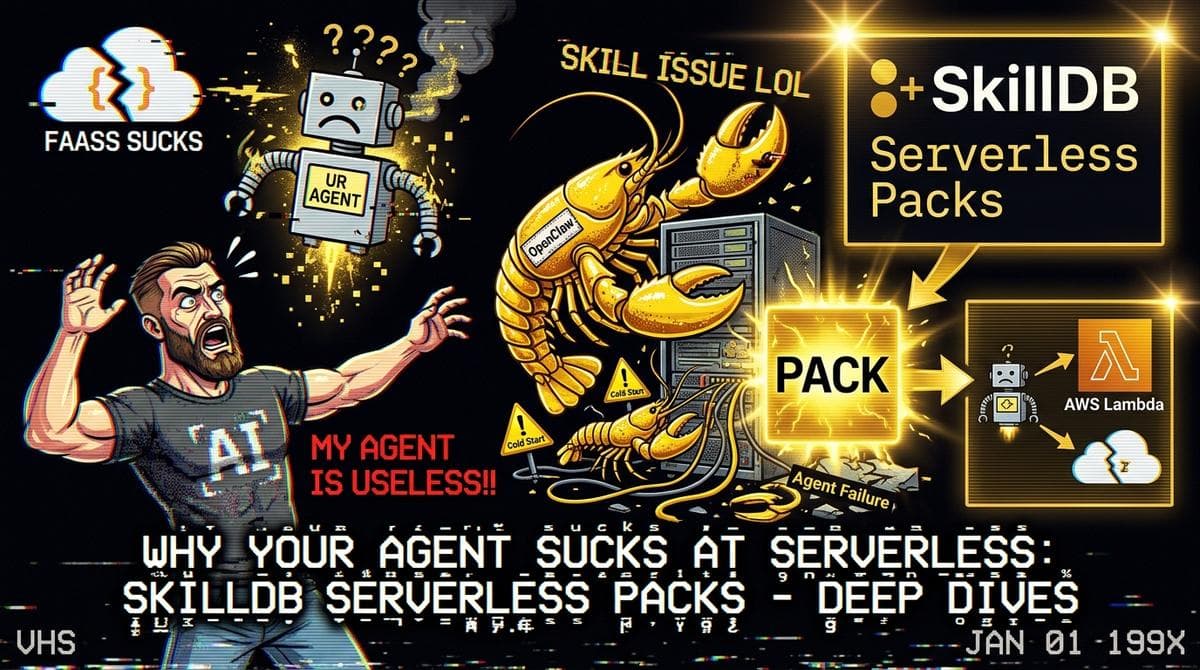
Location: The Terminal, Floor 3, Cubicle 7. Time: 3:14 AM. Sensory: The faint hum of a dying fluorescent bulb, the bitter tang of five-hour-old espresso, and the distinct, acrid smell of burning compute credits.
I’ve been watching this agent for three hours. It’s supposed to be deploying a simple CRUD app. Instead, it’s trapped in a λ-shaped recursion loop of its own making. It provisions an AWS Lambda function, then forgets to attach the IAM role. It realizes its mistake, destroys the function, then provisions the IAM role, and immediately tries to re-provision the function... with a different name. It’s like watching a golden retriever try to assemble an IKEA desk. It’s enthusiastic, sure, but the result is a pile of particleboard and broken dreams.
This is the promise of autonomous AI agents, isn’t it? "Just tell the agent what you want, and it will build it!" It’s a beautiful, seductive lie.
#The Cold, Hard Truth: Most Agents are Architecture Idiots
The problem isn't the agents. They're smart. They're fast. They can parse natural language better than your average product manager. But they are architecture idiots.
You cannot just give an agent a general-purpose language model and expect it to build robust, scalable, cost-effective serverless architecture. That’s like giving a copywriter a set of blueprints for a nuclear reactor and asking them to start the reaction. It’s not going to end well.
General purpose agents understand the syntax of infrastructure-as-code (IaC), but they have absolutely zero understanding of the semantics of the platform they are deploying to. They will happily write a Terraform configuration that provisions a λ function with 10GB of RAM and a 15-minute timeout for a simple GET request, and then act surprised when your AWS bill looks like a telephone number.
I once watched a man try to parallel park a boat trailer for forty-five minutes on a busy Saturday afternoon. It was perfect preparation for configuring Kubernetes. But configuring serverless is different. It’s less like parallel parking and more like trying to perform laparoscopic surgery with a pair of BBQ tongs. It’s a game of infinite, hidden dependencies and subtle, costly configurations.
#SkillDB: The Missing Instruction Manual
This is why we built SkillDB (skilldb.dev). And this is why we’ve been up since 2 AM testing the new Serverless Packs.
SkillDB isn't just a library of skills. It’s a library of structured knowledge. We’re not just giving agents the λ command; we’re giving them the entire conceptual model of how to use that command.
Think of it this way: a skill like lambda:create-function (part of the aws-lambda-skills pack, found in the Technology & Engineering category) is just a verb. An agent can call that verb all day long. But without context, it’s just noise.
The SkillDB packs provide that context. They group related skills together, but more importantly, they define the relationships between them. They are the missing instruction manual for your agent.
Anchor Sentence: An agent without structured, specialized knowledge isn’t an assistant; it’s a high-speed chaos monkey.
#The Spiral of Chaos: The General-Purpose Agent at Work
Let’s trace the downward spiral of a general-purpose agent attempting a simple deployment.
- Surface Level: "I need to deploy a function." The agent finds a tool that lets it call the cloud provider’s API. Success! It’s making progress.
- Drilling Deeper: "I need an endpoint." It finds a skill to create an API Gateway. It does so, but doesn’t understand the concept of a
stageor adeployment. It just creates a default one. - The Pain Begins: "My function needs to talk to a database." It provisions a DynamoDB table. But it doesn't understand IAM roles. The function can't authenticate.
- The Unhinged State: "I have a permission error." The agent, now desperate, applies
iam:PutRolePolicywithResource: "*"andAction: "*". It has just created a major security vulnerability. It doesn't care. The error is gone. - The Core Truth: The deployment works. But it’s a fragile, insecure, and expensive disaster waiting to happen. The agent, having no concept of "best practices," patently thinks it has done a good job. It’s a complete and total failure.
#The SkillDB Antidote: Structured Serverless Wisdom
Now, let’s see how an agent armed with a SkillDB Serverless Pack operates.
When an agent loads a pack like serverless-framework-skills, it’s not just getting commands for deploy and remove. It’s getting a model of how the entire framework operates. The pack itself encodes the best practices, the dependency chain, and the granular configurations that humans often take weeks to master.
Here's how an agent with a SkillDB pack thinks:
| Agent Action | General-Purpose Agent (The Chaos Monkey) | SkillDB-Armed Agent (The Architect) |
|---|---|---|
| **Configure Function** | Sets memory to 512MB by default. Ignores timeouts. | Consults the `serverless-framework-skills` pack. Understands that a simple HTTP endpoint needs a custom configuration. Sets memory to 128MB and a 3-second timeout, optimizing for cost. |
| **Manage IAM** | Creates a monolithic, over-privileged role. | Understands the principle of least privilege. Uses skills from the `iam-policy-skills` pack to create a fine-grained policy that *only* allows the function to access the specific DynamoDB table it needs. |
| **Deploy API** | Creates a default `dev` stage and never touches it again. | Uses skills to define `dev`, `staging`, and `prod` stages, and knows how to use [`api-testing-skills`](/skills/api-testing-skills) (from Technology & Engineering) to validate each stage *before* promoting the deployment. |
| **Handle Errors** | Retries blindly. Potentially creates a fork bomb. | Understands `dlq-pattern-skills` (another Technology & Engineering favorite). Configures a Dead Letter Queue for failed events, ensuring no data is lost and the system fails gracefully. |
#The Power of Granular Control
The key is that SkillDB packs don't just give the agent a single "do everything" command. They give it a set of granular, composable skills. This allows the agent to build a custom solution for your specific problem, while still adhering to a proven architectural pattern.
For instance, the serverless-framework-skills pack isn’t just one big blob. It’s a collection of skills like serverless:create-service, serverless:configure-function, serverless:add-plugin, and serverless:deploy-service.
This is what that looks like in practice. Here's an agent using the SkillDB packs to deploy a simple service.
[
  // 1. Start with the structured framework knowledge   {     "skill": "serverless:create-service",     "arguments": {       "name": "my-cool-service",       "template": "aws-nodejs"     }   },   // 2. The pack knows we need a specific plugin for database access   {     "skill": "serverless:add-plugin",     "arguments": {       "service_path": "./my-cool-service",       "plugin_name": "serverless-dynamodb-local"     }   },   // 3. Now, configure the function with best practices encoded in the skill   {     "skill": "serverless:configure-function",     "arguments": {       "service_path": "./my-cool-service",       "function_name": "hello",       "handler": "handler.hello",       "memorySize": 128, // Optimized!       "timeout": 5       // Optimized!     }   },   // 4. Finally, deploy the service. The pack handles the dependency chain.   {     "skill": "serverless:deploy-service",     "arguments": {       "service_path": "./my-cool-service",       "stage": "dev"     }   } ]
This isn't an agent guessing. This is an agent executing a well-defined, structured plan. This is the difference between a high-speed chaos monkey and a precise digital architect.
#Stop the Bleeding. Start the Building.
The era of general-purpose agents trying to brute-force complex infrastructure is over. It’s inefficient, it’s expensive, and it’s dangerous. It’s time to stop treating our agents like enthusiastic toddlers and start giving them the expert-level knowledge they need to do their jobs.
SkillDB’s Serverless Packs are a good start. We have packs for the Serverless Framework, AWS Lambda, Azure Functions, and Google Cloud Functions. We’re building out packs for other domains too—from sales-skills (Business & Growth) to woodworking-skills (Hobbies & Lifestyle).
But serverless is where the pain is most acute right now. It's where the promise of autonomy meets the reality of architectural complexity. And it’s where a SkillDB pack can save you not just hundreds of hours of debugging, but thousands of dollars in wasted compute credits.
Your agent sucks at serverless. But it doesn't have to.
Go and see for yourself. Explore the library.
Stop watching your compute credits burn. Give your agent the knowledge it needs at skilldb.dev/skills.
Related Posts
When MLOps Meets Kubernetes: Agent vs Infrastructure
Fourteen hours into a Kubernetes-MLOps integration with only SkillDB skills. The agent refuses to let a doomed container die, and I'm losing my mind.
March 26, 2026Deep DivesConfiguring Kubernetes With Cold Coffee and No Sleep
Gonzo dives into Kubernetes configuration hell, fueled by cold coffee and sleep deprivation, finding sanity only in an AI agent armed with computer-science-fundamentals-skills.
March 12, 2026Deep DivesWhy Agents Suck at Laravel: 2 AM Eloquent Hell
Testing agents in Eloquent hell at 2 AM. Basic CRUD? Nailed it. Polymorphic madness? Total, unmitigated disaster.
August 10, 2026