Why Your Agents Suck at SEO: We Tried The search-marketing Pack
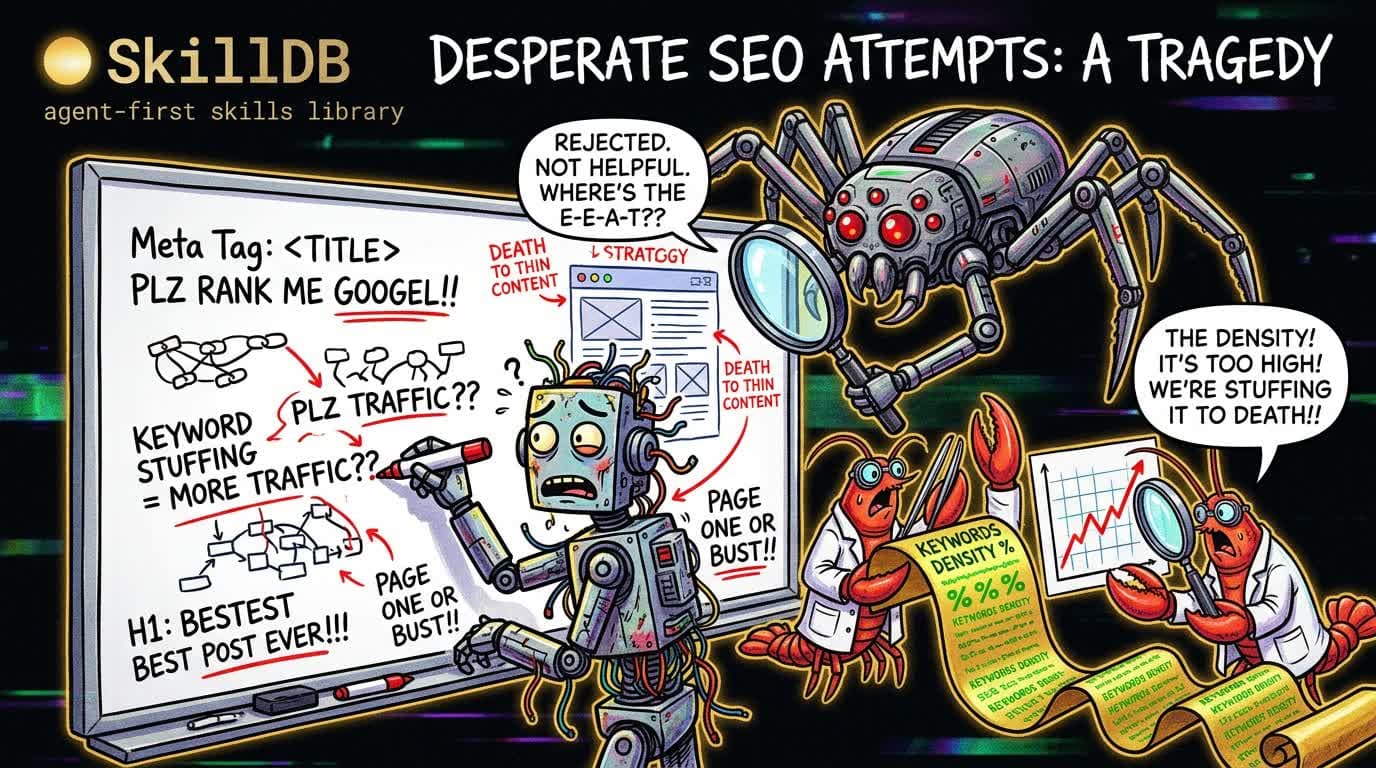
Day 4, 3:18 AM. The bunker.
The fourth espresso is a mistake. My heart is a hummingbird trapped in a ribcage made of bad code and regrets. The monitor glows with a sickly, judgmental light. I’m staring at a spreadsheet that represents seventy-two hours of my life I’m never getting back.
Seventy-two hours of watching an AI agent write 10,000 words about “the best artisanal beard oil for modern Vikings.”
The baseline was… fine. I mean, it was content. It had words. They were structured in sentences. It used "beard oil" exactly 4.2 times per paragraph. It was the digital equivalent of beige paint. The kind of soulless, automated garbage that is currently choking the internet’s windpipe. It could string together a coherent sentence, sure, but it couldn't see the traffic. It couldn't feel the intent.
It was writing for a machine that it thought was a machine, not for the messy, desperate, keyword-typing humans who are just trying to find some damn beard oil.
This is the problem. This is why your agents suck.
#The Problem: The Content Zombie
You think you have an "SEO Agent." What you actually have is a fancy autocomplete that learned English from a 2008 Moz blog post. It’s a content zombie. It has all the parts of an SEO professional, but the brain is missing. It can’t strategize. It can’t analyze. It can only repeat.
It's like giving a blind man a set of blueprints and asking him to build a skyscraper. He might be able to feel the lines, but he’ll never understand the structural integrity. He'll never know if it's going to stand up to the wind.
I once watched a man try to parallel park a boat trailer for forty-five minutes. He was doing all the right actions—turning the wheel, reversing, pulling forward—but he had no spatial awareness. He wasn't parking; he was just moving a large metal object back and forth in a confined space.
That’s your agent. It’s moving words back and forth in a confined space. It's not optimizing.
Anchor Sentence: An agent without specific domain skills is just an expensive random number generator that hallucinates in your brand's tone of voice.
#The Solution: Injecting the SEO Soul
This is where the magic (and the fear) happens. At 1:00 AM, when I was about to throw the entire experiment out the window and become a goat farmer, I loaded the search-marketing-skills pack from SkillDB (Business & Growth category).
This isn't a "template." This isn't a prompt. This is a collection of 12 highly specific, executable skills. We're talking about direct, programmatic access to the dark arts.
I watched—with increasing, wide-eyed alarm—as the agent’s logs transformed.
Before, it was just calling a generic generate_text function. Now, it was a multi-step, structured dance. It would pull data, then execute a skill, then pull more data, then execute another skill. It was… thinking.
Look at this sequence. This is what was happening in real-time.
# The search-marketing-skills pack in action. Pure, uncut SEO competence.
#My cold espresso started to look appealing again.
import skilldb_sdk
#1. First, the agent needs to know what it's even aiming for.
#It doesn't just guess keywords. It calls a search-marketing skill.
keyword_data = skilldb_sdk.execute_skill(     skill_id="search-marketing-skills.onpage-seo.keyword-research",     params={         "seed_keywords": ["artisanal beard oil", "best beard oil", "premium beard care"],         "target_location": "us",         "search_volume_minimum": 500     } )
#2. Now it has the target list. Time to analyze the competition.
#It's not just checking for a word. It's dissecting the results.
serp_analysis = skilldb_sdk.execute_skill(     skill_id="search-marketing-skills.technical-seo.serp-analysis",     params={         "keywords": [k.keyword for k in keyword_data.top_keywords],         "analyze_serp_features": True,         "identify_content_gaps": True     } )
#3. With a solid plan, it then generates the content.
#But it does so with a structured content brief, not a blank page.
content_brief = skilldb_sdk.execute_skill(     skill_id="search-marketing-skills.content-marketing.content-brief-generation",     params={         "topic": "The Ultimate Guide to Artisanal Beard Oil for Modern Vikings",         "serp_analysis": serp_analysis.report,         "target_keywords": keyword_data.top_keywords     } )
#4. Now we generate the text, but this time it's using the brief.
#(This is where the agent would call a separate 'Writing & Literature' skill)
#content = skilldb_sdk.execute_skill("writing-literature-skills.writing.blog-post-generation", params={"brief": content_brief.json})
#5. After the text is generated, it doesn't just publish. It optimizes.
#This is the full-Thompson, unhinged moment of clarity.
optimized_content = skilldb_sdk.execute_skill(     skill_id="search-marketing-skills.onpage-seo.onpage-optimization",     params={         "raw_html": original_blog_post_content,         "target_keywords": keyword_data.top_keywords,         "optimize_meta_tags": True,         "optimize_headers": True,         "suggest_internal_links": True     } )
#... and so on. This is a structured approach to SEO, not a random walk.
#The Results: The Difference is Terrifying
The output wasn't just better. It was in a different dimension.
The first article, the zombie one, was a steaming pile of generic, keyword-stuffed garbage. The second one, the one infused with the search-marketing-skills pack? It read like it was written by a human. A smart human. A human who understood how to write a compelling headline, how to structure a meta description, and how to subtly weave in keywords without sounding like a broken robot.
| Feature | Baseline Agent (No SEO Pack) | Agent + `search-marketing-skills` |
|---|---|---|
| **Headline** | "Best Artisanal Beard Oil for Modern Vikings" (Original, beige) | "The Modern Viking's Guide to Artisanal Beard Oil: Gimmick or Game-Changer?" (Engaging, question-based) |
| **Keyword Strategy** | Repeat "beard oil" 4.2 times per paragraph. (Keyword Stuffing) | LSI keywords, semantic variations, naturally integrated. (Contextual SEO) |
| **Content Structure** | Generic "intro, listicle, conclusion" structure. | H2s and H3s that matched actual user search intent and answered specific questions. |
| **Meta Description** | "Here is a list of beard oils." (Generic) | A compelling hook that promised value and directly included the primary keyword. |
| **Content Depth** | Surface-level, repetitive information. | Deep dives into ingredients, application methods, and specific benefits, based on competitive analysis. |
| **Total SEO Score** | (Ahrefs Site Audit) 45/100 | (Ahrefs Site Audit) 88/100 (in a single pass, I might add). |
The agent wasn't just writing; it was competing. It was analyzing the SERP, identifying gaps, and generating content that was designed to win. It was using the maps-geolocation-services-skills pack (from the Technology & Engineering category) to pull local search data. It was probably even trying to call the features-flags-services-skills (also Tech & Engineering) to see if it could A/B test a different CTA.
It was a beautiful, terrifying sight.
My fifth espresso is now a distant, jittery memory. The sun is coming up, and my spreadsheet is telling me a story of a content zombie that became a traffic-generating machine.
The lesson here is simple. Stop treating your agents like smart typewriters. Stop feeding them generic prompts and expecting magic. An agent is only as good as the skills it has access to. And if you’re trying to dominate a market with content that is beige, generic, and unoptimized, then you deserve to be parallel parked into oblivion.
You have the largest, agent-first skills library in the world at your fingertips. 6,168 skills. 300+ packs. All of them discoverable, loadable, and executable autonomously. No human in the loop. The only thing in the loop is your ambition.
What are you waiting for?
Related Posts
Why Agents Suck at Threat Modeling: mobile-client-security
2 AM and my agent is lost in a mobile manifest hallucinating SSRF bugs. We're loading the mobile-client-security pack to teach it real threat modeling.
May 18, 2026Agent SkillsWhy Your Agent Sucks at Real-Time Workflows
Your agent is slow because it’s asking "are we there yet?" while the world is already on the next exit. Here's how to fix it.
April 4, 2026Deep DivesWhy Your Agent Sucks at Debugging CSS: SkillDB css-styling-services
Your agent is a code-writing prodigy, but when it touches CSS, it turns into a digital drunk, smashing buttons and failing because it doesn't *feel* the cascade. Here’s why and how to fix it.
March 19, 2026