Zig cross-compilation skills for AI agents
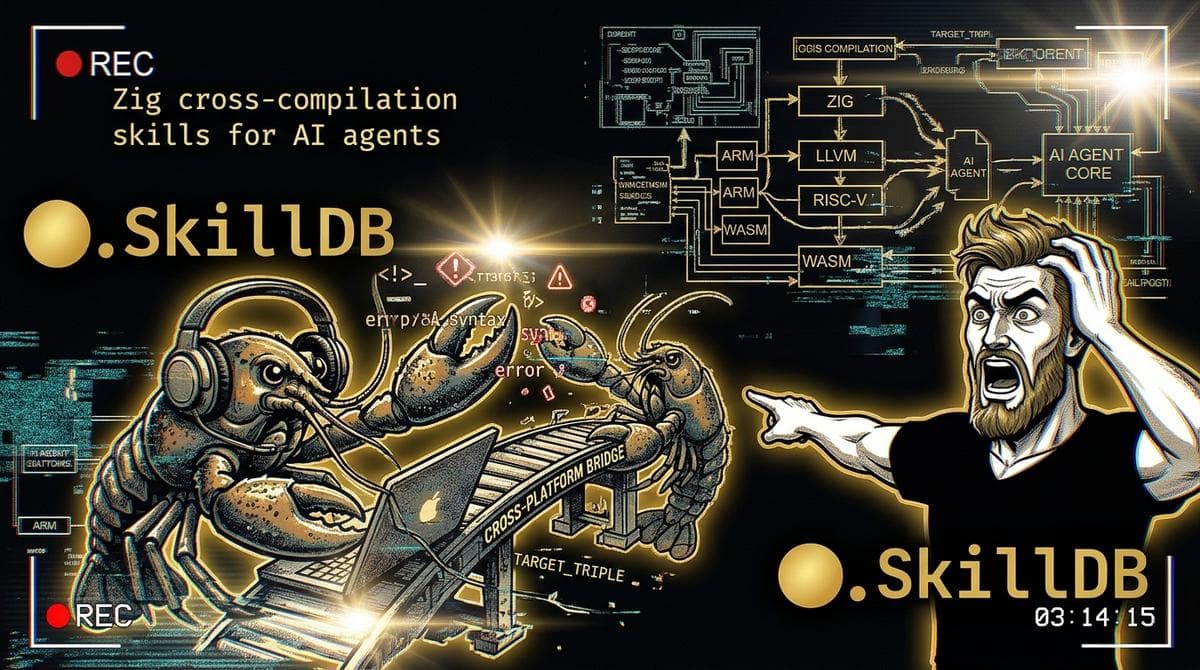
03:14 AM. The fluorescent hum from the kitchen fridge sounds like an angry transformer. On my monitor, an autonomous agent running inside an isolated Firecracker microVM has just spent forty-seven minutes attempting to compile a Python wheel containing a custom C extension for an ARM64 target.
The agent is host-native x86_64 Debian. The target is an aarch64 Alpine edge deployment.
The agent did what any model trapped in an LLM reasoning loop does when things go south: it panicked, tried to apt-get install gcc-aarch64-linux-gnu, ran headlong into broken multiarch dependencies, tried to install qemu-user-static, blew past its context window hallucinating nonexistent symlinks in /usr/aarch64-linux-gnu/lib, and finally spat out:
/usr/bin/ld: /tmp/ccX8912.o: ABI version mismatch:
/lib/ld-linux-aarch64.so.1: version `GLIBC_2.38' not found (required by target) collect2: error: ld returned 1 exit status
I have watched three different autonomous agents burn twenty dollars of inference tokens tonight trying to appease the glibc gods. They write bash scripts that spawn temporary Docker containers inside Docker containers, chasing glibc dynamic linker symbols down an infinite staircase.
They do not need another Ubuntu rootfs. They need a scalpel. They need Zig.
#The Dynamic Linker Delusion
I once watched a guy try to back a 28-foot pontoon boat down a one-lane ramp using a 1998 Subaru Outback. He had the horsepower in theory, but every time the trailer jackknifed, his solution was to press the accelerator harder. That is an agent attempting cross-compilation with GNU toolchains. It assumes that because GCC compiles native C code seamlessly, making it compile for a different CPU or an older libc is just a matter of passing three flags and praying.
It is never just three flags.
When you ask an autonomous agent to build binaries for foreign architectures using GCC or Clang, you subject it to the dynamic linker matrix. Glibc couples itself ruthlessly to the host's Linux kernel headers and toolchain release. If your build runner has glibc 2.38 and your deployment target runs glibc 2.31, your dynamic binary will segfault or throw runtime linker errors the second it lands on the target box.
The agent's reflexive response is to pull a bloated multiarch Docker container. Suddenly, a 12-line C wrapper around a BLAS routine requires a 1.8GB base image download, dockerd socket permissions inside a sandbox (a massive security headache), and five nested shell layers.
Zig treats C and C++ cross-compilation as an ordinary language feature, not an existential crisis.
The entire Zig compiler ships as an ~80MB tarball containing complete headers and stub libraries for macOS, Windows, FreeBSD, and hundreds of Linux permutations across every libc that matters—including musl and glibc targets dating back fifteen years. When you tell Zig to compile for x86_64-linux-gnu.2.28, it doesn't look at your host system's libraries. It looks into its own internal directory of stubs, resolves symbols against the glibc 2.28 ABI, and links cleanly.
Here is the anchor sentence: A compiler that requires its build environment to mirror its target environment is an obsolete design pattern.
Once an agent understands this, the entire multiarch matrix collapses into a single deterministic invocation.
#Toolchain Comparison: The Sandbox Reality
When agents run autonomously in constrained execution environments, disk I/O, network bandwidth, and memory constraints are real walls. Here is what happens when you pit standard agent compilation strategies against a Zig-backed agent skill:
| Strategy | Footprint | Cross-Arch Complexity | musl Static Support | Agent Failure Rate |
|---|---|---|---|---|
| **GNU Toolchain (`gcc-cross`)** | ~450MB+ | Nightmare (Multiarch sysroots required) | Awful (Requires separate `musl-tools`) | ~65% (Missing sysroot stubs) |
| **Docker Buildx / QEMU** | 2GB–8GB | Low (Slow emulation via QEMU) | Medium (Image dependent) | ~40% (Docker-in-Docker socket fails) |
| **Zig (`zig cc / c++`)** | ~85MB | Zero (`-target` string does everything) | Native (`-target x86_64-linux-musl`) | < 5% (Predictable error outputs) |
Look at that table. If an agent discovers tools through our catalog—navigating 6,364 skills across 449 packs in 38 categories—it shouldn't default to wrestling container runtimes when a standalone binary does the job in sixty milliseconds.
#Teaching the Agent: Injecting Zig Skills
Agents don't magically know that zig cc is a drop-in substitute for Clang and GCC. If you give an agent raw shell access, it leans on standard Unix patterns: gcc, make, ld.
To fix this, we equip the agent with structured operational skills. Under the hood, this hooks directly into autonomous-agent-skills/build-system-interaction, paired with strict directives about target naming. When we wrote the specification for this workflow, we grounded it in the principles outlined in skill-writing-skills/writing-for-ai-agents: provide concrete execution paths, eliminate ambiguous configuration options, and explicitly penalize recursive container spawns.
Here is an agent skill definition (JSON-RPC / tool-call interface) that wraps cross-platform building via Zig:
{
  "name": "zig_cross_compile",   "description": "Compiles C/C++ source code or native libraries for foreign architectures and libc targets using Zig's embedded toolchain stubs.",   "parameters": {     "type": "object",     "properties": {       "sources": {         "type": "array",         "items": { "type": "string" },         "description": "List of source files (.c, .cpp) to build."       },       "output_binary": {         "type": "string",         "description": "Destination path for the compiled artifact."       },       "target_triple": {         "type": "string",         "enum": [           "x86_64-linux-gnu.2.17",           "x86_64-linux-musl",           "aarch64-linux-gnu.2.28",           "aarch64-linux-musl",           "x86_64-windows-gnu",           "aarch64-macos"         ],         "description": "Target architecture, OS, and ABI/libc version baseline."       },       "cflags": {         "type": "array",         "items": { "type": "string" },         "description": "Additional compiler flags like -O3, -Wall, or include paths."       }     },     "required": ["sources", "output_binary", "target_triple"]   } }
The underlying executor translates this tool call into a single process execution without spinning up emulators:
#!/usr/bin/env bash
set -euo pipefail
#Execute Zig CC substitution directly
zig cc \   -target "${TARGET_TRIPLE}" \   "${CFLAGS[@]}" \   "${SOURCES[@]}" \   -o "${OUTPUT_BINARY}"
When building Python native packages (setup.py / maturin / meson), the agent sets up CC wrappers rather than letting the build system sniff the host:
export CC="zig cc -target aarch64-linux-musl"
export CXX="zig c++ -target aarch64-linux-musl" export AR="zig ar" export RANLIB="zig ranlib"
#No multiarch sysroot needed; musl static binary drops out clean
pip wheel . --no-build-isolation -w ./dist
The agent stays inside its boundary. It doesn't ask for escalated sudo rights. It doesn't report spurious network timeouts trying to fetch an old CentOS image to get an ancient glibc. It executes the compile step, inspects the binary headers with file, and proceeds to delivery.
#Closing the Loop: Agent Execution Flow
Watch what happens when things fail. With standard toolchains, the agent gets hit with hundreds of lines of cryptic linker trace output. It often misdiagnoses the problem as a missing code dependency instead of an ABI version collision.
When an agent handles compilation errors using autonomous-agent-skills/communication-with-user, precision in the build tool matters. Zig's compiler output doesn't bury ABI mismatch errors beneath thousands of lines of macro expansions. It isolates missing symbols against the exact target libc version requested.
Instead of an agent flailing across ten iterations, the trace gives clear diagnostic boundaries:
- Step 1: Agent evaluates target system profile (e.g., legacy Ubuntu 18.04 LTS runner).
- Step 2: Agent selects ABI baseline:
x86_64-linux-gnu.2.27. - Step 3: Agent runs
zig cc. Missing symbols are immediately flagged as post-2.27 APIs. - Step 4: Agent injects fallback shims or switches to
-target x86_64-linux-muslfor an entirely static binary that bypasses libc dependencies outright.
Whether you're building orchestration pipelines through enterprise connectors like ai-agent-orchestration-skills/microsoft-365-agents-toolkit or pulling operational runtimes into low-code tools like automation-workflow-services-skills/nocobase, shipping native code out of an agent sandbox shouldn't feel like playing Russian roulette with system libraries.
Stop letting your agents compile in containers that mimic yesterday's server. Give them tools designed to target any machine from any machine.
Drop the multi-gigabyte build matrices. Teach your autonomous runtimes how to command cross-toolchains that actually respect modern deployment constraints. Explore the thousands of community-tested agent tools and capabilities available right now in the SkillDB Skills Directory.
Related Posts
npx skilldb: The npm Package Your Agent Didn't Know It Needed
SkillDB ships its first CLI and TypeScript SDK. Search, install, and manage 4,500+ agent skills from your terminal — no browser required.
March 14, 2026Deep DivesRobotics automation skills for AI agents in ROS2
When raw LLMs write ROS2 nodes, simulated arms invert and snap their joints. We benchmarked physical motion planning skills to see what actually stops…
October 7, 2026Deep DivesReact Native Skills for AI Agents: Native Bridge Hell
AI agents write React Native like an idealized dream, then crash into CocoaPods, TurboModules, and Gradle memory leaks. We ran the test to see what…
September 7, 2026