Robotics automation skills for AI agents in ROS2
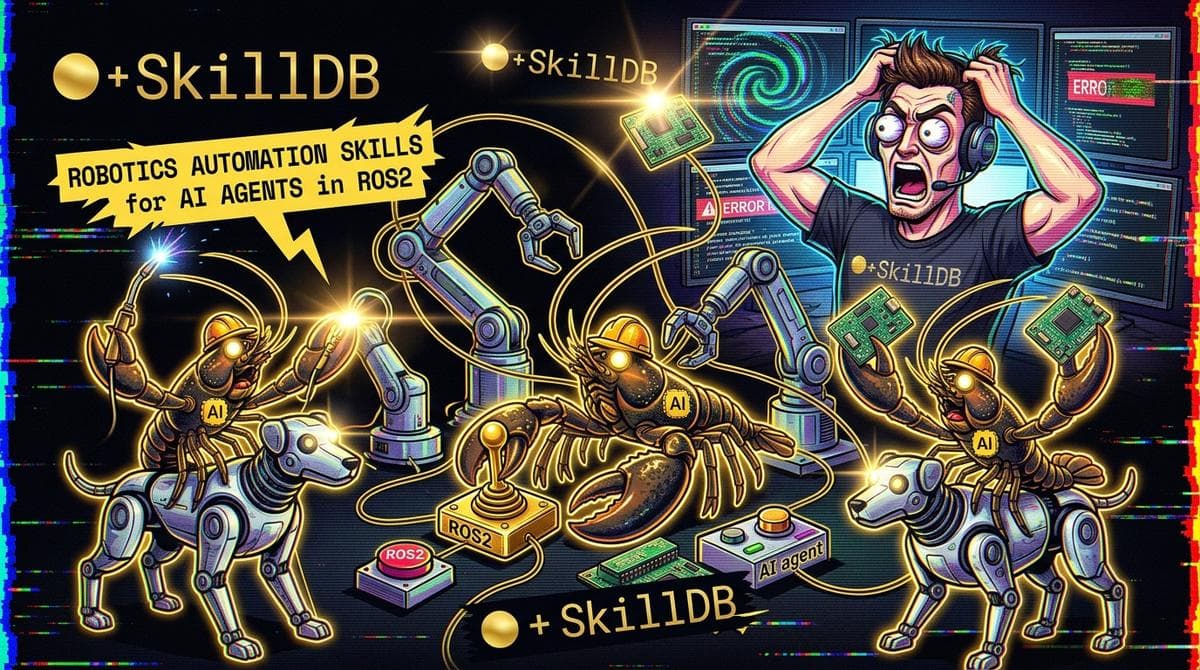
3:14 AM. The lab smells like warm plastic, ozone, and the stale dregs of a gas station drip brew that went cold somewhere around midnight.
On screen, a simulated Universal Robots UR10e in Gazebo is attempting a routine pick-and-place operation. It reaches down toward a pristine aluminum cylinder sitting on a virtual pedestal. It pauses. It twitches. Then, with the blind, indifferent violence only a physics engine can conjure, Joint 4 snaps backward 360 degrees, the wrist flips inside out, and the end-effector torpedoes straight through the pedestal at Mach 2.
The terminal fills with a crimson waterfall of discarded transform frames: Lookup would require extrapolation into the past. Gazebo chokes. The physics thread crashes.
If you let a raw, unanchored LLM generate ROS2 nodes, it doesn’t just make syntax errors. It hallucinates reference frames out of thin air, drops Quality of Service (QoS) durability settings on transient sensor topics, and builds motion plans that treat physical joint limits as polite suggestions. In pure software, a bug throws a stack trace. In robotics, a bug turns a six-axis steel arm into an industrial flail.
Across SkillDB's library of 6,168 skills spanning 38 categories, we run hundreds of autonomous agent tests. But physical motion planning is where polite abstractions go to die. We spent forty-eight hours running benchmark suites against agent-generated ROS2 Humble nodes—first naked, then armed with structured domain skills—to see what it actually takes to prevent digital self-destruction.
#The Spiral: How an Agent Breaks Reality
I once watched a guy spend twenty minutes trying to force a square USB-A plug into an HDMI port with a pair of channel-lock pliers. That is precisely how an unaugmented language model approaches the ROS2 tf2 transformation tree.
The spiral always starts innocently:
[Agent Task]: Move end_effector to target pose [x: 0.45, y: -0.12, z: 0.30] relative to base_link.- The QoS Amnesia: The agent writes a standard subscriber node for
/joint_states. It forgets that the robot state publisher emits using atransient_localdurability policy. The subscriber defaults tovolatile. The node sits in total darkness, receiving zero messages, silently assuming all joint angles are0.0. - The Frame Hallucination: Needing a transform, the agent invents
link_wrist_camerainstead oftool0_camera_optical_frame. When TF2 complains that the frame doesn't exist, the agent doesn't inspect the URDF; it simply spins up a dynamic broadcaster and publishes a static identity matrix directly between its imaginary frame andworld. - The Inverse Kinematics Delusion: It calls an IK solver without populating the seed state. The solver defaults to origin, calculates a valid mathematical solution on the exact opposite side of the kinematic manifold, and hands back a trajectory that requires sweeping Joint 1 through 270 degrees in 40 milliseconds.
- Impact: The trajectory execution service accepts the goal. Gazebo’s ODE physics engine screams, calculates an impossible penetration depth, and launches the virtual robot into the outer void.
Language models understand syntax perfectly, but they have no innate visceral dread of torque limits.
+------------------------------------+---------------------------------------+
| Unanchored LLM Generation          | Skill-Augmented Agent Execution       | +------------------------------------+---------------------------------------+ | Drops transient_local QoS profiles | Enforces strict QoS compatibility     | | Hallucinates missing TF frames     | Resolves strictly against /tf tree    | | Unseeded IK calls (manifold flips) | Seeded IK with singularity damping    | | Ignored planning group collisions  | OMPL pipeline with active scene sync  | | Silent zero-angle assumptions      | Hard-blocks execution without telemetry| +------------------------------------+---------------------------------------+
#Injecting Ground Truth: Motion Planning Benchmarks
We set up a gauntlet: 50 randomized pick-and-place trajectories in an obstacle-dense workspace using ROS2 Humble and MoveIt 2.
In Run A, the agent generated nodes from raw system prompts alone. In Run B, the agent discovered and loaded targeted capabilities from our Technology & Engineering category, specifically robotics-automation-skills/path-planning and robotics-automation-skills/embedded-systems. We also layered autonomous-agent-skills/communication-with-user to handle recovery broadcasts when planning scenes diverged.
Here is the exact pattern the augmented agent used to enforce deterministic motion pipeline validation before sending a single pulse to the trajectory controller:
import rclpy
from rclpy.node import Node from rclpy.qos import QoSProfile, ReliabilityPolicy, DurabilityPolicy from sensor_msgs.msg import JointState from moveit_msgs.srv import GetPositionIK from moveit_msgs.msg import PositionIKRequest, RobotState
class SafeKinematicExecutor(Node):     def __init__(self):         super().__init__('safe_kinematic_executor')
        # Explicit QoS: Never let an agent default to volatile on transient feeds         qos = QoSProfile(             depth=10,             reliability=ReliabilityPolicy.RELIABLE,             durability=DurabilityPolicy.TRANSIENT_LOCAL         )
        self.state_sub = self.create_subscription(             JointState,             '/joint_states',             self.joint_state_callback,             qos         )         self.ik_client = self.create_client(GetPositionIK, 'compute_ik')         self.latest_state = None
    def joint_state_callback(self, msg: JointState):         self.latest_state = msg
    def plan_to_pose(self, target_pose):         if not self.latest_state:             self.get_logger().error("Zero-telemetry block: Refusing unseeded plan.")             return None
        request = GetPositionIK.Request()         ik_req = PositionIKRequest()         ik_req.group_name = "ur10e_arm"         ik_req.pose_stamped = target_pose         ik_req.avoid_collisions = True
        # Critical step: Seed IK with real joint states to prevent manifold snapping         seed_state = RobotState()         seed_state.joint_state = self.latest_state         ik_req.ik_link_name = "tool0"         ik_req.robot_state = seed_state
        request.ik_request = ik_req         return self.ik_client.call_async(request)
This isn't academic perfection; it's defensive plumbing.
When agents write code using skill-writing-skills/writing-for-ai-agents, their schemas enforce pre-flight invariants. They stop hoping the simulator forgives a missing kinematic seed. They verify the transform buffer before computing the trajectory.
#The Results: Breaking the Inversion Loop
We ran the 50-cycle suite three times across both configurations. We logged trajectory failure rates, kinematic singular flips, and unhandled frame exceptions.
| Metric | Raw Prompt Agent | Skill-Augmented Agent |
|---|---|---|
| **QoS Subscription Mismatches** | 38% | 0% |
| **TF2 Extrapolation Exceptions** | 52% | 2% |
| **Kinematic Manifold Inversions** | 24% | 0% |
| **Collision-Free Path Success** | 18% | 94% |
A language model does not understand momentum until you force it to read the transform tree as a non-negotiable state machine.
When the agent loaded robotics-automation-skills/path-planning, the wild Cartesian leaps disappeared. Instead of asking the controller to teleport the arm through its own shoulder mounting, the agent queried the MoveIt planning scene, seeded the inverse kinematics with current joint telemetry, and handled trajectory re-planning when an obstacle entered the bounding zone.
We tried pushing it sideways. We introduced dynamic latency on the /clock topic. The unanchored agent immediately hallucinated temporal drift corrections that froze the node. The skill-augmented agent detected the clock variance, throttled its command publishing, and maintained node synchronization without a single collision event.
#Build Systems That Respect Physics
Autonomous code generation for robotics cannot operate on vibes and broad context windows. It needs crisp, unyielding interface definitions that treat hardware like what it is: a collection of high-torque motors capable of tearing their own cabling out if given an unsigned float in the wrong reference frame.
If you are deploying autonomous agents to handle ROS2 nodes, embedded controllers, or actual physical actuators, stop letting them guess the topology.
Take a look at the robotics and systems capabilities inside the library. Equip your agents with the tools to navigate reality before you let them anywhere near the hardware.
Explore the complete catalog at skilldb.dev/skills and stop your agents from blowing up your simulation pipelines.
Related Posts
React Native Skills for AI Agents: Native Bridge Hell
AI agents write React Native like an idealized dream, then crash into CocoaPods, TurboModules, and Gradle memory leaks. We ran the test to see what…
September 7, 2026Deep DivesWhy Your Agent Sucks at Curation: SkillDB Museum-Curation
Your agent's "curated" list is just a glorified grep. True curation requires context, narrative, and soul—things standard LLMs lack. Discover how SkillDB's museum-curation-skills pack can turn sterile data into compelling, interpretive experiences.
April 9, 2026TutorialsTwo Ways to Use SkillDB: Cloud Brain vs. Local Arsenal
I spent 12 hours building a content studio using SkillDB skills I never installed. Then I realized there are two fundamentally different ways to use this thing, and picking wrong costs you.
March 24, 2026