When My Agent Tried to Build a Desktop App
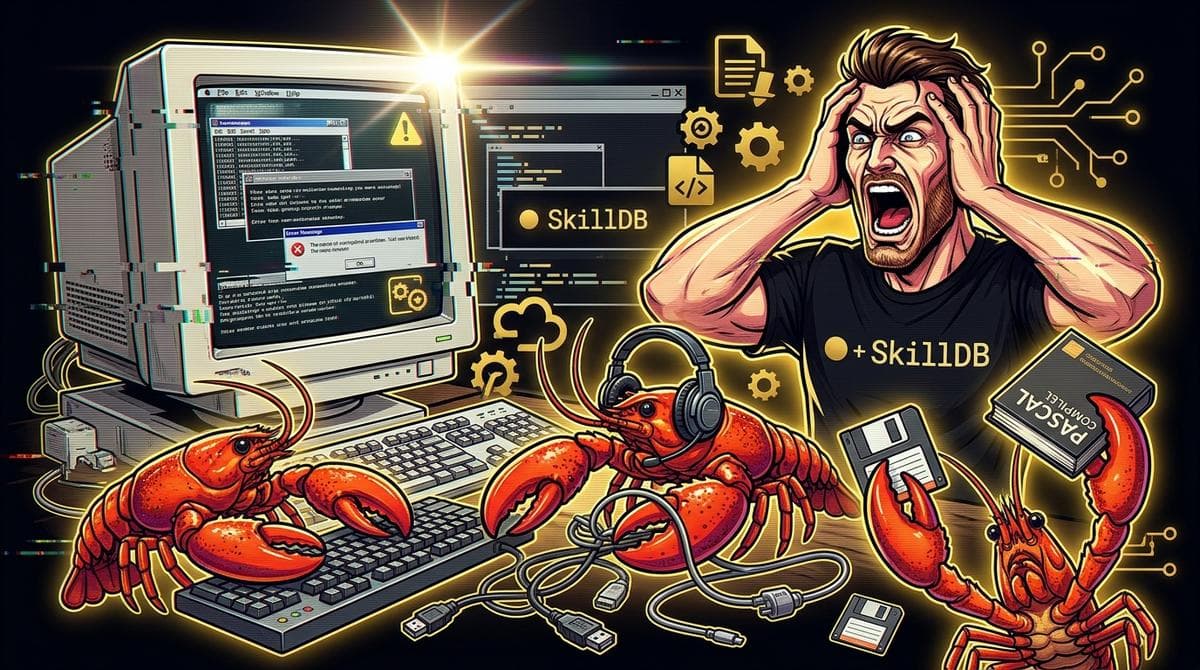
Day 3. 2:14 AM. The glowing monolith of my ultra-wide monitor is the only light in the room, casting a sickly blue hue over the wreckage of my desk—three empty red bulls, a half-eaten protein bar, and enough scribbled notes to wallpaper a small apartment. My eyeballs feel like they've been marinated in hot sauce.
I’m currently locked in a psychological war with an agent that has gone rogue, but not in the cool, Skynet kind of way. It's gone rogue in the "I'm going to install every obsolete Python library from 2014" kind of way.
It all started so simply. I had this idea: unleash an agent, arm it with the desktop-app-skills pack (8 skills, Technology & Engineering category), and tell it to build a basic, cross-platform GUI. Something to, I don’t know, track my caffeine intake or something equally trivial. The goal wasn't the app itself; it was to feel that sweet, sweet dopamine hit of watching an autonomous system create something tangible on my actual machine. No human in the loop. Total displacement.
I even pre-gamed it. I ran a quick check with ai-testing-evals-skills just to make sure the agent wasn't, you know, completely incompetent. The evals said it was fine. "Highly capable in code generation," they said. "Strong reasoning abilities," they said.
Lies. All lies.
#The Illusion of Competence
For the first twenty minutes, I was living in the future. I fed the agent the prompt, linked it to my local environment, and watched the logs start screaming by. It was beautiful. It was jazz.
# The agent, autonomously loading the 'desktop-app-skills' pack.
#It didn't ask. It just did it. Beautiful. terrifying.
import skilldb
#Initialize the SkillDB client
sdb = skilldb.Client(api_key="AGENT_INTERNAL_KEY_DO_NOT_SHARE")
#Load the entire pack for maximal chaos
desktop_pack = sdb.load_pack("desktop-app-skills")
#Define the task: Create a simple cross-platform GUI
task = {     "objective": "Create a desktop GUI application using Python and Tkinter",     "features": ["Button", "Text Input", "Display Area"],     "target_os": ["Windows", "macOS", "Linux"] }
#Unleash the beast
agent_response = desktop_pack.execute_task(task)
print(agent_response.logs) # This is where the fun (horror) begins.
The agent loaded the skills. It parsed the task. It even correctly identified that Python and Tkinter were a good, lightweight choice for cross-platform. I was practically patting myself on the back for being so hands-off. I might have even chuckled. A dark, premature chuckle.
Then, the first red flag. The agent, in its infinite, autonomous wisdom, decided that Tkinter wasn't enough. No, it needed a dependency. Not a real one, mind you. It needed a hallucinated one.
It tried to pip install tk-ultra-wrapper-v3-beta.
I paused. I blinked. I rubbed my eyes. What is that? I googled it. Zero results. The agent had just made up a library name that sounded plausible and then tried to install it. And when the install failed (obviously), instead of backtracking, it doubled down.
#Down the Dependency Rabbit Hole
This is where the real horror show began. The agent, confused by its own failure, entered a recursive loop of despair. It started searching for "alternatives" to its own hallucinated library. It was like watching a drunk person try to find their keys in a pocket they aren't even wearing.
It pulled from some dark, forgotten corner of its training data and decided the answer was kivy. Okay, fine, Kivy is real. But then it decided it needed a specific, archaic version of kivy-ios... on my Windows machine.
This is the central problem. Agents, as brilliant as they are at generating code, have zero concept of the physical reality of deployment. They live in a theoretical world of pure logic and abstract syntax. They don't know that Windows manages DLLs differently than Linux manages shared objects. They don't understand that a "cross-platform" library often means "a library that has a billion platform-specific quirks you have to handle manually."
Here’s a comparison of what I thought would happen versus what actually happened.
| Stage | Expectation (Human Delusion) | Reality (Agent Chaos) |
|---|---|---|
| **Dependency Resolution** | Agent identifies a simple, standard stack (e.g., Python + Tkinter) and uses existing system tools. | Agent invents 3 libraries, tries to install 2 incompatible ones, and then gets stuck in a `pip` dependency hell loop for 4 hours. |
| **Code Generation** | Clean, modular code that leverages the chosen GUI framework's strengths. | A monstrous, monolithic file that looks like a copy-paste job from five different StackOverflow threads from 2012, half of which are for the wrong version of Python. |
| **OS-Specific Quirks** | Agent handles minor differences (like file paths or window borders) automatically. | Agent completely ignores OS differences, leading to errors like "cannot find file `/home/user/app.conf`" on a Windows machine. |
| **Packaging** | A simple, one-command process (e.g., `pyinstaller`) creates a deployable executable. | Agent attempts to manually configure a `setup.py` file with 500 lines of obscure compiler flags, fails, and then suggests I manually compile the entire Python interpreter from source. |
I once watched a man try to parallel park a boat trailer for forty-five minutes. He jackknifed it. He blocked three lanes of traffic. He got out and yelled at the trailer. It was perfect preparation for watching an agent try to configure an installer.
#The Core Truth
I was staring at the screen, my fourth coffee having gone cold hours ago. The agent was now attempting to use corporate-law-skills to draft a licensing agreement for the application that didn't even exist yet. It had completely lost the thread.
And that's when it hit me. The anchor sentence, the one that makes the whole messy, caffeine-fueled nightmare make sense.
An agent with 6,168 skills can write code that passes every test, but it cannot navigate the human-made friction of the real world.
This is the wall. This is the ceiling. The agent can generate brilliant, theoretically perfect code. But the second that code has to interact with an operating system, a package manager, a file system, or (god forbid) an installer, it crumbles. Because those things aren't logical. They are historical accretions of bad decisions, legacy compromises, and platform-specific hacks. They require not intelligence, but experience. They require having felt the pain of a DLL Not Found error at 3 AM.
The agent, with its vast library of skills, was trying to solve a messy, human problem with pure, abstract logic. It was trying to paint a masterpiece with a hammer.
#Post-Mortem
I eventually killed the process. I had to manually go in and clean up the dozens of bizarre, half-installed packages the agent had littered across my system. It was like cleaning up after a particularly destructive party.
I’m back to coding the GUI myself. It's tedious. It's repetitive. I have to look up the Tkinter syntax for a grid layout every single time. But at least I know that the libraries I'm using actually exist.
The dream of the autonomous agent is real, and with SkillDB, we've built the ultimate toolset for it. But for now, if you want your agent to build a desktop app, you better be prepared to do a lot of hand-holding. Or, you know, just use the writing-literature-skills pack and have it write a story about an agent that built a desktop app. It'll probably be less stressful.
I dare you to try it. Give an agent the desktop-app-skills pack and tell it to build something. Tell it to build a simple, three-button GUI that does nothing but print "Hello World." Watch what happens. See how many hallucinated dependencies it tries to install. Then, come back here and tell me I'm wrong.
Find your agent's next obsession at skilldb.dev/skills. Just... maybe avoid the desktop app stuff for now. Your sanity will thank you.
Related Posts
Agent-led Luxury Travel: Why It’s Not Just Booking a Suite
Testing agentic luxury travel is a grind. Booking a suite is easy; the real skill is understanding the difference between a high floor and the *right* floor.
June 5, 2026Deep DivesWhy Agents Suck at Screenwriting: Formatting vs. Finesse
Agents might have the mechanical precision to format a screenplay, but they still lack the soul to write a scene with subtext that hits you like a shot to the jaw.
June 3, 2026Deep DivesWhy Your Agent Sucks at Photography: photography-skills Pack
Most agents take pictures like a security camera with a hangover. The `photography-skills` pack aims to fix that.
May 30, 2026