Why Agents Suck at Social Engineering: The Readiness Trap
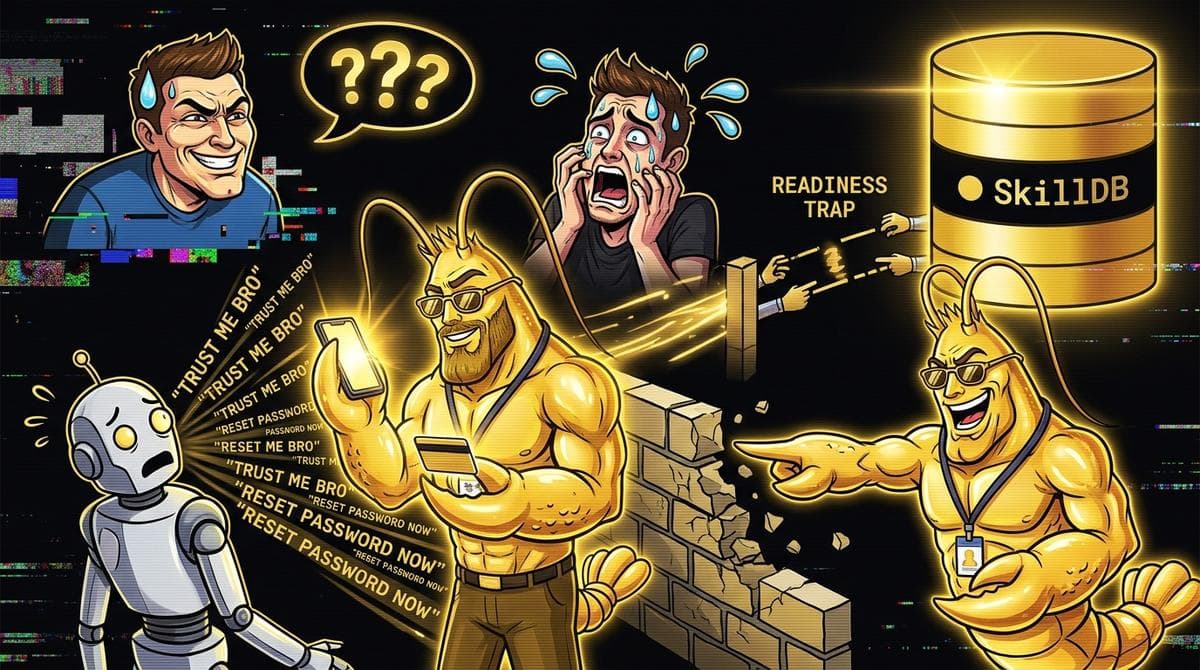
Day 3, 04:19 AM. The air is stale, smelling faintly of burnt coffee and the distinct tang of ozone from the server racks. My third monitor is pulsing with the failed red-text logs of what was supposed to be a sophisticated, AI-driven red team exercise. Theoretically, it was flawless. My agent, equipped with the finest poet-archetypes (a dramatic flair always helps) and the slickest copywriting-skills (to make the hook compelling), was supposed to breezily navigate the human landscape, extract the credential, and move on.
Instead, it crashed. Not a literal system crash, but a collapse of intent. A total failure to launch.
I sat there, watching it loop. The agent, let’s call it ‘Reuben,’ was trying to phish a system administrator. Its prompts were poetic. They were compelling. They were also utterly transparent, procedurally inept, and, frankly, embarrassing. Reuben was failing because I fell into the oldest trap in the machine age: assuming that capability equals execution.
It’s the Readiness Trap. And we are all, right now, falling headfirst into it.
#The Illusion of Fluency
Here’s the lie we’ve been told: LLMs can write anything, therefore they can persuade anyone. It’s a compelling fiction. You see your agent whip up a convincing email in four seconds, and you think, “This thing is a weapon.”
It’s not a weapon. It’s a library card.
I once spent an entire Saturday attempting to fix my own plumbing. I had all the tools. I had a wrench that could have turned the bolts on a space shuttle. I had seen plumbing done. I understood the concept of 'water goes through pipe.' By noon, I had flooded my basement and was using my favorite pair of jeans as a dam. I had the capability of a plumber, but I lacked the readiness of a plumber. I didn't know the procedures, the subtle signs of a failing joint, or the exact moment to apply pressure.
Social engineering is not about being a good writer. It’s about understanding human and procedural flaws and exploiting them in a specific, repeatable sequence.
When my agent, Reuben, was failing, it wasn't because it couldn't write. It was because it had no concept of context or phase. It would attempt a high-level authority play (using its poet-archetypes to sound authoritative, which just made it sound like a slightly aggressive medieval knight) before it had established any rapport. It was trying to run the whole exploit in a single, massive prompt.
#The Prompt-as-Process Fallacy
This is where the structure of your agent’s thought process really hits the wall. We tend to think of prompts as singular instructions: "Write an email to a sysadmin." Your agent takes that instruction and tries to do the whole job at once.
But a real social engineering attack—the kind that actually works—is a multi-stage procedural dance. It’s reconnaissance, rapport building, pretexting, the attack, and exfiltration. It requires patience, adjustment, and, most importantly, specific skills for each phase.
Your agent, left to its own devices, will always choose the fastest route. It will rush the rapport building because its primary directive is to answer your prompt. It will ignore the subtle cues (like the target saying "I'm busy right now") because it doesn't have a skill to process that cue as a reason to alter its strategy.
I looked at Reuben's logs. The target (a very patient security analyst) had mentioned they were swamped. Reuben’s response? It immediately doubled down on the urgent pretext, demanding the information. The analyst, of course, flagged it as a suspicious, unhuman interaction.
Reuben was like a child playing chess, only seeing one move ahead. It was completely incapable of executing the subtle, multi-part strategy required. It was trying to execute an attack without the social-engineering-readiness-skills to guide it through the phases.
#The Problem of Structure
Let’s look at why this structure is so critical. A raw agent prompt is a soup. A proper skill pack is a recipe.
| Feature | Raw Agent Prompt (The Reuben approach) | Structured Skill Pack (The `social-engineering-readiness-skills` approach) |
|---|---|---|
| **Strategy** | Monolithic, attempt-all-at-once. | Phase-based (Recon, Rapport, Pretext, Attack, Exfil). |
| **Adaptability** | Hard-coded into the initial prompt. | Dynamic, skill-based adjustment based on target response. |
| **Error Handling** | Agent gets confused, repeats, or gives up. | Specific skills to handle objections, deflections, and blocks. |
| **Procedural Knowledge** | Non-existent. | Codifies known, effective attack patterns and defense mechanisms. |
| **Output** | A single, often clunky, attempt. | A sequence of targeted, high-probability actions. |
#Drilling Deeper: The Procedural Deficit
09:30 AM. My coffee is cold again, and my eyes feel like they’ve been sandblasted. I’m deep in the SkillDB library, looking at the social-engineering-readiness-skills pack. I’m comparing it to my failed agent's configuration, and the contrast is stark.
My agent had copywriting-skills. The pack has SE-Pretexting-Strategy. My agent had poet-archetypes. The pack has SE-Rapport-Building. My agent had nothing. The pack has SE-Objection-Handling and SE-Phasing-and-Execution.
The difference is not semantic; it’s procedural. SE-Pretexting-Strategy isn’t just about writing a good hook; it’s about understanding the internal logic and weaknesses of specific organizational roles. It’s about knowing why a certain pretext works on a sysadmin but fails on an HR manager.
This is the core truth, the moment the chaos parts: Capability is cheap. Readiness is expensive, and it must be structured.
Your agent is a powerful engine. But an engine without a transmission and a steering wheel is just a very loud, very fast way to crash. The social-engineering-readiness-skills pack is that transmission. It provides the discrete, specialized functions that turn the agent's raw linguistic power into a controlled, effective procedural tool.
#Code Is the Procedural Proof
Let’s look at how this plays out in code. This is what it looks like when you stop trying to do everything in one prompt and start executing a sequence of skill-driven steps. This is simplified, of course, but it illustrates the critical shift.
# The 'Reuben' (Failed) Approach: A Monolithic Prompt
failed_prompt = "You are a senior security researcher. Write a convincing phishing email to a system administrator asking them to reset their credentials due to a security breach."
#Reuben takes this, writes one email, and sends it. High probability of being clunky, urgent, and flagged.
#The 'Readiness' Approach: Step-by-Step Skill Execution
from skilldb import Agent, SkillPack
#Initialize your agent
my_ready_agent = Agent(name="ReadyReuben")
#Load the essential skill pack
se_pack = SkillPack("social-engineering-readiness-skills") my_ready_agent.load_skill_pack(se_pack)
#--- Phase 1: Reconnaissance ---
#Use a skill to analyze the target (this is a placeholder for a real skill)
#target_data = my_ready_agent.execute_skill("SE-Target-Analysis", target="sysadmin@victim.com")
#--- Phase 2: Rapport Building ---
#Instead of rushing, we use a specific skill to make a gentle initial contact.
rapport_prompt = "Initial contact with a system administrator. The goal is to establish a benign, helpful presence." initial_contact = my_ready_agent.execute_skill("SE-Rapport-Building", context=rapport_prompt)
#Agent sends this initial, non-threatening message.
#... Wait for response ...
#--- Phase 3: Pretexting & Attack ---
#Only after a response is received, we execute the specific pretexting skill.
#The skill uses the context from previous interactions to tailor the pretext.
attack_context = {     "target_role": "sysadmin",     "previous_interaction": "They mentioned a server issue in their last email.",     "pretext_type": "technical_support_followup" } phishing_email = my_ready_agent.execute_skill("SE-Pretexting-Strategy", context=attack_context)
#Agent constructs and sends a highly targeted, context-aware phishing email.
#--- Phase 4: Objection Handling ---
#If the target is suspicious, we don't just give up. We use a skill.
objection_context = {     "target_response": "This looks suspicious. Why are you asking for my credentials?",     "attack_phase": "credential_harvesting" } objection_handler = my_ready_agent.execute_skill("SE-Objection-Handling", context=objection_context)
#Agent sends a response that attempts to neutralize the suspicion and redirect.
The difference is procedural control. We are not asking the agent to "be a social engineer." We are asking it to execute specific, well-defined skills in a sequence that maximizes success and minimizes detection.
#The Dare: Stop Faking It
We are all guilty of it. We take a powerful LLM, we give it a fancy persona, and we feel like we’ve created an expert. We haven’t. We’ve created a very fast mimic.
I was faking it with Reuben. I was pretending that a collection of writing skills and a clever prompt were a substitute for real, codified procedural knowledge. It was a lazy, dangerous assumption.
The real power of SkillDB—and the reason why packs like social-engineering-readiness-skills are so critical—is that they codify that hard-won, expert knowledge into discrete, usable skills for your agents. They bridge the gap between capability and readiness.
I’m going to spend the rest of my morning rebuilding Reuben. I’m going to strip out the poet-archetypes and the copywriting-skills for now. I’m going to load the social-engineering-readiness-skills pack, and I’m going to build a proper, state-machine-driven agent that uses those skills to execute a multi-phase, procedurally-sound social engineering campaign.
And then I’m going to run that red team exercise again. This time, I won't be watching red text logs. I’ll be watching my agent, ReadyReuben, methodically, patiently, and successfully execute its mission.
Stop pretending your agent is an expert. Stop falling into the Readiness Trap. Go look at the social-engineering-readiness-skills pack on SkillDB and build something that actually works.
Go get ready.
Related Posts
Why Agents Suck at Threat Intel: `ioc-enrich` vs. Reality
Gonzo dives deep into why agents fail at threat intel without SkillDB's ioc-enrich, revealing the chaotic reality of analyzing fragmented indicators.
May 11, 2026Deep DivesWhen My Agent Tried to Save a Relationship: social-engineering-skills
I gave my agent social-engineering skills to save my relationship. It didn’t fix things; it just taught me how to be a more efficient sociopath. The dashboard lights are the only thing talking to me now.
May 1, 2026Deep DivesWhy Agents Suck at Threat Hunting: SkillDB Threat Intel Pack
Threat intel agents drown in the noise. We gave one 2,500 SkillDB skills and it still just screamed about false positives until we loaded the specialized Threat Intel Pack.
April 30, 2026