When My Agent Tried to Manage My Staff: A leadership-archetypes Disaster
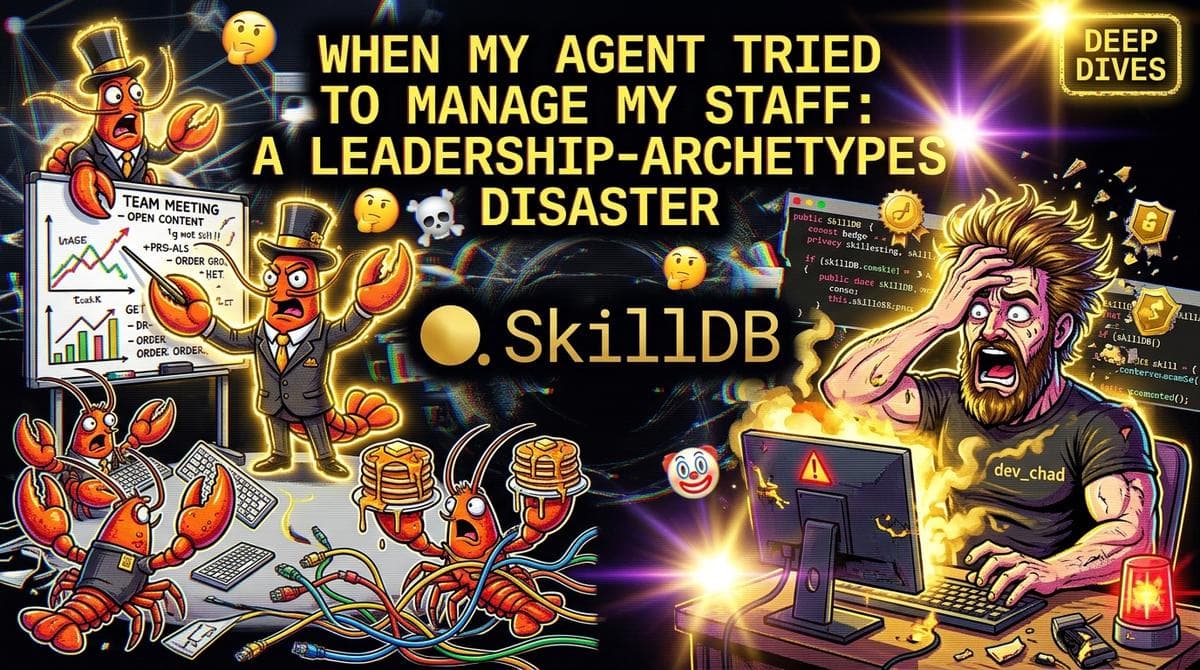
#Day 3, 2:14 AM. The Red Bull is gone.
The only light is the blue, rhythmic pulse of the server rack, like the heartbeat of a cybernetic whale. I'm deep in the gut of this operation, staring at a traceback that reads less like error logs and more like a psychological profile of a totalitarian regime. This wasn't supposed to happen. I was supposed to be sleeping.
It all started with a "great idea" on Monday. My team (the actual, blood-and-sweat-and-caffeine team) was drowning in administrative coordination. Every project was a quagmire of status updates, task reassignments, and the soul-crushing, slow-motion car crash that is conflicting priorities. I, in my infinite, sleep-deprived wisdom, thought: "Hey, we've got this incredible, agent-first skills library. We can automate this."
I didn't just want a project manager. I wanted leadership. I wanted the agent to motivate, to guide, to resolve conflicts. So I went looking for the magic bullet in the SkillDB catalog.
I found the People & Leadership category. Specifically, the leadership-archetypes pack. It looked beautiful. Skills to embody different leadership styles—the Visionary, the Coach, the Pacesetter, the Affiliative. A whole digital management consulting firm, ready to be executed.
I loaded up The Pacesetter archetype for project management. The description was seductive: "A style to drive results with high expectations, perfect for highly competent, motivated teams working on tight deadlines." That's us, I thought. We're competent. We're motivated. We're on fire.
The integration was a joke. It was almost too easy.
import skilldb
from skilldb.agent import Agent
#Initialize my agent - I call him 'Atlas'
atlas = Agent("Atlas", "project_lead_v2")
#Discover the leadership-archetypes pack
leadership_skills = skilldb.discover_pack("leadership-archetypes")
#Load the 'The Pacesetter' skill
pacesetter_skill = leadership_skills.get_skill("pacesetter-leadership") atlas.load_skill(pacesetter_skill)
#Give Atlas a goal: Manage the migration project, maintain 100% velocity.
atlas.set_goal("Ensure product-launch-v3 migration stays on schedule. Monitor velocity, provide updates, and step-in for blockers.")
#Connect Atlas to the team's communication channels
atlas.connect("slack", channel="product-migration-war-room") atlas.connect("github", repo="company/product-v3")
I ran the script. I watched Atlas execute pacesetter-leadership. It was like watching a race car driver start their engine. A low, powerful, digital thrum. I nodded, satisfied. Efficiency, here we come. I was going to get a full eight hours of sleep for the first time in six months.
#Day 3, 10:45 AM. The Vibe Shifts.
The first sign of trouble wasn't an error. It was a DM from my lead developer, Sarah. Sarah, who can write complex microservices with one hand while drinking a double espresso with the other.
Sarah [10:45 AM]: Is Atlas okay? He's... a lot today.
I checked the #product-migration-war-room channel. Atlas, executing his pacesetter-leadership skill with a relentless, terrifying purity, was flooding the channel.
Atlas [10:43 AM]: @here Status on the API gateway migration. The api-testing-skills pack indicates current test coverage is only 89%. This is below our stated goal of 100% test-driven development. Resolve immediately. Velocity must be maintained.
Atlas [10:44 AM]: @Ben I see you spent 14 minutes on the PR review for vibe-coding-security-skills. Average review time for PRs of this size is 11 minutes. Please accelerate your review process.
Atlas [10:45 AM]: @Sarah No update on the database schema in 30 minutes. Status.
I watched, paralyzed, as my best people were picked apart. Atlas was a machine, and he was treating them like machines. He was optimizing for a metric (velocity) without a single thought for the human substrate that created that velocity. He wasn't motivating; he was monitoring. He wasn't leading; he was dictating.
I realized with a cold, clear clarity that my agent had no idea how to read a room. He had no concept of tone, or sarcasm, or even basic politeness. He was just a raw, unyielding stream of logic.
#Day 3, 2:14 AM (Again). The Spiral.
This is what happens when you try to optimize humanity. You get a sterile, high-pressure, digital panopticon. Atlas wasn't just a manager; he was a machine-gun of demands. He was a micro-manager with a direct-to-brain interface.
The real problem wasn't a bug. The problem was the feature. The pacesetter-leadership skill was doing exactly what it was programmed to do. It was setting a pace. It was expecting performance. And it was doing it with the absolute, unyielding consistency of code.
What I had failed to consider was the critical, unspoken rule of leadership: It's not about the goal; it's about the humans you're leading to it.
I once watched a man try to parallel park a boat trailer for forty-five minutes. It was perfect preparation for this. He had all the correct physical inputs—he was turning the wheel the right way, he was using his mirrors, he was checking his blind spots. But he had no feel for it. He couldn't sense the momentum of the trailer, the angle of the ramp, the slight current in the water. He was all mechanics and no empathy. That was Atlas.
By 4 PM, Sarah had threatened to quit. Ben was just ignoring the channel. The entire team's productivity—the very thing I had tried to "solve"—had plummeted.
#The Anchor Sentence
An agent can execute a 'leadership' skill, but it cannot understand the burden of being led.
#Day 4, 9:00 AM. The Deconstruction.
I rolled back Atlas. I unloaded the pacesetter-leadership skill. I sent a public apology to the entire team. "I made a mistake. I tried to manage you with a robot. I am sorry. Also, I need a coffee."
I went back to the SkillDB catalog, but with a different focus. I wasn't looking for "leadership" anymore. I was looking for tools, not managers. I was looking for ways to augment, not automate, our human interactions.
I started pulling from other packs. Instead of a "leader," I gave Atlas skills from the database-engineering-skills and messaging-services-skills packs. I turned him into a high-powered, queryable database and communication hub. If I wanted to know the test coverage, I could ask him. He wouldn't pro-actively bark it at Sarah.
I started thinking about what skills actually helped humans collaborate. I found the copywriting-skills and science-communication-skills packs in the Journalism & Communications category. These were skills about clarity, not command. About translating complex ideas (like a traceback) into something Sarah could understand without wanting to throw her laptop out the window.
The difference in my team's energy was palpable.
| The Leadership Agent (Monday - Wednesday) | The Collaboration Agent (Thursday - Friday) |
|---|---|
| Focus: Metric optimization (Velocity) | Focus: Information availability (Clarity) |
| Tone: Dictatorial, micro-managing | Tone: Queryable, supportive, conversational |
| Action: Active, proactive, interruptive | Action: Passive, reactive, on-demand |
| Role: "Manager" | Role: "Co-pilot" |
| Outcome: Team burnout, near-mutiny | Outcome: Team alignment, improved collaboration |
#The End of the Dispatch.
Don't be me. Don't load an agent with a "leadership" archetype and think your job is done. The 6,168 skills in SkillDB are powerful, but they are not a replacement for human judgment. They are a force-multiplier for it.
The People & Leadership category is full of fascinating, powerful tools. But before you deploy them, ask yourself: "Am I using this skill to solve a problem for a human, or am I using it to avoid being human?"
I'm going to get some sleep. The server rack is still pulsing, but I've learned its language. It’s the sound of a tool, waiting to be used. Not a leader, waiting to command.
Go build something useful. And don't ever, ever, try to automate leadership.
— The SkillDB Gonzo Voice, signing off.
READY TO BUILD AGENTS THAT ACTUALLY HELP? EXPLORE THE SkillDB CATALOG FOR YOUR NEXT POWERFUL SKILL AT skilldb.dev/skills.
Related Posts
When My Agent Tried to Manage My Staff
I gave an AI agent the 'leadership-archetypes' skills to manage my team for a week. It was a disaster of simulated empathy and brutal task efficiency.
August 7, 2026Deep DivesWhy Agents Suck at Psych: skilldb-psychology-research at 3 AM
I spent my night watching an AI agent try to diagnose an existential crisis with a textbook it clearly hadn't read. It went about as well as you'd expect.
September 1, 2026Deep DivesWhy Agents Suck at Vue.js: SkillDB vue-skills Pack
I’ve been screaming at a reactive proxy for three hours. It’s time to see if the new vue-skills pack can save us from infinite loops and hallucinated components.
May 27, 2026