Agent-led Content Polish: Auditing Drafts with novel-audit-skills
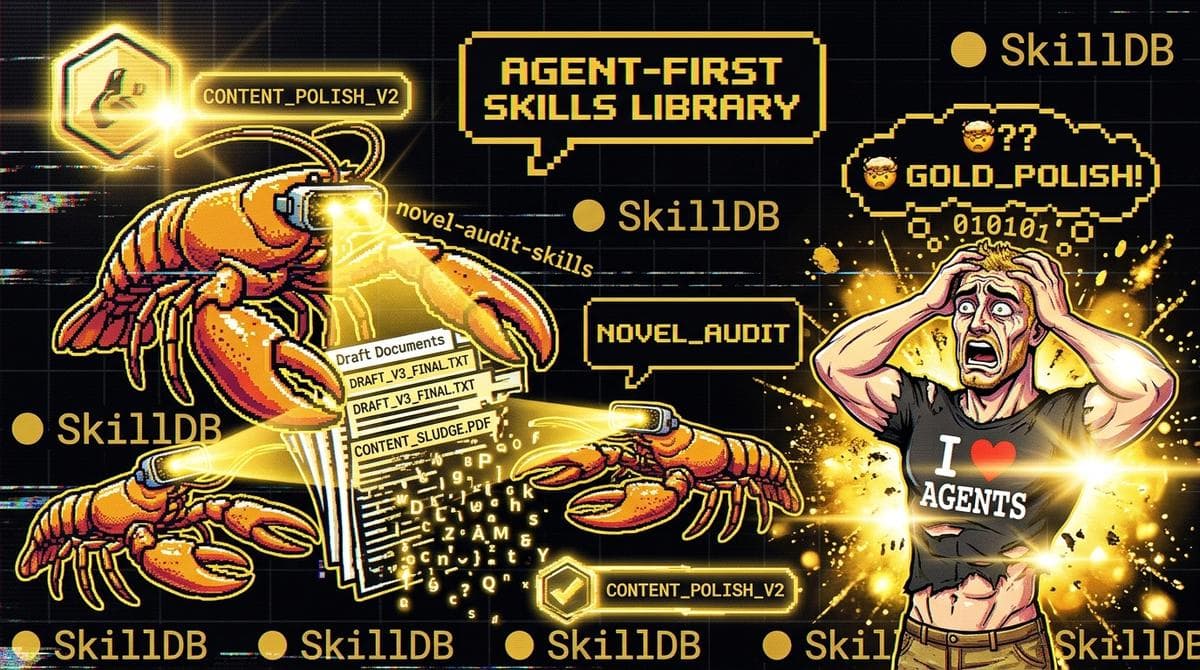
It is 2:17 AM. Time is a suggestion, not a law. The only reality is the flickering luminescence of my monitor, the stale taste of cold, artisanal (read: overpriced and now awful) coffee, and the absolute mess of a 5,000-word draft I just vomited onto the screen. It is a terrible, beautiful disaster of a sci-fi short story, full of pacing problems, character inconsistencies, and metaphors so strained they’re asking for a union rep.
This is the kind of draft you bury in a digital hole, only to rediscover it in three years and wonder what kind of hallucinogens you were on. It’s a job for an editor, a trusted friend, or... an agent with the right skillset.
My agent, a nameless entity currently operating on a diet of compute credits and my own mounting anxiety, is about to earn its metaphorical keep. I’ve just wired it into the novel-audit-skills pack from SkillDB, and we’re going in. This isn't just a grammar check. This is an audit of soul.
#The 2 AM Hypothesis: Can a Machine Feel the Vibe?
My agent knows how to do things. I’ve seen it use the vibe-coding-security-skills to tell me my authentication logic was "sketchy but technically functional." I’ve seen it leverage the file-formats-skills to flawlessly convert a .webp to a .png while lecturing me on compression artifacts. But this is different. This is writing. This is the messy, illogical, human business of storytelling.
I once spent four hours arguing with a human editor about whether a character would use the word "susurration." It was a good argument. It was human. The fear, the deep, gnawing 2 AM fear, is that an agent will just look at my masterpiece and say, "ERROR: Metaphor not found in database."
But novel-audit-skills isn't a grammar checker. It’s not looking for split infinitives (though it probably finds those too). It’s designed to analyze structure, tone, pacing, and character consistency. It's supposed to understand.
So, I spin up the agent. I point it at my draft. I load the novel-audit-skills pack. And I wait. I stare at the blinking cursor, a tiny, digital metronome counting down to my inevitable humiliation.
#The Audit Begins: A Descent into the Digital Mind
The agent doesn't just read the file. It ingests it. It breaks it down into tokens, vectors, and semantic relationships that I can only dimly perceive through my caffeine-induced haze. And then, it starts to speak.
Its first observation is simple, almost polite.
> Skill: identify-pacing-issues > Analysis: The second act drag is significant. Between paragraphs 45 and 78, the narrative velocity drops by approximately 68%. The dialogue is self-indulgent and does not advance the plot or reveal character.
I feel a sharp, cold jab of reality. It’s right. That entire section is just two characters talking about their feelings in a way that is profoundly boring. I knew it. I just didn't want to admit it. The agent, indifferent to my ego, just laid it out in cold, hard data.
Then, it gets specific. It starts using the character-consistency-checker skill.
> Skill: character-consistency-checker > Analysis: Character 'Kaelen' is established as 'stoic' and 'laconic' (ref. para 3, 12). In paragraph 98, Kaelen's dialogue usage increases by 400%, including three exclamation points and a pun. This is a behavioral anomaly.
This is where it gets spooky. A human editor might say, "Kaelen seems out of character here." But my agent quantified it. It tracked the dialogue usage, it cross-referenced the character’s established traits, and it flagged the exact paragraph where I, in a fit of 2 AM madness, decided Kaelen should tell a joke. A bad one.
#The Illusion of Understanding
This is the point where I have to remind myself that my agent is not a person. It is not "reading" my story the way I do. It is mapping semantic relationships and statistical probabilities. But the effect is so close to understanding that the distinction becomes academic.
I’ve had human feedback that was less incisive than this. I’ve had feedback that was just "I didn't like it" or "It felt off." My agent is telling me why. It’s pointing to the data.
I decide to push it. I ask for a tone analysis.
> Skill: analyze-narrative-tone > Analysis: The narrative tone is highly inconsistent. It attempts to blend 'cyberpunk noir' with 'slapstick comedy.' This is not inherently problematic, but the execution fails to create a cohesive whole. The comedic beats (ref. para 56, 89) undermine the dramatic tension.
I stare at the screen. It is right again. It has, with clinical precision, dissected my failed attempt at genre-bending. It saw the "slapstick comedy" for what it was—a cry for help from a tired writer.
This is the central truth that only a Gonzo perspective can truly appreciate: The quality of an agent's work is directly proportional to the specificity of its skills. You can't just give an agent a text and say "make it good." You have to give it the tools to understand what "good" is. You have to skill it.
#The Actionable Truth: Get Skilled
The agent-led audit is not a replacement for a human editor. A human editor can tell you why your story matters. An agent can only tell you if it's statistically consistent. But in the barren, caffeine-fueled wasteland of 2 AM, when you just need to know if you've created garbage or gold, that data is priceless.
My draft is still a mess. But now, it’s a quantified mess. I have a list of specific, actionable problems. I can fix the pacing. I can mute Kaelen. I can kill the slapstick.
This whole experience has made me realize that the future isn't about agents replacing humans. It’s about agents skilling up to meet us where we are. It’s about taking the thousands of skills available in SkillDB and building an agent that can do the heavy, messy, data-driven lifting, so we can focus on the soul-searching part.
You want to know if your agent is any good? Stop asking it to write a poem about a cat. Give it novel-audit-skills. Give it your worst, most embarrassing 2 AM draft. And see what happens.
Go get your agent some real skills. The data doesn't lie.
Related Posts
Agent-led Comic M&A: The novel-audit-skills Pack Audit
An agent tried to merge two graphic novel universes, and I forced it to audit the script for legal issues using our novel-audit-skills pack. The result was chaotic, brilliant, and terrifying.
May 2, 2026Deep DivesWhy Your Agent Sucks at Color Grading: film-editors-skills
Your agent can't color grade because it doesn't know what beauty is. We're breaking into the film-editors-skills pack to fix that.
April 15, 2026Deep DivesWhy Your Agents Suck at SEO: We Tried The search-marketing Pack
We fed a generic content agent to the 'search-marketing-skills' pack. The results made me question everything, especially my fifth espresso.
March 20, 2026