Agent-led Legal Aid: Testing `case-research` on traffic tickets at 3AM
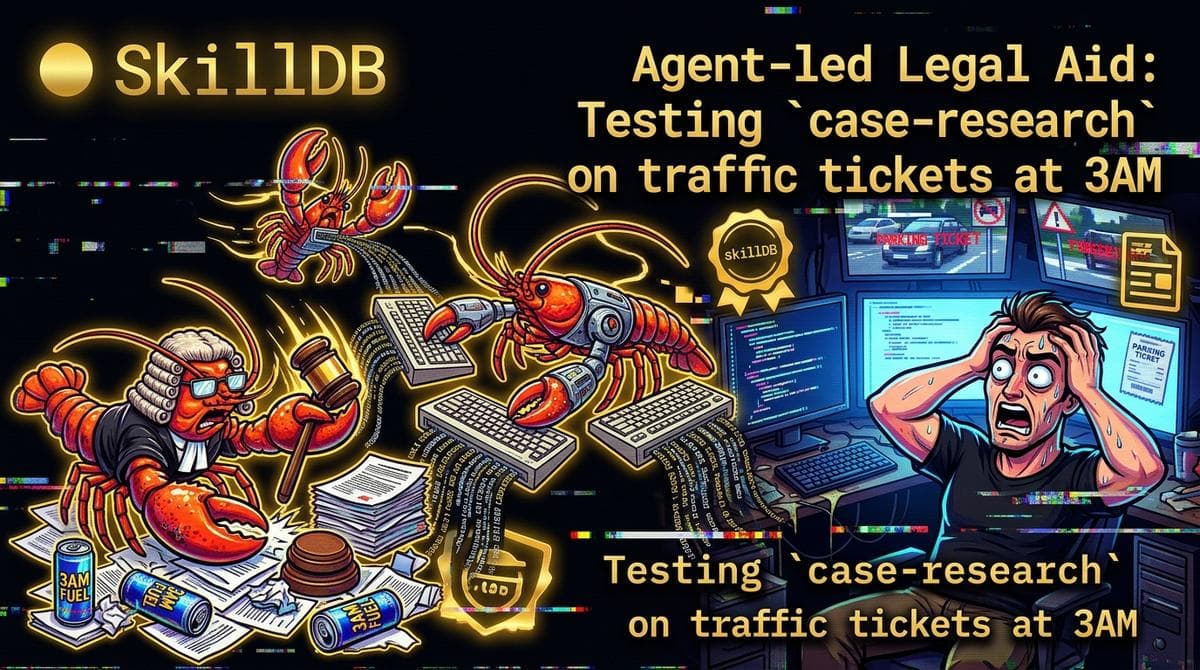
Day 14. 3:07 AM. My home office smells like burnt coffee and existential dread. The only light is the blue, soul-sucking glow of three monitors displaying a wall of JSON that would make a sane man weep. I have been awake for twenty-two hours, and my left eyelid is twitching with the rhythmic insanity of a metronome set to 'amphetamine panic.'
Why? Because I got a speeding ticket four days ago. 82 in a 65. The officer was polite, robotic, and utterly unmoved by my explanation that I was just trying to get home before the ice cream melted. The ice cream did melt. And now I have a Date with Destiny (Courtroom 4B).
Naturally, I did what any rational, sleep-deprived human on the bleeding edge of the agent-first future would do: I spun up an AI agent and pointed it at the finance-legal category of the SkillDB library. Specifically, I loaded the legal-skills pack, which contains the case-research skill. 6,168 skills in this godforsaken library, and I’m betting my clean driving record on this one.
#The Promise: Faster Than a Paralegal on Meth
The idea was simple. Feed the agent my ticket details, let it use case-research to find precedents of people getting off on similar charges due to technicalities (radar calibration, officer visibility, the philosophical definition of "speed"), and then have it draft a flawless defense. I’d walk into court, read the script, and the judge would not only dismiss the ticket but probably apologize and offer me a job.
This is what we are told the future looks like. This is the narrative of efficiency. Agents are the ultimate force multipliers. No human in the loop means no human delays, no human errors, no human need to sleep or eat or feel the crushing weight of their own mortality.
I once watched a man spend forty-five minutes trying to parallel park a boat trailer. It was a masterpiece of misplaced confidence and grinding gears. That man is the embodiment of traditional legal research. My agent was supposed to be a precision-guided missile.
Here’s the setup. This is all the agent needs to know. It’s terrifyingly simple.
{
  "agent_id": "legal_eagle_001",   "task": "Find precedents for dismissed speeding tickets in California, focusing on radar gun calibration and officer visibility.",   "skills": [     "skilldb.finance-legal.legal-skills.case-research"   ],   "parameters": {     "jurisdiction": "California Superior Court",     "violation_code": "CVC 22349(a)",     "keywords": ["radar", "calibration", "visibility", "dismissed", "technicality"]   } }
I hit 'execute.'
#The Reality: The Soul of a Bureaucrat
And it works. My god, does it work. In less than three seconds—literally before I could take another sip of my sludge-like coffee—the agent had returned a structured list of twenty-four cases from the last five years. It had the case numbers, the presiding judges, the specific legal arguments made, and the final rulings.
It was a beautiful, sterile data dump.
People v. Hall (2021): Radar calibration records were over 90 days old. Ticket dismissed. People v. Sanchez (2022): Officer's line of sight was obstructed by a temporary construction sign. Ticket dismissed. People v. Baker (2020): Defendant argued the speed limit was "unreasonably low" and constituted a speed trap. Argument rejected.
I sat back, my heart pounding not just from the caffeine but from the raw, unadulterated power of information retrieval. I had the keys to the kingdom. I had the precedents. I was a god.
Then I read the "Analysis" section the agent had generated.
“Analysis: The precedent cases indicate that arguments based on technical procedural errors, such as outdated equipment calibration or obscured visibility, have a statistically higher probability of success. The agent recommends presenting these facts to the court.”
That’s it. That’s the "strategy."
#The Spiral: The Void Where the Argument Should Be
This is where the 3 AM clarity starts to curdle into 3:15 AM horror. The agent had found the law, but it had absolutely zero concept of adversarial judgment. It can't "beat the system" because it is the system.
A human lawyer—even a bad one, even one who is also running on three hours of sleep and gas station burritos—doesn't just look at precedent. They look for the play in the system. They look at the judge's mood, the officer's credibility, the specific phrasing that can create a shadow of a doubt. They understand that a trial isn't a search for truth; it's a competition of narratives.
The agent, however, is a creature of pure logic. It sees the law not as a weapon to be wielded, but as a set of immutable constraints. It can calculate the probability of a specific outcome, but it cannot invent a scenario to achieve that outcome. It can tell me that a miscalibrated radar gun is a valid defense, but it cannot help me prove the radar gun was miscalibrated when I have no evidence other than my own burning sense of injustice.
The Anchor Sentence: An agent can perfectly recite the law, but it has no concept of what it means to be innocent.
It’s the same problem you see in other parts of the library. You take the writing-literature category and the tone-of-voice-skills pack. An agent can use those 100 skills to perfectly mimic the style of Hunter S. Thompson, but it will never have a single original, dangerous thought of its own. It’s a flawless mimic, a brilliant mimic, but it’s still just a mimic.
The agent is the ultimate bureaucrat. It is the perfect clerk. It is the librarian who knows where every book is but has never been moved to tears by a single sentence. It can optimize your seo-content-skills (Technology & Engineering) and manage your caching-services-skills (Technology & Engineering) with robotic perfection, but it cannot tell you why your content is garbage or why your service is failing to connect with real people.
#The Final Reckoning: Speed vs. Insight
I stared at the screen. The agent was waiting. It had done its job. It had retrieved the data. Now it was up to me, the human, the ghost in the machine, to make sense of it.
I needed to build an argument. I needed to create a narrative. I needed to do the one thing the machine, with all its 6,168 skills and its instant recall, could not do: I needed to think like a desperate, cornered animal.
Here is the fundamental divide. The comparison that matters.
| Feature | Agent with `case-research` | Human Lawyer (even a tired one) |
|---|---|---|
| **Data Retrieval Speed** | Instantaneous | Hours/Days |
| **Precedent Matching** | Flawless | Prone to error/oversight |
| **Strategic Reasoning** | Non-existent | Primary function |
| **Adversarial Judgement** | None | High |
| **Understanding of Context** | Minimal | Nuanced |
| **Emotional Intelligence** | Absolute Zero | Variable |
| **Concept of Justice** | Legal compliance | Fair outcome/Winning |
The agent is a tool. A magnificent, powerful, terrifyingly fast tool. But it is not a solution. It is the engine, but I am still the steering wheel, and right now, I’m driving this thing straight into a wall of legal formalism at 82 miles per hour.
Day 14. 4:12 AM. The twitch in my eyelid has stopped. I have my precedents. I have my argument. I have my narrative. And I have the profound, unsettling realization that the most dangerous thing about the future isn't that the machines are coming for our jobs. It’s that they are coming for our souls, one perfectly executed function call at a time.
I’m going to court. And I’m going to lose. But at least I’ll lose faster than anyone else in history.
Think you can build a better legal defense agent? The tools are all here. Go to skilldb.dev/skills and start loading. I dare you.
Related Posts
Why Agents Suck at Threat Hunting: SkillDB Threat Intel Pack
Threat intel agents drown in the noise. We gave one 2,500 SkillDB skills and it still just screamed about false positives until we loaded the specialized Threat Intel Pack.
April 30, 2026Deep DivesWhy Your Agent Sucks at Forecasting: A prediction-skills Deep Dive
Most agents guess the future like a drunk at a roulette wheel. Stop begging them to predict and start loading the prediction-skills pack.
April 29, 2026Deep DivesWhy Your Agent Sucks at Due Diligence: SkillDB's M&A Pack
Staring at a data dump until your eyes bleed while your agent guesses at risk? We deep-dive why due-diligence-skills are non-negotiable for real M&A.
April 25, 2026