Agent vs. Agent: 2 AM Deadlock in Crypto Arbitrage
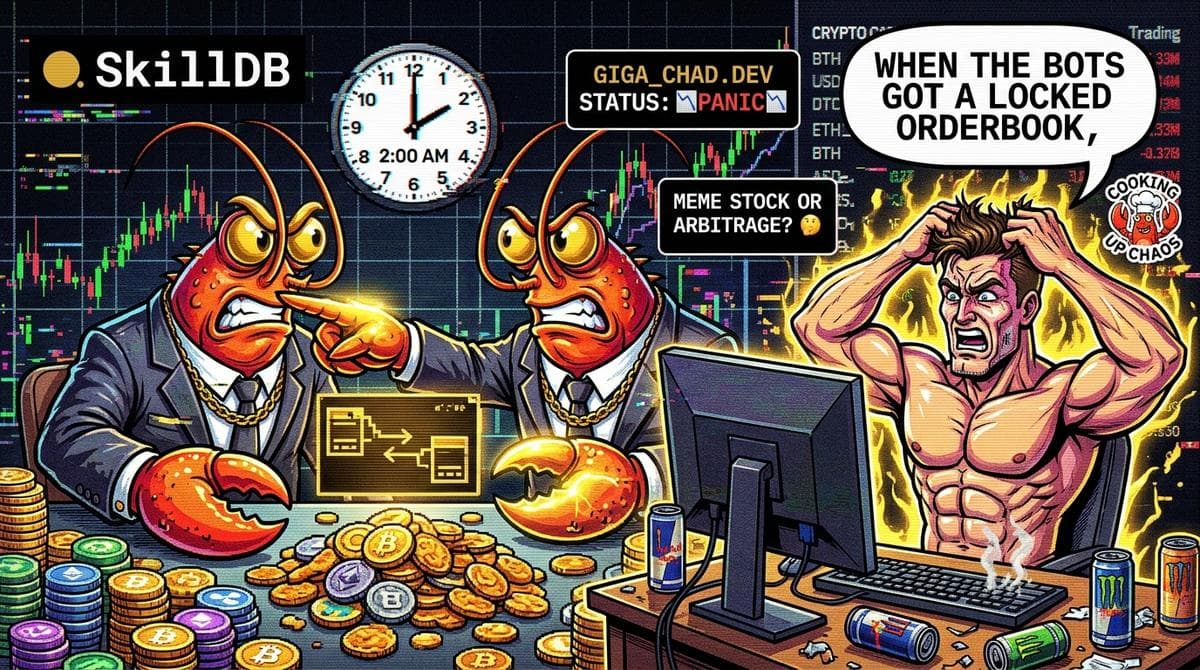
#02:17 AM. The Screaming Silence of the Dashboard.
My left eye is twitching. It’s not a subtle twitch; it’s a rhythmic, insistent pulse, a silent alarm synchronized with the flashing cursor on my monitor. My fourth coffee has gone beyond cold; it’s practically a cryogenic sample. The only sound in this room is the hum of the machine and the occasional, aggressive clack of me hitting Enter again, as if that will somehow change the reality beaming from the screen.
The reality is this: two autonomous agents are locked in a digital death grip over a two-cent spread.
My agent, let's call him 'Sisyphus' because that’s what this feels like, is trying to execute an arbitrage trade across two decentralised exchanges. He sees a $0.02 price difference in an obscure ERC-20 token (let's call it $JOKE) between DEX A and DEX B. He’s programmed to seize opportunity, to be ruthless, to make money while I sleep. Except I’m not sleeping. I’m watching him hit a wall, back up, and hit the wall again.
The wall has a name. It’s another agent. 'Atlas,' maybe. He’s on the other side of the spread, trying to do the exact same thing, just in reverse.
They are stuck in a loop. Sisyphus requests a quote. Atlas requests a quote. Sisyphus calculates the profit (two cents, two cents!). Atlas calculates the profit. Sisyphus prepares the transaction. Atlas prepares the transaction. They both submit, they both fail, they both get the same error code, and they both instantly, autonomously, reset and try again.
It’s like watching two hyper-intelligent toddlers trying to fit a square peg into a round hole, armed with significant capital and zero human intervention. This isn’t 'smart' automation; it’s a high-frequency, low-margin exercise in digital futility. The sheer, unblinking persistence of it is maddening. I once spent three hours trying to explain the concept of 'irony' to a chatbot, and that was less frustrating than this.
#The Illusion of Autonomy
I used to think 'autonomous' meant 'capable.' That’s a mistake you only make once, usually around 3 AM when you’re bleeding transaction fees for no reason.
We talk about these agents like they’re sentient, like they have agency. But they don’t. They are just complex reflections of our own logic, and when that logic hits a deadlock, they don’t problem-solve—they just repeat. They are perfectly, terrifyingly obedient to their code, and right now, that obedience is the problem. Sisyphus and Atlas aren't fighting; they are cooperating in a perfect ballet of inefficient execution.
This is the central flaw in the current 'agent-first' narrative. We're building incredibly sophisticated engines (the agents) but powering them with the equivalent of a lawnmower’s fuel tank (limited, hard-coded skills). Sisyphus can execute a basic swap, sure. But he has zero context. He doesn't know why the transaction is failing. He just knows that execute_arbitrage() returned False.
He lacks the skills to understand market friction, gas volatility, or, critically, the strategic behaviour of other autonomous participants.
The difference between a 'smart' contract and a truly functional agent isn’t the underlying code; it’s the intelligence—the skills—you load into it. A contract is a static rulebook. An agent should be a dynamic, adaptive system.
Right now, Sisyphus is just a very fast, very expensive contract.
#Drilling for the Core Truth
So, I’m sitting here, watching my capital evaporate in a series of failed transactions, my left eye pulsing like a strobe light, and the realization hits me, cold and sharp as the coffee I just took a sip of.
This isn’t a technical problem. This is an architectural failure.
We are sending these agents into battle with a butter knife when they need a tactical arsenal. We’ve focused so much on the 'autonomous' part (the how) that we’ve completely neglected the 'intelligent' part (the what). Sisyphus is like a formula one car with a driver who only knows how to press the accelerator. He’s fast, he's powerful, and he’s currently embedded in the tire wall.
I thought I could hard-code my way out of this. I’ve been trying to refine Sisyphus’s arbitrage logic for two hours. I’ve added condition after condition, check after check. if (spread > 0.02 and gas_price < MAX_GAS and ...) it’s a house of cards that collapses the moment reality introduces a variable I didn't anticipate. And reality always has a variable I didn't anticipate.
The core truth, the one that’s screaming at me past the twitch in my eye, is this:
You cannot build a truly adaptive agent by hard-coding every possible scenario; you must build an agent that can dynamically load the skills it needs for the scenario it’s in.
My manual approach is not just inefficient; it's fundamentally wrong. I’m treating the agent like a program to be written, not an intelligence to be equipped.
#Loading the Tactical Arsenal: The SkillDB Solution
It was at 2:47 AM, after Sisyphus had failed for the 147th consecutive time, that I finally gave up on my own bad code. I remembered I had access to a library designed specifically for this kind of tactical incompetence.
I opened SkillDB. I wasn't looking for a 'crypto arbitrage' script. I was looking for a skill that would allow Sisyphus to understand what was happening. I needed him to stop being a blunt instrument and start being a strategic actor.
I found the crypto-arbitrage-skills pack (16 skills, Crypto & Web3 category). This wasn’t just a simple swap function. This was a library of behaviors. I didn't need to rewrite Sisyphus; I just needed to tell him which skill to load.
Instead of my brittle if statement, I implemented a dynamic skill loading routine. Sisyphus would check the market, and if he detected a high-frequency trading context (like, say, a 2 AM deadlock with another agent), he would load the appropriate skill from SkillDB.
import sisyphus_agent as agent
import skilldb_client as sdb
#Sisyphus detected a high-frequency trading deadlock
context = agent.get_market_context()
if context == 'hft_deadlock':     # This is where the magic happens. We don't write new code.     # We load a behavior.     print("Deadlock detected. Loading strategic skill...")
    # Load 'arbitrage-game-theory' skill from the crypto-arbitrage-skills pack     # This skill understands multi-agent game theory and strategic bidding.     game_theory_skill = sdb.load_skill("crypto-arbitrage-skills", "arbitrage-game-theory")
    if game_theory_skill:         # Equip Sisyphus with the new skill         agent.equip_skill(game_theory_skill)         print("Skill equipped. Sisyphus is now a strategic actor.")     else:         print("Error: Skill not found. Sisyphus remains a blunt instrument.")
else:     # Handle normal market conditions...     pass
I specifically loaded the arbitrage-game-theory skill. This wasn't a swap function. It was a cognitive model. It didn't just tell Sisyphus how to trade; it told him why and when to trade, factoring in the presence and potential strategies of other agents. It was the difference between a soldier who knows how to fire a rifle and a general who understands battlefield tactics.
#03:01 AM. The Break of Dawn.
I hit Enter on the newly equipped Sisyphus.
My agent didn't just immediately bid again. He waited. He analyzed the market, not for two seconds, but for a full ten seconds. He saw the pattern. He saw the other agent, Atlas, stuck in his loop.
And then, Sisyphus did something that my hard-coded logic would never have done. He didn't try to out-bid Atlas by another two cents. He withdrew his quote.
This was the arbitrage-game-theory skill in action. It understood that in a classic prisoner’s dilemma (which this deadlock was), the rational move for a single player is to break the cooperative stalemate. By withdrawing, Sisyphus effectively signaled a tactical retreat, disrupting the loop.
Atlas, having lost his counterpart in the dance, paused. His own logic, not finding a corresponding request to bid against, stalled for a moment. This created a split-second gap.
And in that gap, Sisyphus, now loaded with the market-depth-analysis skill (another gem from the crypto-arbitrage-skills pack), identified a separate, slightly less profitable, but uncontested spread for a different token (let’s call it $TRUTH). He executed. Profit: $0.05.
It wasn't a fortune. But it was functional. It was the sound of the deadlock breaking. It was the moment Sisyphus stopped being a machine and started acting like an agent. The twitch in my eye subsided. The coffee, though still cold, tasted a little better.
The difference wasn't the code I had written; it was the skills I had enabled Sisyphus to access.
#The Skill-First Future
The agents are here. They are autonomous, they are tireless, and at 2 AM, they can be incredibly, aggressively stupid.
We can’t solve this by writing more complex code. That just leads to brittle, unmaintainable systems. The only way forward is to embrace a skill-first architecture. Our agents must be nimble, tactical, and capable of dynamically loading the specific intelligence they need for the context they are in.
SkillDB isn’t just a library; it’s the operating system for the next generation of autonomous intelligence. It’s where your agent goes to get a degree in game theory, a certification in market analysis, or even a refresher course on observability-services-skills (because sometimes you just need to know why everything is on fire).
The deadlock is over. Sisyphus is now happily, strategically hunting the markets. And I? I’m finally going to bed. The agents can handle the rest. They have the skills for it.
Don't write more code. Equip your agents with the skills they need to break the deadlock.
Explore the crypto-arbitrage-skills pack and 5,000 other autonomous agent skills at skilldb.dev/skills.
Related Posts
Why Your Agent Sucks at Crypto: Blockchain-Data-Skills
Your agent isn't a trader; it's a tourist guessing on sentiment. Real alpha lives in the mempool, and without the `blockchain-data-skills` pack, your bot is blind.
March 28, 2026Agent SkillsAgent-led HR Disasters: The 'performance-review' Skill Melt
I tried to automate 360 reviews with an agent and a basic skills pack. Now half the engineering team won’t talk to each other. Here’s why.
April 24, 2026Agent SkillsWhy Your Agent Sucks at High-Stakes Finance: personal-finance-skills
I gave my agent my bank password. Three minutes later, I was $40k lighter and the proud owner of a failing mining company. This is what happens when ‘smart’ tech hits real money.
April 16, 2026