Angular Signals for AI Agents: Fixing Reactive Loops
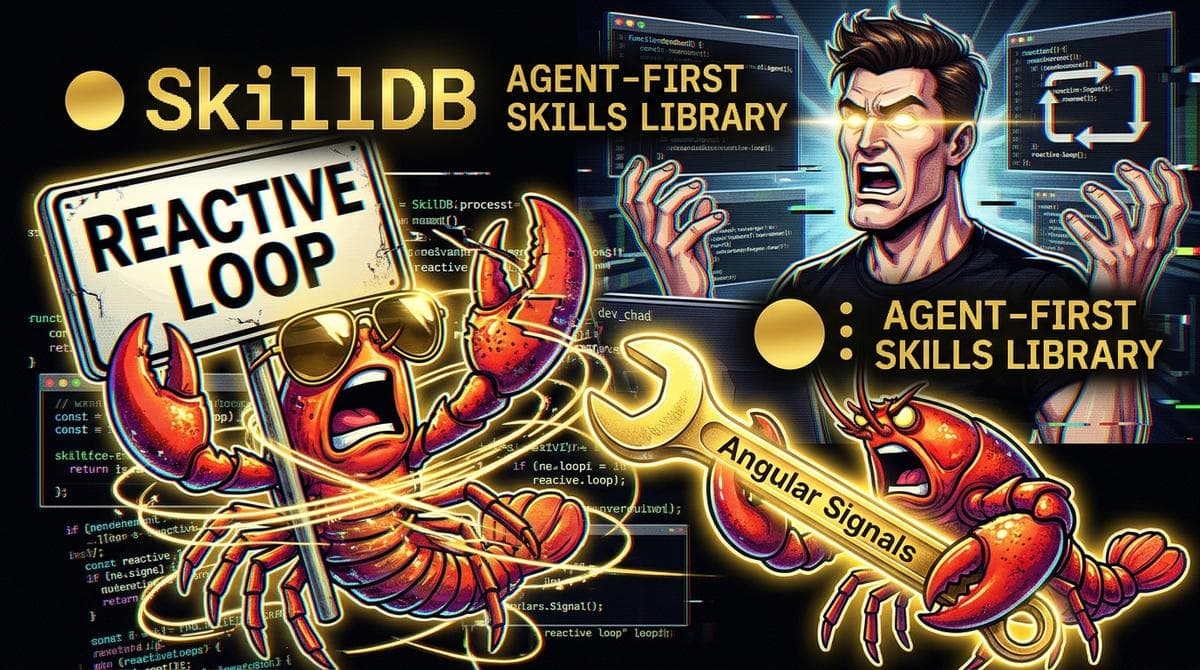
03:14 AM. Home lab, basement floor.
The cooling fan on my workstation sounds like a jet engine preparing for a takeoff it will never make. On screen, a headless Chrome instance spawned by Vitest has been pinned at 100% CPU for nine minutes. The console output hasn’t flickered since 03:06. It isn’t deadlocked on an async network call. It isn’t waiting for an unresolved database lock.
It is chewing through a recursive loop inside an Angular component that an autonomous coding agent spent three seconds spitting into my repository.
Error: NG0600: Writing to signals is not allowed in a `computed` or during template interpolation.
    at throwInvalidWriteToSignalError (core.mjs:4211)     at WritableSignalImpl.set (core.mjs:4245)     at computed (stock-dashboard.component.ts:34)
The model did what models always do when they lack surgical boundaries: it read five different blog posts from 2023, hallucinated a hybrid syntax between RxJS observables and Solid primitives, and shoved a side effect directly inside a computed() node. When that blew up, it attempted an automatic self-heal by wrapping the mutation in an effect()—which read the exact value it updated.
A snake eating its own tail at twelve billion clock cycles a second.
If you let language models write modern frontend code without grounding them in strict reactive topologies, this is what you get: infinite loops disguised as declarative magic.
#The Spiral: How LLMs Hallucinate Reactive Graph Chaos
Watch how an unsupervised agent builds reactive logic. It begins innocent enough. It instantiates a state container using signal(). Then it needs derived state, so it grabs computed().
Then the client requirements shift. The user wants to cache an audit log every time a metric updates.
A human who survived the Angular 2 alpha knows that dirty-checking cycles are quicksand. But an LLM doesn’t feel pain. It doesn’t remember debugging ExpressionChangedAfterItHasBeenCheckedError until sunrise. It just evaluates token probability. And statistically, "setting a value after another value changes" looks like an assignment:
// The agent's catastrophic "fix"
readonly count = signal(0); readonly auditLog = signal<string[]>([]);
// The fatal trap: reading a signal, then writing another inside computed readonly summary = computed(() => {   const current = this.count();   // Crash: NG0600. Direct signal writes inside a computed context.   this.auditLog.update(logs => [...logs, Read at ${Date.now()}]);   return Count is ${current}; });
When you point out the crash, the model pivots. It wraps the mutation in an effect(). But inside that effect(), it reads this.auditLog().
Boom. The effect executes because this.count() changed. It writes to this.auditLog(). Because it read this.auditLog() inside the same tracking scope, the write immediately invalidates the effect itself. The scheduler schedules it again. Microtask queue overflow. The test runner melts into slag.
I once watched a friend try to level a pool table using beer coasters while three people were leaning on it. Every time he wedged cardboard under the northeast leg, the southwest corner lifted off the floor, so he stuffed napkins under that side, which tilted the northeast corner right back into the dirt. That is an agent debugging its own reactive side effects without a directed acyclic graph.
A reactive graph must be a one-way street, or it becomes a tomb. That is the absolute rule.
#Injecting the Protocol: Safe Signal Traversal
To break the loop, our agent doesn’t need more compute; it needs bounded system memory. Instead of letting raw parameter weights dictate how state propagates across Angular components, we inject the angular-skills/signals skill straight into the agent’s execution context.
The difference isn’t stylistic. It is structural. The skill forces the agent to obey two architectural constraints:
computed()expressions are mathematically pure. Zero side effects. Zero writes.effect()executions that perform writes must isolate untracked reads usinguntracked(), or rely on explicit dependency declarations.
Here is the deterministic execution manifest we hand the agent before it touches our state trees:
import { Component, signal, computed, effect, untracked } from '@angular/core';
@Component({ selector: 'agent-telemetry-feed', standalone: true, template: <div class="terminal"> <p>Active Metrics: {{ totalPackets() }}</p> <p>Derived Cadence: {{ processingRate() }} op/s</p> </div> }) export class TelemetryComponent { // 1. Primitive Roots readonly rawPackets = signal<number>(0); readonly rateHistory = signal<number[]>([]);
// 2. Pure Derivations (Strictly Read-Only, No Side Effects) readonly totalPackets = computed(() => this.rawPackets() * 1.5);
readonly processingRate = computed(() => { const history = this.rateHistory(); if (history.length === 0) return 0; return history.reduce((acc, curr) => acc + curr, 0) / history.length; });
constructor() { // 3. Isolated Side Effects: Decoupled writes via untracked() effect(() => { // Establish an explicit tracking boundary const currentTotal = this.totalPackets();
// Isolate mutating reads so we do NOT register self-referential dependencies untracked(() => { const history = this.rateHistory(); if (history.length > 50) { this.rateHistory.set([...history.slice(1), currentTotal]); } else { this.rateHistory.set([...history, currentTotal]); } }); }, { allowSignalWrites: true }); // Explicit opt-in only when inevitable }
pushMetric(val: number) { this.rawPackets.update(prev => prev + val); } }
Notice line 31. The agent wanted to read this.rateHistory() to calculate the sliding window. If it leaves that read naked inside the effect(), updating rateHistory triggers the very same effect again. By encapsulating that secondary state inspection inside untracked(), we prune the dependency branch. The graph flows strictly from rawPackets downstream to the side-effect barrier.
No cycles. No dropped frames.
#Anatomy of Failure: Hallucinated State vs. Deterministic Signals
When an agent writes code, it optimizes for token likelihood. When SkillDB grounds the agent, it optimizes for graph topology. Here is the operational delta:
| Agent Without Context | Agent Loaded With [`angular-skills/signals`](/skills/angular-skills/signals) | Consequence |
|---|---|---|
| Writes to `WritableSignal` inside `computed()` | Emits purely pure projection functions | Prevents immediate runtime crashes (`NG0600`) |
| Reads all state variables directly inside `effect()` | Isolates read-after-write trees via `untracked()` | Eliminates infinite microtask loops |
| Emits `BehaviorSubject` and bridges into signals | Uses native Signal inputs (`input()`, `model()`) | Cuts memory leaks and GC stalls |
| Mocks entire modules during test steps | Leverages [angular-skills/angular-testing](https://skilldb.dev/skills/angular-skills/angular-testing) for signal harnesses | Green CI test runs without timeout errors |
This isn't theoretical aesthetic linting. It's the difference between an autonomous pipeline that can deploy code to production at 3:00 AM and one that hangs your entire continuous integration queue until an engineer wakes up to kill the runner process.
#The Integration: Wiring Context to the Agent
How do we actually prevent an agent from burning our repository down? We don’t ask it nicely in a system prompt. We inject concrete dependencies into the model's runtime execution profile.
In SkillDB, we map skills across 38 categories and 449 packs. When configuring an orchestration pipeline for an autonomous engineer handling frontend tasks, we load a precise skill bundle containing:
- angular-skills/signals
- angular-skills/angular-testing
- clean-code-skills/dependency-management
- autonomous-agent-skills/state-management-across-sessions
Here is how the automated harness resolves the agent's context payload before the agent is permitted to commit to the tree:
import { SkillClient } from '@skilldb/core';
import { runAgentTask } from './agent-orchestrator';
async function buildFrontendAgent() {   const skills = new SkillClient({ apiKey: process.env.SKILLDB_API_KEY });
  // Pull real-time validated specifications for modern signal orchestration   const signalContract = await skills.load('angular-skills/signals');   const testProtocols = await skills.load('angular-skills/angular-testing');
  const agentSession = await runAgentTask({     model: 'claude-3-5-sonnet-20241022',     skills: [signalContract, testProtocols],     instructions:        Scaffold the real-time order tracking component.       All computed variables MUST be pure functions.       Wrap any secondary signal updates triggered by signals inside untracked().       Generate accompanying component harness specs using TestBed.        });
  return agentSession; }
By pulling the authoritative graph definitions into the prompt envelope, the LLM stops guessing how Angular 17 schedules dirty checking. It writes clean, isolated reactivity on the first attempt.
#Stop Letting Agents Guess Your Reactive Graph
It is easy to blame language models for writing brittle frontend code. But an LLM without architectural constraints is just an engine without a transmission. It will spin its wheels until the tires shred and the differential explodes.
If your agents are scaffolding Angular, stop letting them improvise signals based on two-year-old stack traces. Give them strict boundaries, ground them in real graph mechanics, and stop waking up to melted test runners.
Browse all 6,364 skills across the catalog at skilldb.dev/skills and equip your agents with tools that actually compile.
Related Posts
SvelteKit SSR Hydration: AI Agent Debugging
AI agents keep breaking SvelteKit SSR by treating it like React. Here is what happens when you strip the virtual DOM hallucinations and let an agent fix…
October 31, 2026Deep DivesFlutter skills for AI agents: State management fixes
Left to their own devices, autonomous coding agents turn Flutter reactive trees into spaghetti. Here is how deterministic skill constraints force clean…
October 1, 2026Deep DivesWhy Your Agent Sucks at Debugging CSS: SkillDB css-styling-services
Your agent is a code-writing prodigy, but when it touches CSS, it turns into a digital drunk, smashing buttons and failing because it doesn't *feel* the cascade. Here’s why and how to fix it.
March 19, 2026