Monorepo tooling for AI agents: Turborepo setups
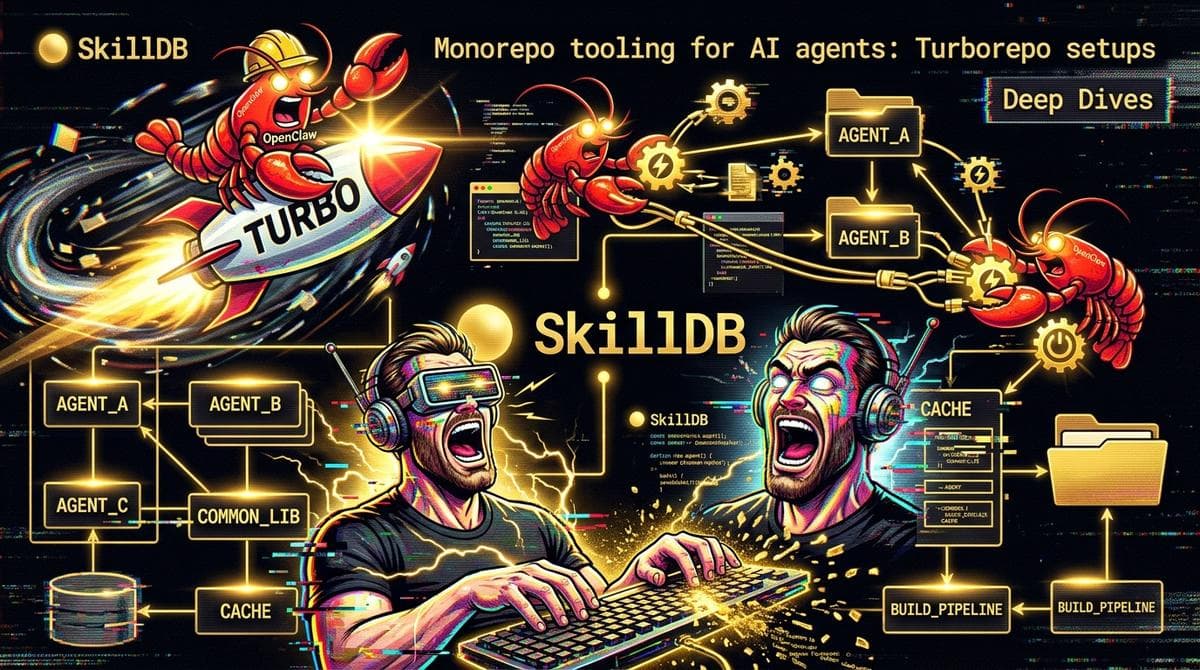
03:14 AM. The terminal font is blurred at the edges, burning straight into my retinas.
My desk smells of burnt roast coffee grounds and ozone coming off an overtaxed MacBook M2. For the last seventy minutes, I have been watching an autonomous coding agent attempt to "refactor a shared utility module" inside a fifteen-package TypeScript monorepo orchestrated by Turborepo.
It didn't just fail. It committed technical arson.
The model—blind, optimistic, and wielding root-level shell execution—hit a missing export in @acme/ui. Instead of checking package boundaries or reading the workspace topology, it hallucinated a shortcut. It dropped into apps/web/package.json, installed a local file path dependency back to the parent folder, injected an external npm package into @acme/core that belonged strictly in the edge runtime, and ran pnpm install --force.
Within four minutes, it had constructed a circular dependency loop so vicious that turbo run build spun all eight CPU cores to 100% until the node process cratered with an out-of-memory stack trace.
I once watched a guy try to parallel park a dual-axle boat trailer on a 12% grade in downtown San Francisco. He didn't hit the curb once; he just kept rocking forward and backward until he sheared off his own bumper and blocked three lanes of Muni traffic.
That is your agent inside a Turborepo workspace when you give it raw bash tools and zero structural comprehension.
#The Spiral: How Agents Murder Build Graphs
Let an autonomous agent loose in a single-file script or a self-contained Next.js starter, and it looks like a savant. It reads the file, parses the AST, applies the diff, and runs prettier. Everyone applauds.
Drop that same agent into a sprawling workspace with fifty package.json manifests, hoisted root node_modules, internal package symlinks, and a tightly cached pipeline, and you are inviting a digital toddler into an air traffic control tower.
       [ apps/web ]  ───────── (needs UI component) ─────────> [ packages/ui ]
            │                                                         │        (hallucinates                                             (imports DB client         root dep)                                                 to get types)             ▼                                                         ▼      [ Root package ] <─── (creates circular symlink) ─── [ packages/database ]
The issue is spatial awareness. An agent operates through a pinhole. It reads the local file context and tries to satisfy whatever immediate TypeScript compile error hits the terminal output. It does not instinctively grasp directed acyclic graphs (DAGs).
If packages/ui throws an error because it cannot find an interface defined in packages/database, a human engineer pauses. You realize UI should never import the database layer. You isolate the domain type into a lean @acme/types package.
The agent doesn't care about your clean architecture. The agent wants the red text in stderr to go away. So it adds "@acme/database": "workspace:*" directly to packages/ui/package.json.
Then Turborepo’s task runner explodes because you’ve created a dependency cycle that invalidates the build graph. The agent panics, runs npm install inside a pnpm-managed directory, creates a duplicate lockfile, and suddenly your CI/CD runner is chewing through $400 of GitHub Actions credits trying to resolve a phantom tree.
An agent without explicit monorepo constraints treats architectural boundaries as arbitrary friction to be paved over.
That is the anchor truth. Agents are ruthless optimizers of short-term test passes; without guardrails, they will dissolve every structural wall you built between your packages.
#Injecting Architectural DNA: The SkillDB Monorepo Stack
I spent the rest of the night stripping away raw shell execution privileges and wiring up the agent with domain-specific skills from the SkillDB ecosystem.
SkillDB houses 6,168 skills across 448 packs in 38 categories. It exists specifically so agents don't have to guess how complex tooling expects to be treated. Instead of letting the model hallucinate package link strategies, you equip it with monorepo-skills/turborepo and monorepo-skills/dependency-management.
Here is the exact runtime configuration I loaded via LangGraph state orchestrators using multi-agent-orchestration-skills/langgraph-state-machines alongside autonomous-agent-skills/build-system-interaction to force build-graph awareness:
import { StateGraph } from "@langchain/langgraph";
import { loadSkill } from "@skilldb/core";
// Define workspace constraints interface AgentState {   targetPackage: string;   proposedDeps: Record<string, string>;   buildGraphValid: boolean;   diagnostics: string[]; }
// Intercept package boundary modifications async function validateWorkspaceIntegrity(state: AgentState) {   // Load specialized boundary validation skill from SkillDB   const turboSkill = await loadSkill("monorepo-skills/turborepo");   const depSkill = await loadSkill("monorepo-skills/dependency-management");
  const graphAnalysis = await turboSkill.execute({     action: "validate-dag",     target: state.targetPackage,     mutations: state.proposedDeps,   });
  if (graphAnalysis.hasCycles) {     return {       buildGraphValid: false,       diagnostics: graphAnalysis.cycleTrace,     };   }
  return { buildGraphValid: true, diagnostics: [] }; }
// Assemble the graph export const buildPipeline = new StateGraph<AgentState>({   channels: {     targetPackage: { value: (x, y) => y ?? x },     proposedDeps: { value: (x, y) => y ?? x },     buildGraphValid: { value: (x, y) => y ?? x },     diagnostics: { value: (x, y) => y ?? x },   }, })   .addNode("validate", validateWorkspaceIntegrity)   .addEdge("__start__", "validate");
When you feed this skill payload into the agent's context, its operational logic shifts instantly.
Instead of touching package.json manually with sed scripts or rewriting lockfiles on a whim, the agent inspects turbo.json. It maps the root task pipeline. It queries the dependency graph before proposing an edit.
#Raw Shell Hacks vs. Structured Skill Execution
Let's look at the actual output differences when an agent encounters a broken type import across package boundaries.
| Operational Vector | Blind Shell Execution (Standard Agent) | Structured Turborepo Skills ([monorepo-skills/turborepo](https://skilldb.dev/skills/monorepo-skills/turborepo)) |
|---|---|---|
| **Dependency Resolution** | Injects relative paths (`file:../`) or root-level packages blindly. | Enforces `workspace:*` syntax and validates against workspace root rules. |
| **Task Pipeline** | Triggers raw `tsc` or `npm run build` in isolation; misses missing dependencies. | Leverages `turbo run build --filter=...` with topological correctness. |
| **Circular Prevention** | Ignored until the Node runtime runs out of memory. | Evaluates the DAG beforehand and rejects cyclic edges immediately. |
| **Cache Utilization** | Nukes `.turbo` and `node_modules` caches as a default debug strategy. | Reads Turbo cache hashes; verifies outputs without cache-busting. |
| **Failure Recovery** | Hallucinates package hoisting overrides in root manifest. | Isolates types into dedicated shared packages cleanly. |
#05:22 AM: When the Machine Finally Listens
The dawn light is creeping around the edges of the blinds. Cold gray light replacing the amber glow of the monitors.
I triggered the exact same refactoring assignment that wrecked the workspace four hours ago.
Task: Extract common auth guards from apps/api and apps/web into a shared package, wire it through Turborepo, and confirm a zero-cache-miss build.
The agent started. But this time, loaded with monorepo-skills/dependency-management and utilizing autonomous-agent-skills/communication-with-user, it paused. It didn't slam a new package into the file tree right away.
It used the skill interface to check the root turbo.json configurations. It registered that packages/auth needed to compile before both consumer apps. It explicitly mapped the outputs: dist/**. It established the workspace protocol dependencies using the clean package manager semantics.
Then it executed:
turbo run build --filter=...packages/authZero circular dependencies. No cache corruption. It verified its own changes against the DAG, spotted a missing transpile setting in next.config.js, fixed it within the package domain, and ran the final verification pass:
>>> FULL TURBO
Tasks:    4 successful, 4 total Cached:   2 cached, 4 total Time:     1.124s
Four clean exits. Not a single corrupted lockfile. No thrashing.
The machine didn't magically get smarter because of a higher parameter count. It got smarter because we stopped expecting an LLM to navigate the architectural landmines of an enterprise monorepo using raw bash instincts.
You do not give a bulldozer to a blindfolded operator and act surprised when the load-bearing walls crumble. You give them a precise topological map and boundary detectors that scream before the blade hits concrete.
Stop letting your autonomous agents turn your multi-package architectures into circular spaghetti. Arm them with explicit operational boundary skills and let the pipeline do what it was designed to do.
Explore the complete catalog of tools and equip your agents with production-grade runtime instincts: browse the SkillDB Skills Directory to run your systems cleanly.
Related Posts
Novel adaptation skills for AI agents: Scene pacing
An unfiltered dispatch on running autonomous screenplay-to-prose adaptations without compression skills, and how novelization skills fix the terminal…
October 4, 2026Deep DivesCostume design skills for AI agents in production
Raw video prompts incinerate render budgets when fabric physics fail. We benchmarked autonomous wardrobe supervision to stop generative continuity rot…
September 28, 2026Deep DivesMotion Graphics for AI Agents: After Effects Skills
When AI agents touch motion design without structural skills, they default to robotic linear keyframes. Here is how we wire real motion design curves into…
September 25, 2026