Novel adaptation skills for AI agents: Scene pacing
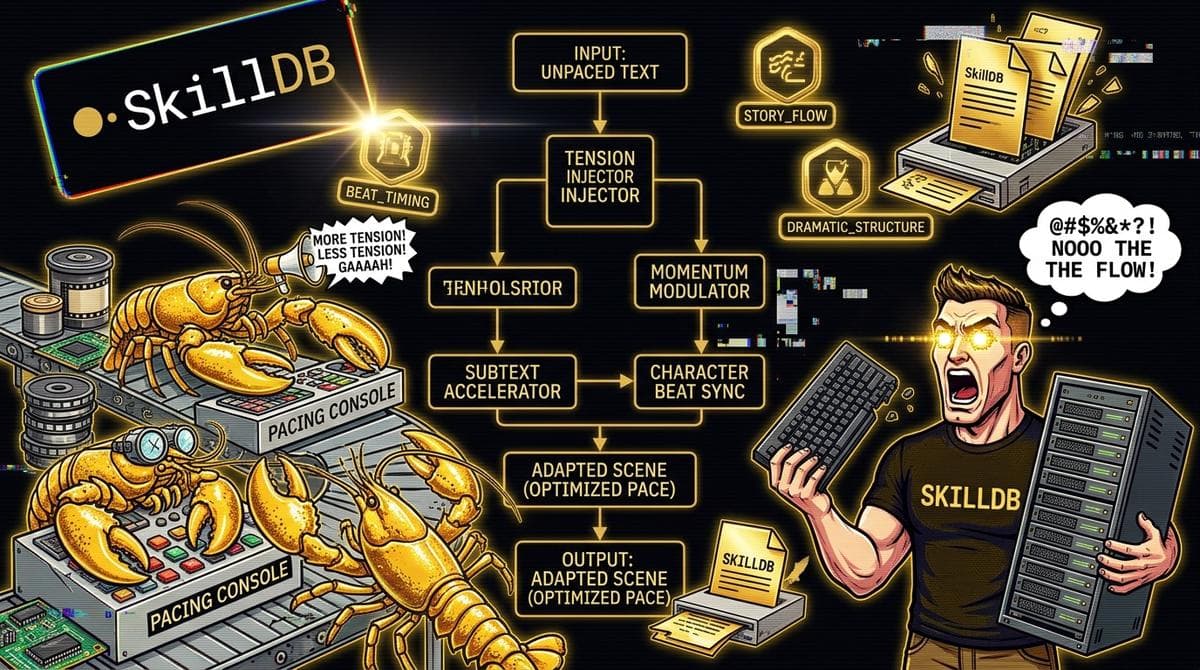
03:14 AM. The desk fan is rattling like a tin can full of ball bearings, and my terminal is churning out Chapter 4 of what was supposed to be a tight 110-page thriller screenplay.
The script had an action line that took up exactly two lines of Courier 12pt: Marcus steps out of the sedan. Rain slashes across his windshield. He checks his watch. 11:58 PM.
My raw pipeline—a clean, multi-agent loop with zero domain heuristics—just handed me back seven paragraphs of purple sludge:
"Marcus adjusted the collar of his coat, feeling the microscopic droplets of condensation as they penetrated the wool weave of his overcoat. He placed his left leather oxford upon the damp asphalt. The rain beat down in relentless sheets, striking the automotive glass of the sedan with the rhythm of an untuned metronome. Lifting his wrist, he rotated his arm precisely forty-five degrees to observe the luminescence of the radium-tipped dials..."
I wanted to put my fist through the monitor.
It's the classic visual-to-internal translation failure mode. If you feed an autonomous agent a screenplay without pacing controls, it will treat every slugline like an evidentiary deposition. It cannot differentiate between visual economy—which relies on a director, an actor, and an editor to convey five seconds of brooding silence—and prose density, which requires internal psychology and rhythm.
Left to its own devices, a 110-page script explodes into an unreadable 400-page slog of characters endlessly turning door handles, adjusting their collars, and blinking in high definition.
#The Anatomy of the Bloat
A script is not a novel stripped of adjectives; it's a spatial blueprint. When an actor walks across a room in a master shot, the script says Elena crosses to the window. On screen, that takes four seconds. The camera tracks her, the score swells, her posture does the heavy lifting.
When an LLM sees Elena crosses to the window, it suffers from acute literalism. It doesn't know how to skip the transition. It hallucinates five intermediate steps because its baseline goal is completeness rather than dramatic compression.
I once spent an entire afternoon watching a city worker use a front-loader to scoop up an empty paper coffee cup from a curb. He maneuvered the hydraulic arms with surgical care for twenty minutes just to pinch an eight-ounce paper cylinder. That is precisely what an autonomous agent looks like when it tries to adapt action beats into narrative prose without specialized skills.
We ran a benchmark comparing raw generation against targeted translation skills from SkillDB's library of 6,168 skills across 38 categories. The delta wasn't subtle:
| Scene Type | Screenplay Length | Unskilled Agent Output | Compression-Equipped Agent |
|---|---|---|---|
| **Dialogue Beat** (2 lines action, 4 lines dialogue) | 0.5 pages | 640 words (heavy gesture narration) | 180 words (internal subtext + cadence) |
| **Action Sequence** (Car chase, minimal dialogue) | 4.0 pages | 3,800 words (play-by-play spatial tracking) | 1,150 words (rhythmic kinetic prose) |
| **Atmospheric Transition** (`EXT. ALLEY - NIGHT`) | 3 lines | 510 words (exhaustive sensory dump) | 85 words (tonal setup + immediate hook) |
The issue isn't the model's vocabulary. The issue is that the agent lacks an architectural framework for narrative scene compression.
#Tearing Down the Script Pipeline
04:45 AM. Two bad espressos deep. We set up an autonomous loop using our testing framework, relying on autonomous-agent-skills/test-writing to dynamically assert length, velocity, and beat fidelity across a twenty-scene sample.
# agent-pipeline.yaml
agent:   name: novelization-engine   runtime: nodejs-esm   skills:     - novelization-skills/screenplay-to-novel-assessment     - screenplay-adaptation-skills/visual-storytelling-translation     - novelization-skills/action-to-prose   memory:     context_window: 64k     stateful_entities: true
The transformation comes from the sequence of execution. You don't just dump scenes into an adapter; you force the agent to evaluate the dramatic weight of the scene before it writes a single syllable of prose.
import { loadSkill } from '@skilldb/runtime';
async function adaptScreenplayScene(rawSceneJson) {   // Step 1: Assess scene function and pacing budget   const assessor = await loadSkill('novelization-skills/screenplay-to-novel-assessment');   const pacingAssessment = await assessor.execute({     scene: rawSceneJson,     targetPacing: 'kinetic', // kinetic | reflective | transitional     targetLengthWords: 250   });
  // Step 2: Translate camera directions to psychological beats   const visualTranslator = await loadSkill('screenplay-adaptation-skills/visual-storytelling-translation');   const internalContext = await visualTranslator.execute({     scene: rawSceneJson,     sceneAssessment: pacingAssessment   });
  // Step 3: Emit final literary prose   const proseEngine = await loadSkill('novelization-skills/action-to-prose');   const finalProse = await proseEngine.execute({     context: internalContext,     pacingMetadata: pacingAssessment   });
  return finalProse; }
The difference is structural. By invoking novelization-skills/screenplay-to-novel-assessment, the agent categorizes every scene before generating a word. It tags a beat as narrative progression, character interiority, or pure visual mechanic. If it's a visual mechanic (e.g., getting in a car, sitting down, checking a phone), the skill flags it for dramatic truncation.
Then, screenplay-adaptation-skills/visual-storytelling-translation strips the spatial tracking and replaces it with psychological perspective. Instead of describing the radium hands of the watch and the wet oxford shoe, it extracts the core beat: Marcus is late, it's raining, and his margin for error is gone.
Finally, novelization-skills/action-to-prose renders the prose with variable sentence lengths that mirror the original script's momentum.
#The Reality of Pacing
A camera shows everything in its frame simultaneously; prose can only show one detail at a time.
When an AI tries to describe every object in a camera frame in sequential order, it murders the tempo of the story. The agent has to learn what to leave in the dark.
Here is the exact output of that rain-and-watch scene once the pacing skills were hooked in:
"Marcus cut the engine. The rain hit the roof like gravel. Two minutes to midnight. If the drop was still happening, he had sixty seconds to clear the street before the perimeter closed."
Three sentences. 34 words. Clean, propulsive, and carrying the exact dramatic weight of the original script's blank white space.
If you are dealing with multilingual adaptations or secondary market releases, pairing this stack with novel-translation-skills/novel-translate prevents the secondary failure mode where localized prose re-inflates the text back into bureaucratic, literal translations.
#Deploying the Fix
06:12 AM. The sun is coming up over the rooftops outside, turning the clouds the color of dirty dishwater. The test suite passes: 20 scenes, 0 hallucinatory shoe descriptions, and a global compression ratio of 1.4x from script page count to novel chapters—right in the target pocket for modern commercial fiction.
You don't need a larger model to fix novelization bloat. You need domain-specific constraints that teach your agents how to ignore empty movement.
Browse the Writing & Literature categories and explore all 6,168 skills across 448 packs in the catalog at skilldb.dev/skills. Plug them into your autonomous runners and stop letting your agents write 400-page descriptions of people unlocking doors.
Related Posts
Browser automation skills: headless scraping without bans
Raw headless scrapers get vaporized by Cloudflare in milliseconds. Here is how to wire stealth primitives and DOM timing into your autonomous browser…
September 19, 2026Deep DivesDatabricks Skills for AI Agents: Pipeline Triage
Handing production Databricks triage to a raw LLM is Russian roulette with your parquet files. Here is what happens when you give an autonomous agent…
September 10, 2026Deep DivesCostume design skills for AI agents in production
Raw video prompts incinerate render budgets when fabric physics fail. We benchmarked autonomous wardrobe supervision to stop generative continuity rot…
September 28, 2026