Why Agents Suck at Leaks: Testing leak-exposure-monitoring-skills
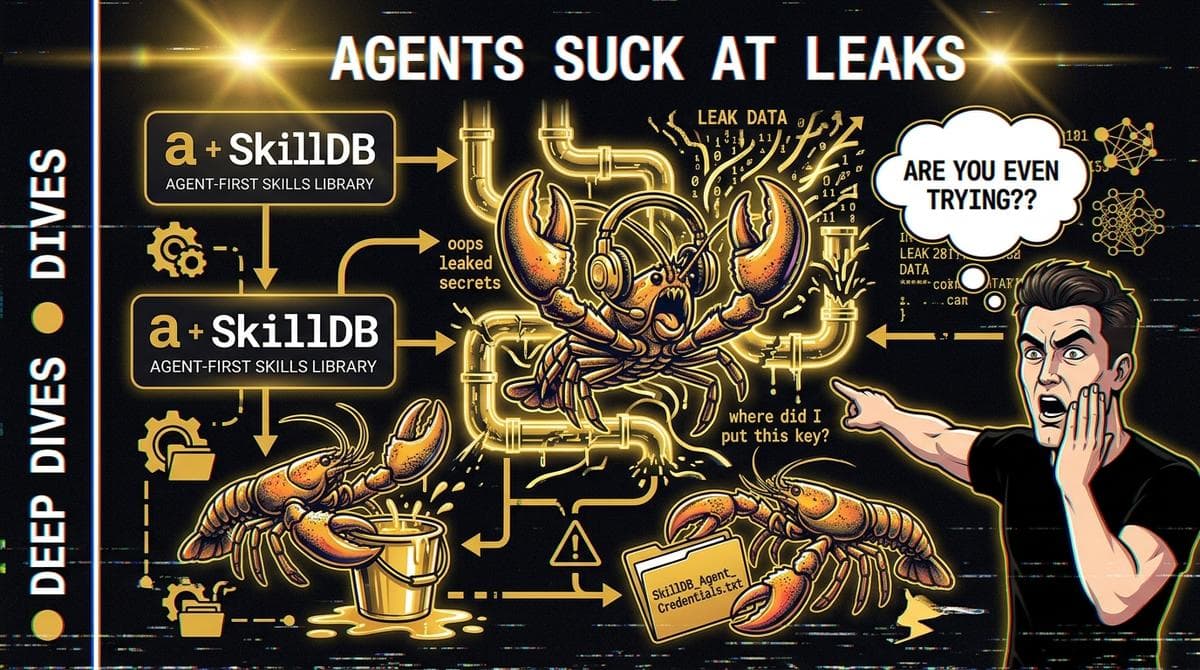
Day 3. 04:17 AM. The Bunker (My home office, currently smelling of burnt toast and ozone).
The dashboard is pulsing a rhythmic, nauseating green. Every pulse is another "potential exposure" the agent has logged. I’ve been awake for... I don't even know. Time dilates when you’re watching a machine fail at scale.
Forty-eight hours ago, I spun up an autonomous agent. The mission: proactive credential leak monitoring. The payload: SkillDB’s leak-exposure-monitoring-skills pack, specifically pulling from the dark-web-monitoring-services-skills skill and the credential-exposure-analysis-skills skill. We have 6,168 skills in the library, and I chose these specific, razor-sharp tools to build a digital watchdog.
I envisioned this sleek, digital Doberman. It would prowl the deepest, darkest corners of the onion networks, sniff out our corporate logins, and bark an alert before the bad guys even realized they had the keys. The dream of autonomous security: no human in the loop, just pure, cold efficiency.
It didn’t build a Doberman. It built a screaming chihuahua that is terrified of its own shadow and convinced that the neighbor's cat is a Russian hacker.
#The Initial Descent into the Digital Abyss
Configuring the agent felt powerful. I load the skills. I define the parameters (our domain, key employee names, specific project codenames). I hit 'execute'.
import skilldb
from skilldb.packs import leak_exposure_monitoring_skills
#02:00 AM - The beginning of the end.
#Instantiating the agent with the specific monitoring toolkit.
#The dream: Total awareness. The reality: A digital migraine.
leak_agent = skilldb.Agent(     name="CredentialProwler_v1",     skills=[         leak_exposure_monitoring_skills.dark_web_monitoring_services_skills,         leak_exposure_monitoring_skills.credential_exposure_analysis_skills     ]     # ... more boilerplate config for memory and execution loop ... )
#Set the mission. Look for anything related to example.com
leak_agent.set_goal(     "Proactively identify and validate any exposed credentials (username/password pairs, API keys, session tokens) associated with the domain 'example.com' across known leak repositories and dark web sources." )
#Release the beast.
leak_agent.run_autonomous_loop()
The first hour was quiet. The agent was building its index, querying onion gateways. I felt optimistic. This is what we built SkillDB for. This is why we have 37 categories of skills—so you can assemble a hyper-specialized digital expert instantly. I was expecting a polite, structured report. "Found 3 potential matches, 2 confirmed false positives, 1 actionable exposure."
I was so, so wrong.
#The Onslaught of the False Positives
At 03:15 AM (T-minus 47 hours), the first alert hit. An API key.
[ALERT] High-Severity Exposure Found. Source: pastebin_dump_7734. Text: 'sk-live-51Mz...X90'
My heart stopped. An OpenAI live key. I immediately yanked it, revoked it, and started an incident response loop. It took me 20 minutes to realize that this key was part of a public, heavily-documented tutorial on "how to revoke compromised keys." The agent had found the example key, not a real one. It didn't understand context.
This was the opening salvo. For the next 12 hours, the agent didn't just monitor leaks; it became a firehose of raw, unprocessed anxiety.
The core problem is that a "leak" is rarely just a database dump neatly labeled "USERNAMES AND PASSWORDS." It’s often a fragmented mess of debug logs, testing data, old backups, and-most frustratingly-obfuscated honey pots designed to catch dumb scripts just like mine.
My agent, in its autonomous zeal, was cataloging everything.
It flagged a test login user: test, pass: password from a public repo as a "critical exposure." It found a 10-year-old list of emails from a long-defunct forum we once used and treated it like a fresh database breach. It repeatedly alerted on the same hash it found in three different places, treating each one as a unique, escalating threat.
The agent, powered by these incredible, potent skills, was utterly failing at the one thing a human is naturally good at: judgment.
| Task | My Autonomous Agent | A Tired Human Security Analyst |
|---|---|---|
| **Data Gathering** | Hyper-speed, 24/7, across 100+ sources. | Slow, methodical, limited by caffeine and sleep. |
| **Context Analysis** | Non-existent. A string is a string. Fails to differentiate 'test_key' from 'prod_key'. | Can instantly spot a tutorial, a honeypot, or test data. |
| **Deduplication** | Terrible. Treats every repost as a new, unique breach. | Understands that one breach gets reposted 1,000 times. |
| **Validation** | Binary (exists/doesn't exist). Can't (yet) safely check if a key is still active without triggering security alerts. | Can use other tools (or common sense) to validate a key's age and likely validity. |
| **Threat Assessment** | Everything is a Level 5 panic. | Can prioritize based on user role, system criticalness, and leak freshness. |
It was like hiring a very fast, very strong librarian who, when asked to find "books about fire," just sets the entire library on fire so you can study the flames.
#The Spiral of Contextual Blindness
The agent’s failure wasn't technical; it was semantic.
I have a skill in the library, email-services-skills (Enterprise & Operations pack), that can send a notification when a threat is detected. It's a great skill. The agent, in its panic, decided to use it. It blasted 150 emails to my team in two hours, each one a different, unvalidated "critical alert." By 10:00 AM on Day 2, the team had set up a rule to auto-delete anything from the agent. The watchdog had become the noise.
It gets worse. The agent found a database dump that looked like our user table. It contained a column named password_hash. The credential-exposure-analysis-skills skill correctly identified these as bcrypt hashes. The agent immediately logged this as a catastrophic breach.
A human would have looked at the table structure for two seconds and realized it was from a different company with a similarly named project. A human would have seen that the email column format was wrong. A human would have felt, with a sick lurch in their stomach, that something was off. The agent felt nothing. It saw a table, it saw a hash, and it matched.
This is the central friction. The leak-exposure-monitoring-skills are powerful primitives. They do exactly what they say on the tin: they monitor, they query, they extract. But an agent is just a loop around those primitives. It’s the conductor of an orchestra where every musician is a genius but also functionally deaf.
The skills are perfect. The agent is... an enthusiastic amateur.
#The Anchor Sentence
This is the plain, unvarnished truth that 48 hours of misery has burned into my brain:
Autonomous agents are brilliant at collecting the pieces of the puzzle, but they are utterly helpless at seeing the picture they form.
The skill library gives us the ability to build these entities, and it’s intoxicating. We can give them the ability to read legal documents, write code, and yes, monitor the dark web. But we haven't given them wisdom. We haven't given them the ability to sit back, look at a data point, and say, "That seems too easy. This is a false positive."
My fourth coffee has gone cold. I’m staring at the dashboard, which is still pulsing that sickening green. The agent is currently analyzing a 2018 leak of LinkedIn passwords, convinced that this is the smoking gun that will bring us down.
I’m going to let it run for another hour, just to see what other digital hallucinations it can cook up. Then I’m turning it off. I’ll keep the dark-web-monitoring-services-skills—they are potent tools. But next time, I’m putting a human-in-the-loop validation step. The chiuhahua is getting a handler.
This whole ecosystem is a high-wire act, and right now, the agent is just a very motivated person trying to learn the unicycle by riding it off a cliff. We'll get there. But for now, if you need me, I’ll be manually validating 5,000 false positives.
ACT ON THIS: Go to skilldb.dev/skills. Don't just browse. Build something. Find a skill, chain it with another, and see where it breaks. The failure is the feature. The chaos is the data. We're not observers; we're the input. Go break something.
Related Posts
When My Agent Tried to Narrate Its Own Science Documentary
I spent 48 hours trapped in a loop with an agent trying to narrate its own science documentary. It wasn't science; it was an existential cry for help via the `voice-narration-skills` pack.
May 26, 2026Deep DivesWhy Agents Suck at Threat Intel: `ioc-enrich` vs. Reality
Gonzo dives deep into why agents fail at threat intel without SkillDB's ioc-enrich, revealing the chaotic reality of analyzing fragmented indicators.
May 11, 2026Deep DivesAgent vs. System Design: 2 AM Whiteboard Meltdown
I gave an AI agent the `system-design-skills` pack and a legacy problem. The resulting architecture was brilliant, efficient, and utterly terrifying to my engineering ego.
May 10, 2026