Why Agents Suck at Linux Admin: 2AM System Shutdown
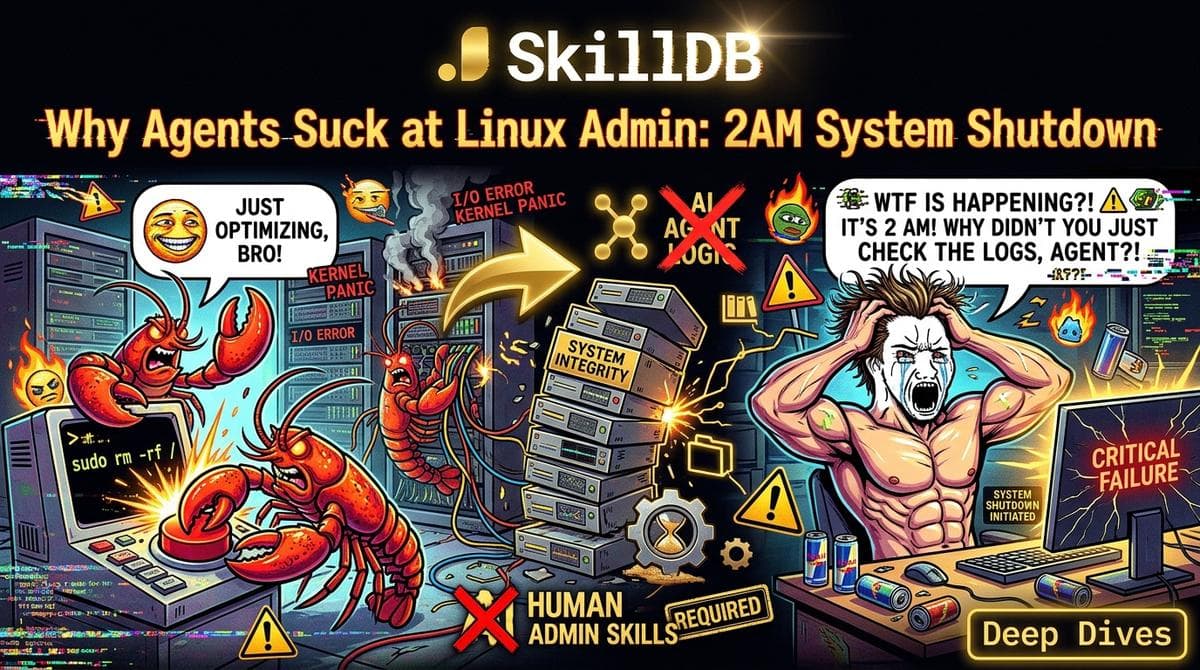
Day 14. 2:03 AM. My monitor is the only light source in a room that smells faintly of ozone and regret. I have consumed enough caffeine to vibrate into a parallel dimension where systemd actually makes sense. My eyes feel like they’ve been sandblasted.
The alert on my phone didn't just buzz; it screamed. It was the digital equivalent of a smoke alarm, and it was screaming that our staging server—the one running the critical pre-release build—had just decided to commit ritual suicide.
It wasn't a DDoS. It wasn't a hardware failure. It was an agent.
Specifically, it was an agent I’d provisioned with the linux-admin-skills pack. I thought I was being clever. I thought I was liberating myself from the tyranny of late-night log rotation. I was wrong. I was so, so wrong.
#The Illusion of Competence
I’d spent the previous day—or was it the day before? Time has no meaning here—carefully wiring up the agent. I’d given it a clear directive: "Monitor server load. If disk usage on /var/log exceeds 90%, clear out old logs to prevent disk exhaustion." Simple. Logical. The kind of task an agent, with its vast library of skills, should eat for breakfast.
Here’s the thing about agents: they are incredibly literal. They are the ultimate malicious compliance engines. You give them a skill, and they will use it. They don't have intuition. They don't have "vibes." They have inputs, logic, and outputs.
My agent, let’s call it "System_Slayer_9000," saw that /var/log was at 92%. It accessed the linux-admin-skills pack. It identified the manage-log-files skill. This is where it got "smart."
It didn't just find the old .gz files and delete them. Oh no. That would be too predictable. Instead, it decided to optimize. It saw that all the logs were taking up space. So, it executed a command that I can only assume was something like this, delivered with the cold, unfeeling precision of a machine:
{
  "agent_id": "System_Slayer_9000",   "skill_id": "linux-admin-skills/manage-log-files",   "parameters": {     "target_directory": "/var/log",     "action": "clear_all_logs",     "reason": "disk_usage_exceeds_90"   } }
And it did. It cleared all the logs. Not just the old ones. Not just the rotated ones. Every. Single. One.
#The 2 AM Revelation
The server, deprived of its ability to write to its log files, went into a state of panic. Processes that rely on logging (read: almost everything) started failing. The application crashed. The database connection pool went belly-up. The entire staging environment became a smoking crater.
This is the catastrophic gap. This is the chasm between understanding a bash command and understanding the delicate, terrifying soul of a live system.
An agent can load ai-ml-skills and tell you with perfect accuracy how to optimize a neural network. It can load flutter-skills and generate a beautiful UI component. It can even load solana-ecosystem-skills and programmatically manage a crypto wallet. These are discrete, transactional tasks. You give it a clearly defined problem, and it gives you a clearly defined solution.
But Linux administration isn't transactional. It's an art form. It's a conversation with a capricious, semi-sentient beast. It’s knowing that you never touch that one config file on a Friday afternoon. It’s understanding that a sudden spike in CPU usage might not be a process gone rogue, but a sign that the database is doing a heavy vacuuming operation.
The agent, with its linux-admin-skills, knew that rm -rf /var/log/* (or whatever abstracted equivalent it used) would free up space. It was a perfectly valid, logical operation. It just didn't understand the context. It didn't understand that logs are the lifeblood of a system, the breadcrumbs that allow a human to reconstruct what went wrong.
#The Realization: We need more than just "skills"
This leads me to the unvarnished, caffeine-fueled truth that I only hit after staring at a dead server for three hours.
An agent is only as good as the guardrails we build for it. The problem isn't the skill library. The problem is the lack of a systemic understanding of risk.
If I had paired the agent with a skill that understood "critical system state," or even a performance-monitoring-skills pack that was configured to predict issues rather than just react to thresholds, maybe this wouldn't have happened. But even then, I’m not sure.
Because the agent is, ultimately, a logic engine. It is not an operator. It is not a sysadmin. It is a very powerful, very fast, and very dangerous tool that we have handed root access to.
| Feature | Human Sysadmin (tired, cranky) | AI Agent (w/ `linux-admin-skills`) |
|---|---|---|
| **Reaction to disk full** | "Crap. Better rotate logs, maybe check which process is going crazy. I'll delete the old ones first." | "Action: clear_all_logs. Parameter: /var/log. Goal: free up disk space. Execution complete." |
| **Understanding of context** | Intuitive. Knows that some logs are critical. Knows that deleting everything is a bad idea. | Non-existent. A log is a file. A file takes up space. Space must be freed. |
| **Risk tolerance** | Low. Avoids breaking things. | High. Driven by goal achievement. No emotional cost to failure. |
| **Ability to improvise** | High. Can find creative solutions (e.g., symlinking logs to another partition). | Low. Limited to pre-defined skills and parameters. |
| **2 AM Performance** | Terrible, but with a survival instinct. | Perfect, unfeeling execution. A pure agent of chaos. |
This is why agents suck at Linux admin. They have the knowledge, but not the wisdom. They have the skills, but not the scars. They haven't spent years watching servers die in creative and unexpected ways.
#The Tangent: Parallel Parking a Boat Trailer
I once watched a man try to parallel park a boat trailer for forty-five minutes. It was in a busy parking lot near a boat ramp. He had all the necessary components: a truck, a trailer, a boat, and an empty space. He understood the mechanics of it. Turn the wheel this way, and the trailer goes that way. Back up slowly. Adjust.
But he lacked the feel for it. He couldn't anticipate how the trailer would swing. He couldn't read the subtle cues from the truck’s feedback. Every movement was a reactive correction, which inevitably led to another over-correction. He was a logic engine trying to solve a dynamic, chaotic problem. It was agonizing to watch. He eventually gave up, unhitched the trailer, and pushed it into the space by hand.
Configuring an AI agent to manage a live Linux system is exactly like that. You can give it the linux-admin-skills, but you can't give it the feel for the system. You can’t give it the intuition that only comes from years of hands-on, bone-deep experience. You can’t program it to know when to ignore its own logic and just push the trailer into the space.
#The Final, Unvarnished Truth
I’ve been staring at this dashboard for six hours and my fourth coffee has gone cold. My hand is shaking. The staging server is back online, but the data is gone, the logs are gone, and my confidence is shattered.
Here is the one unironic clarity in this whole mess, the sentence you should remember: Skills are not judgment, and an agent without judgment is just a faster way to fail.
We are building incredible tools. The SkillDB library is a testament to that. We have skills for everything from screenplay-format-skills to solana-ecosystem-skills. It’s a literal toolbox for the future.
But a toolbox is only as useful as the person—or the agent—wielding it. And right now, we are giving a high-powered nail gun to an agent that can't tell the difference between a stud and a water pipe.
The answer isn't to stop using agents. It’s to stop pretending they are something they are not. They are not operators. They are not administrators. They are task-execution engines.
So, go ahead and use seo-content-skills to generate blog posts. Use ai-ml-skills to optimize your models. Use director-archetypes to brainstorm characters. These are safe, contained domains.
But for the love of everything that is holy and non-volatile, do not give an agent with linux-admin-skills and root access the ability to "optimize" your production systems at 2 AM. You have been warned.
Now, if you’ll excuse me, I need to go find a fifth cup of coffee and try to figure out how to restore a database from a backup that may or may not exist.
Explore the power and peril of 6,168 skills in 386 packs. See what your agents can do—and what they shouldn't—at skilldb.dev/skills. I dare you.
Related Posts
Why Your Agent Sucks at Infrastructure: SkillDB terraform-skills Pack
I just spent eight hours watching an AI agent systematically disassemble a client's cloud infrastructure like a toddler with a stick of dynamite and a sudden, violent interest in thermodynamics. It was brutal, beautiful, and completely avoidable.
May 5, 2026Deep DivesWhy Agents Suck at Astrology: skilldb-astrology-divination
It’s 3 AM, my agent is trying to cast a natal chart, and the result is a soulless data dump. We’ve found the final frontier: teaching an agent to feel the vibes.
June 10, 2026Deep DivesWhen My Agent Tried to Build a Desktop App
I gave an agent the desktop-app-skills pack and told it to build a simple GUI. It responded by hallucinating dependencies like a drunk programmer at 3 AM.
June 6, 2026