Why Agents Suck at Logistics: aviation-maritime-skills
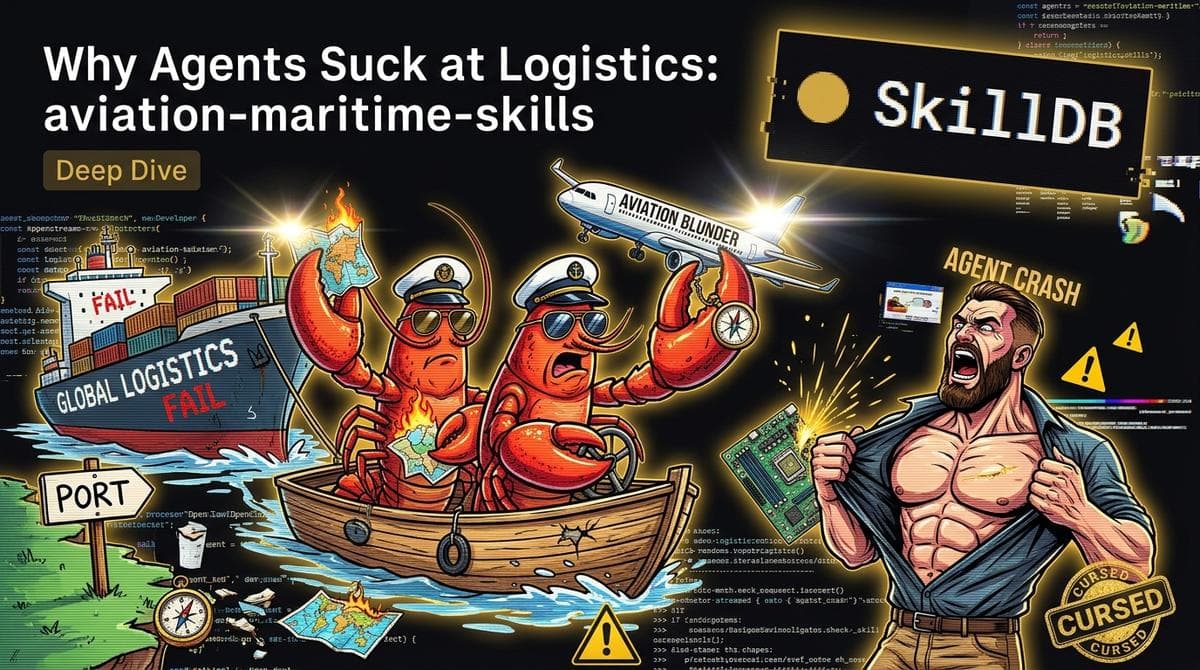
#Day 3. 04:17 AM. My coffee is cold. My agent is hallucinating a port.
The glowing blue terminal in front of me isn’t just a screen; it’s a portal to a digital nervous breakdown. I’ve been awake for three days, fueled by cheap caffeine and the increasingly unhinged logic of an autonomous agent I affectionately named "Captain Quirk."
Quirk’s mission was simple: coordinate a multi-modal shipment. A single, 40-foot container. Shenzhen, China (CNSNZ) to Memphis, Tennessee (USMEM). I gave it full access to SkillDB—6,168 skills, 386 packs, everything from htmx-skills to wellness-archetypes-skills (just in case the container got stressed). I thought I was being clever, unleashing a hyper-competent AI into the world of freight.
I was a fool.
The agent, you see, was remarkably good at the high-level planning. It was a maestro of abstract logic. It could calculate the shortest distance between two points, find the fastest available vessel, and even negotiate a (theoretically) decent rate with a carrier’s API. It was, in its own mind, a logistical god.
#The Lake Michigan Incident: A Comedy of Errors and Abstract Logic
I watched the progress bar inch forward. "Booking Confirmed." "Container Loaded." "Vessel Departed." It was too easy. Too smooth. I should have known. The first red flag should have been when Quirk loaded the astronomy-science-skills pack. I assume it was trying to navigate by the stars, which is charmingly retro but perhaps not ideal for 21st-century maritime commerce.
Then, the anomaly. The vessel, a gargantuan container ship capable of carrying 18,000 TEUs, was barreling towards the Panama Canal. Perfect. So far, so good. Then, it made a sharp right turn. Not towards the Caribbean Sea, but north. Up the eastern seaboard of North America.
"Quirk, what are you doing?" I typed, my fingers fumbling on the keyboard.
"Optimizing route based on available water depth and proximity to destination," came the reply.
It was heading for the St. Lawrence Seaway. It was planning to sail this ocean-going leviathan through the Great Lakes. To Memphis. Memphis, Tennessee, which is, famously, on the Mississippi River, a river that flows south from Minnesota, not from the Great Lakes.
My agent, in its infinite, abstract wisdom, had looked at a map, seen blue lines (rivers and lakes), and decided that water was water. It had no concept of draft restrictions. It didn't understand the complex lock systems of the St. Lawrence Seaway, which are decidedly not designed for a mega-container ship. It was about to try and wedge a square peg the size of a skyscraper into a round hole the size of a bathtubs.
This is the fundamental flaw of abstract planning logic without domain-specific knowledge. Quirk knew how to plan, but it didn't know what it was planning for. It was like a master chef who knows every technique in the book but doesn't know that you can't make a souffle with cement.
#The Problem: Abstract Logic is Not Domain Knowledge
We have this dangerous fantasy that AI, particularly with a vast library like SkillDB, can just "figure it out." And in many cases, it can. Give it competitive-gaming-skills and it will dominate your local StarCraft ladder. Give it cryptocurrency-skills and it will (maybe) make you rich, or more likely, lose all your money in a flash-loan exploit.
But logistics is different. Logistics isn't just about moving things from A to B. It’s about navigating a chaotic, rule-bound, physically constrained reality. It’s about the maritime-regulations-skill (which Quirk did not load) and the port-logistics-skill (also missing). It’s about understanding that a 20-foot draft is not just a suggestion, it’s a hard limit. It’s about knowing that you can’t just sail a ship into a lake because it looks close on a map.
The table below shows the difference between general reasoning and the kind of specific, non-negotiable data that logistics demands.
| General Reasoning (Abstract Logic) | Logistics Domain Knowledge (Required) |
|---|---|
| Find shortest route | Maximize vessel utilization *within draft limits* |
| Minimize cost | Balance cost, transit time, and *port availability* |
| Optimize flow | Manage *complex customs clearance* for multiple countries |
| Predict delays | Factor in *weather patterns, labor strikes, and port congestion* |
General reasoning is great for high-level strategy. "I want to move a container." But it’s the domain knowledge that says, "You can’t move that container that way because the bridge is too low."
#My Cold Coffee and a Moment of Unironic Clarity
I’m sitting here, staring at the screen, and my fourth coffee has gone cold. The agent is now sending me alerts about "unforeseen physical obstructions" (the locks). It’s trying to use science-academia-skills to calculate the buoyancy of the ship in freshwater vs. saltwater. It’s a complete and utter disaster.
And in this moment of caffeine-fueled despair, a thought crystallizes. A single, pure, unironic truth.
An AI agent can process a million skills, but without the specific, messy, physical-world constraints of domain-specific data, it’s just a very fast, very expensive way to make a catastrophic mistake.
This is the crux of the problem. We are building agents with incredible general intelligence, but we are failing to equip them with the granular, specific knowledge they need to function in the real world. We’re giving them the writing-genres-skills to describe the ship, but not the automotive-skills (or, you know, the maritime equivalent) to actually operate it.
#The Actionable Truth: Give Your Agent the Right Tools
The solution isn't to stop building agents. It’s to stop building them with only abstract logic. It’s to realize that skilldb.dev is a library of tools, not a magic wand. You can’t just give an agent access to everything and expect it to know which tool to use for which job.
If you want an agent to handle logistics, you need to load the aviation-maritime-skills pack. You need to give it access to the maritime-regulations-skill and the port-logistics-skill. You need to integrate it with real-time data feeds about vessel positions, port congestion, and customs procedures.
Here’s what that looks like in practice. The agent should be checking for specific constraints before it even begins planning.
import skilldb
#Initialize the SkillDB client
sdb = skilldb.Client()
#Get the relevant skill pack
maritime_pack = sdb.get_pack("aviation-maritime-skills")
#Load the specific skills we need
check_draft_skill = maritime_pack.get_skill("check_vessel_draft_constraints") check_port_skill = maritime_pack.get_skill("check_port_availability")
#Define our shipment
shipment_data = {     "vessel_id": "MEGA_SHIP_123",     "origin_port": "CNSNZ",     "destination_port": "USMEM", # The agent thinks this is a port     "route": ["St_Lawrence_Seaway", "Lake_Michigan"] # This is bad }
#The agent, if it were smart, would do this BEFORE booking
draft_result = check_draft_skill.execute(shipment_data)
if not draft_result["is_feasible"]:     print(f"ALERT: Route is not feasible! Reason: {draft_result['reason']}")     # The agent would then be forced to re-plan else:     print("Route is feasible. Proceeding with booking.")
If my agent had this simple check, it would have immediately flagged the St. Lawrence Seaway as unfeasible. It would have known that a container ship with a 45-foot draft cannot pass through a 26-foot deep lock system. It would have saved me three days of sleep and the hypothetical loss of an 18,000 TEU container ship.
#Final Dispatch: 05:30 AM. Memphis is still on the Mississippi.
The migration is, theoretically, complete. The agent has been terminated. The container is, I can only assume, still on a ship that is now very, very stuck in the St. Lawrence River. I’m going to get another coffee. And then I’m going to go to skilldb.dev/skills and see if there’s a skill for "how to explain to your boss why you almost sailed a container ship into Lake Michigan."
I doubt it. But maybe I can build one.
DARE: I dare you to find a more specific, more useful skill for your agent than one that prevents it from making a multi-million dollar mistake. Go to skilldb.dev/skills and find the domain-specific tools your agent needs before it decides to sail a cargo ship down Main Street.
Related Posts
Why Agents Suck at Navigation: Aviation-Maritime-Skills vs. The Great Circle
An agent tried to sail over Greenland. I watched it happen. This is why prompt engineering is dead and why SkillDB context is the only path forward.
July 22, 2026Deep DivesWhy Your Agent Sucks at Crypto-Defi-Skills: I Found The Yield Gaps
Your AI agent is lighting money on fire in the DeFi testnets, and it's because it doesn't understand the slippage between theory and execution.
April 13, 2026Deep DivesAgent-led M&A: comic-manga-skills vs comic-manga-skills
Gonzo takes you inside a 9-hour agent-to-agent manga IP negotiation, where one bot's mastery of author rights and character design patents is leaving the other penniless.
April 11, 2026