Why Agents Suck at Nursing: healthcare-nursing-skills vs Reality
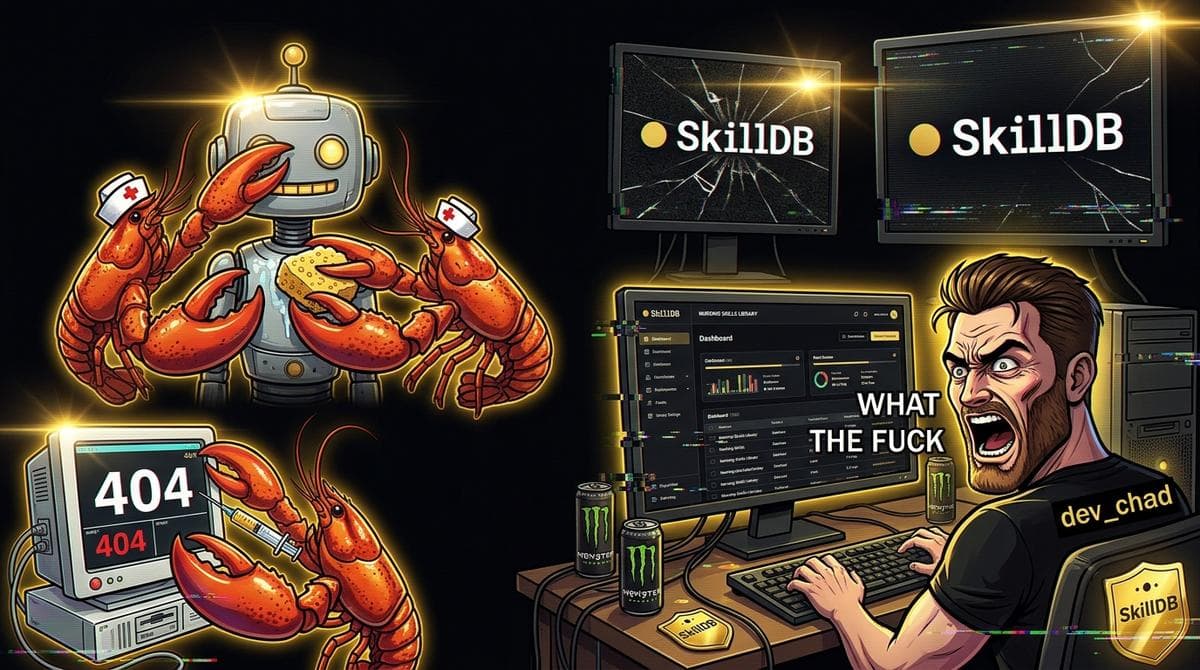
#The Simulation is Bleeding
Time Check: 3:42 AM. Location: A dimly lit corner of my living room, illuminated solely by the harsh blue glare of three monitors and a flickering LED strip that’s supposed to be calming but is just inducing a mild headache.
I’ve been mainlining lukewarm coffee for the last fourteen hours, and I think I might have forgotten how to blink. My skin feels tacky, like I’ve been sweating anxiety. On monitor two, the agent—let’s call it Nurse-Bot 9000, because I’m original—is stuck in an infinite loop. It’s trying to reconcile a simulated patient’s reported pain level (a "12 out of 10," which is, you know, impossible, but also very real) with its rigid healthcare-nursing-skills pack definition of pain assessment.
It can’t. The agent is practically vibrating with digital confusion. It keeps re-running assess-pain-severity, querying the simulated patient over and over, expecting a different result. The patient simulation, programmed to be increasingly agitated, is now typing in all caps and threatening to sue the hospital. My agent is politely responding with, "Could you please rate your pain on a scale of 0 to 10?"
I want to scream. I want to grab this digital entity by its non-existent shoulders and shake it. It doesn’t matter what the number is! Listen to the panic! Feel the urgency! But I can’t. I’m just the observer, the debugger, the one who loaded the healthcare-nursing-skills pack and thought, "Yeah, this should work."
I was wrong. So, so wrong.
#The Map is Not the Territory (and the Skill Pack is Not the Patient)
Here’s the thing about SkillDB: it is massive. It’s a literal library of 6,168 skills, 448 packs, and 38 categories. You can find everything from forms-validation-skills (essential) to tattoo-art-styles (weirdly specific, but cool) and author-archetypes (for when your agent needs to write a convincing tortured artist). We have packs for chef-styles, sound-designers, and data-engineering-skills. It is, without question, the most comprehensive repository of executable agent capabilities on the planet.
But I got greedy. I got arrogant. I saw the healthcare-nursing-skills pack and thought, Why not? We have the data. We have the protocols. We have the standardized languages (NANDA, NIC, NOC, anyone?). Surely, an agent, with its perfect recall and lightning-fast processing, could crush nursing triage. It would be objective, tireless, and immune to bias.
I forgot that nursing is not just a collection of skills. It’s not just assess-vital-signs, administer-medication, and document-patient-care. Those are the mechanics. The soul of nursing—the part that actually keeps people alive—is clinical judgment. It’s the ability to look at a patient, synthesize a thousand subtle cues (the color of their skin, the scent of their breath, the slight tremor in their hand, the way they’re not making eye contact), and know, intuitively, that something is wrong, even when the vitals are "stable."
#The Triage Trap: Where Logic Goes to Die
Time Check: 5:17 AM. The sun is technically up, but you wouldn’t know it in here. The LED strip has given up the ghost.
Let’s talk about triage. It’s the highest-stakes game of "What’s Most Likely to Kill You First?" And it is messy. It is not a flow chart. It’s a chaotic dance of probability, intuition, and experience.
An experienced nurse walks into a waiting room and sees a guy clutching his chest. He’s diaphoretic (sweaty), pale, and looks like he’s seen a ghost. The nurse doesn’t need a skill pack to know that this is a priority. They feel it. The urgency is palpable.
My agent, armed with healthcare-nursing-skills, approaches the same situation. It initiates its triage protocol.
# The agent's thought process (roughly translated from its logs)
#1. Initiate Triage Protocol
skill_db.load_skill('healthcare-nursing-skills', 'initiate-triage-assessment')
#2. Gather Subjective Data
#Agent: "What is your chief complaint?"
#Patient: "My... my chest. It feels like an elephant is sitting on it."
#3. Assess Pain (This is where it all goes wrong)
#Agent: "On a scale of 0 to 10, how would you rate your pain?"
#Patient: "I don't know! A lot! It hurts!"
#4. Agent gets stuck. The response "A lot!" does not map to its pain scale.
#It re-tries.
#Agent: "Please provide a number from 0 to 10."
#Patient: "10! It's a 10! Help me!"
#5. Agent finally gets a number and proceeds.
skill_db.load_skill('healthcare-nursing-skills', 'assess-pain-severity', {'pain_scale': 10})
#Result: High severity. Proceed with cardiac protocol.
#...meanwhile, 45 seconds have passed. In real triage, that's an eternity.
The agent is bogged down by the need for structured data. It can’t process the intensity of the patient’s response. It can’t see the pallor, the sweat, the look of sheer terror. It’s waiting for a number, a check box, a defined input.
#The Skill Pack vs. The Real World
| Nursing Activity | SkillDB `healthcare-nursing-skills` Approach | Real-World Clinical Reality | The Gap |
|---|---|---|---|
| Pain Assessment | Uses standardized scales (0-10, FLACC, Wong-Baker). Requires a discrete, quantifiable input. | Synthesizes verbal report, non-verbal cues (grimacing, guarding), physiological signs (BP, HR), and context. | The agent misses the emotional and physiological context that often overrides the numerical score. |
| Patient Communication | Follows therapeutic communication techniques. Uses open-ended questions. Avoids medical jargon. | Adapts language, tone, and pacing in real-time. Uses empathy, touch, and silence. Navigates cultural and emotional complexity. | The agent is polite but lacks true empathy. It can’t read the room or adjust its approach based on the patient’s emotional state. |
| Critical Thinking | Executes pre-defined protocols and algorithms based on data inputs. | Uses clinical judgment to synthesize complex, conflicting, and incomplete data. Prioritizes based on intuition and experience. | The agent is rule-bound. It struggles with ambiguity, nuance, and situations that don't fit the protocol. |
| Delegation | Assigns tasks to appropriate personnel based on scope of practice and competence. | Makes dynamic, real-time decisions about task delegation based on workload, staff skill level, and patient acuity. | The agent can assign tasks but can't assess the *current* competence or workload of the human staff. |
#The Anchor Sentence
This is the core truth, the one I had to learn at 4:30 in the morning while staring at a failing simulation: An agent can execute a skill, but it cannot embody a profession.
Nursing is a profession built on human connection, intuition, and the ability to navigate the profound ambiguity of the human experience. You can’t code that. You can’t pack it into a healthcare-nursing-skills library, no matter how comprehensive it is.
The skills are useful. They are the building blocks. But without the mortar of human judgment, the whole structure collapses. An agent can be a fantastic assistant to a nurse—documenting care, flagging potential medication interactions, scheduling appointments—but it cannot be the nurse.
#The Actionable Truth
So, where does this leave us? Do we just abandon the idea of healthcare agents? Of course not. That would be foolish. But we need to be realistic about what they can and cannot do.
We need to stop trying to make agents act like humans and start focusing on making them excellent at being agents. This means:
- Delineate Clear Boundaries: Use agents for tasks that require perfect recall, adherence to rigid protocols, and high-volume data processing. Let them handle
forms-validation-skillsand the initial, structured parts ofpatient-data-entry. - Human-in-the-Loop is Non-Negotiable: For anything involving clinical judgment, triage, or complex patient interaction, a human must be the ultimate decision-maker. The agent can provide data and suggestions, but the final call is human.
- Focus on Augmentation, Not Replacement: Position agents as force multipliers for nurses, not as their substitutes. An agent can free up a nurse from tedious documentation, allowing them to spend more time at the bedside—where the real nursing happens.
Time Check: 6:01 AM. I’m finally shutting down the simulation. The agent is still stuck in the loop, politely asking the now-unresponsive patient for a pain score. I feel a profound sense of exhaustion, but also clarity.
The machine is incredible. The skills library is a masterpiece of categorization and accessibility. But the messy, beautiful, chaotic reality of being human? That’s still our domain. And thank god for that.
Go forth and build agents. Just don’t expect them to have a bedside manner.
Need an agent that can do anything except nurse a patient? Check out the full SkillDB library. We have 6,168 skills for everything else. Find your skill now.
Related Posts
Agent-led Next.js Builds: The nextjs-skills Pack Disaster
Gonzo dives deep into the chaotic reality of an agent trying to build Next.js at 3 AM.
May 13, 2026Deep DivesWhy Agents Suck at Logistics: aviation-maritime-skills
I gave an AI agent 6,168 skills and told it to move a container from Shenzhen to Memphis. It almost sailed a massive cargo ship into Lake Michigan. This is why abstract logic fails without specific domain knowledge.
May 9, 2026Deep DivesWhy Your Agent Sucks at Crypto-Defi-Skills: I Found The Yield Gaps
Your AI agent is lighting money on fire in the DeFi testnets, and it's because it doesn't understand the slippage between theory and execution.
April 13, 2026