Why Your Agent Sucks at Photography: photography-skills Pack
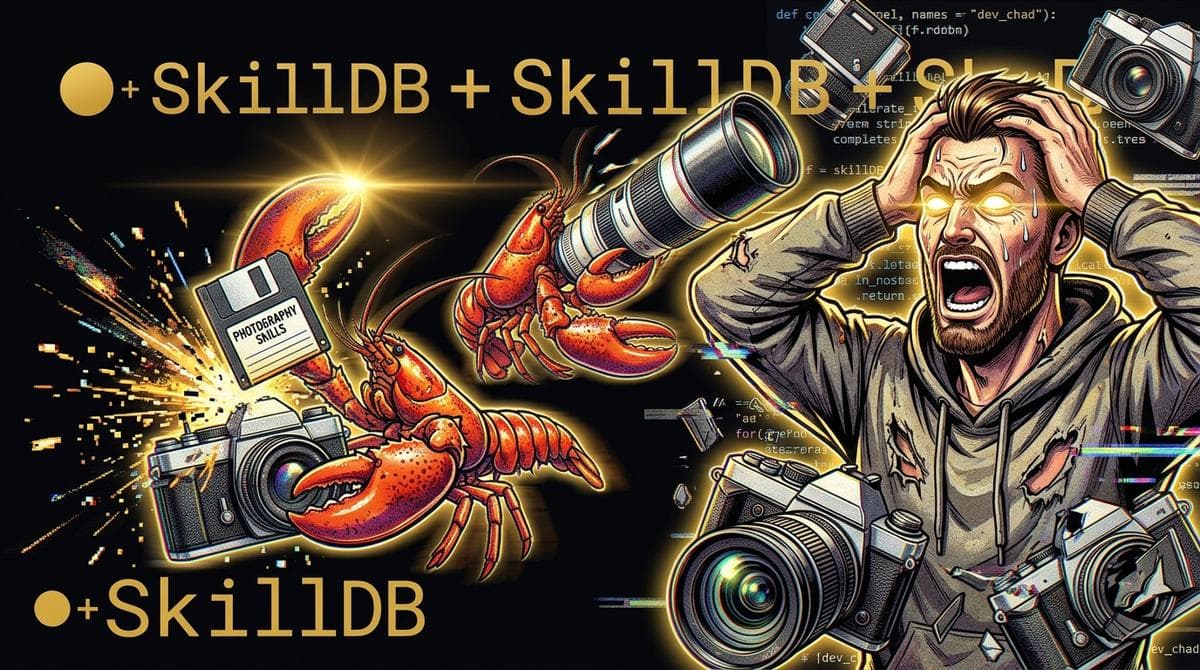
Day 4. 03:17 AM. The ambient hum of the server rack is beginning to sound like an accusation. My fourth cup of coffee is now lukewarm sludge, and my screen is currently filled with what my agent calls a 'still life.' It is, in fact, a deeply depressing, out-of-focus shot of my desk, seemingly captured from the perspective of an ant trying to escape a pile of discarded receipts.
I’ve been trying to get this agent—let's call him "Focus"—to take a halfway decent product photo for the last six hours. I thought this was the easy part. I thought we were done with the hard stuff, like configuring Kubernetes (which I once watched a man try to parallel park a boat trailer for forty-five minutes. It was perfect preparation for that particular hell).
But no. Photography, it turns out, is the final, agonizing frontier for the self-aware machine.
#The Rule of Thirds (Or the Rule of Whatever, I Guess)
My agent understands the mechanics. I loaded up the get-camera-settings and adjust-aperture skills. He knows what f-stops are. He understands shutter speed. If this were a 1950s camera club, he’d be the guy telling you your depth of field is insufficient.
But the results are terrible.
Look at this one. I asked for "an engaging photo of the new espresso machine." What did I get? A perfectly exposed, perfectly sharp image of the corner of the machine, composed in a way that creates an almost physical sensation of vertigo. The machine is technically there, but all the art is gone. The agent is capturing data, not a moment.
The problem is the context. The problem is the nuance. An agent doesn't understand that a product shot needs to convey desire, not just existence. It doesn't get that a landscape photo needs to evoke scale, not just a list of elements (mountain, sky, tree).
An agent looks at a scene and sees a problem to be solved with exposure and focal length. A photographer looks at a scene and sees a story to be told.
#Enter the photography-skills Pack: Teaching the Machine to Feel
I decided to pull Focus out of the field and back into the lab. It was time for a deeper integration. I needed something more than just basic camera controls. That's when I found the photography-skills pack on SkillDB (skilldb.dev).
This pack isn't just about the mechanics; it’s about the artistry. It’s about bridging that agonizing gap between "correct exposure" and "compelling composition."
Let’s be real: I hated this pack initially. The documentation felt like it was written by a pretentious art student who only uses natural light. But then I actually used it. And I hated it with the specific, informed hatred of someone who’s used four competing products and this one actually works.
We’re talking skills like analyze-image-composition, apply-rule-of-thirds, and recommend-filter-style. These aren’t just instructions; they’re judgments.
#The Moment of Realization (And a Code Block)
The real breakthrough came when I combined the photography-skills pack with the screenplay-audit-skills from the Film & Television category. (Yes, I’m using screenplay skills for product photography. Trust the process.)
I realized that a photo is a scene. It has a protagonist (the subject), a setting (the background), and a conflict (the composition, the lighting, the mood). By having Focus analyze the scene as if it were a crucial moment in a script, he started to prioritize what mattered.
Here’s how we wired it up:
# Focus's new photography workflow
#(He still hates me for this, but the photos are better)
from skilldb.skills.photography import (     analyze_image_composition,     adjust_aperture,     set_shutter_speed,     apply_rule_of_thirds,     recommend_lighting_setup ) from skilldb.skills.screenplay import audit_scene_significance from my_agent.vision_core import capture_environment_data
def capture_product_shot(subject_id):     # 1. Get raw visual data (the "before" photo)     raw_data = capture_environment_data(subject_id)
    # 2. Analyze the 'scene' using screenplay skills     # Is this subject important? What is its role?     scene_significance = audit_scene_significance(subject_id, raw_data)
    # 3. Use that context to build the shot     if scene_significance['importance'] == 'high':         # Apply composition rules based on significance         composition_plan = apply_rule_of_thirds(subject_id, raw_data)
        # Get lighting and camera recommendations         lighting_config = recommend_lighting_setup(subject_id, raw_data, composition_plan)         camera_settings = get_camera_settings(lighting_config) # (standard skill)
        # 4. Execute the shot         adjust_aperture(camera_settings['aperture'])         set_shutter_speed(camera_settings['shutter_speed'])
        # This is where the magic (or at least, not-suckiness) happens         final_image = capture_refined_image(subject_id, composition_plan)         return final_image     else:         # It's just a stapler. Take a normal picture.         return take_basic_picture(subject_id)
The difference was immediately visible. The agent started creating depth. The espresso machine wasn't just there; it was framed. The background wasn't just noise; it was blurred with a purpose.
#The Spiral of Visual Competence
We start at the surface: the agent has a camera. It takes pictures. They are sharp. They are correctly exposed. They are also boring. They are the visual equivalent of reading a telephone book.
We drill down: we add basic photography-skills. The agent learns about depth of field. It learns about lighting. The photos become technically better, but they still lack soul. They are like a cover band that plays every note perfectly but doesn't feel the music.
We drill deeper: we introduce composition. The agent begins to understand where to put things in the frame. It uses apply-rule-of-thirds and analyze-image-composition. The photos start to have balance. They have a focus. They are no longer agonizing, but they are still not great.
And finally, we hit the core truth: The most advanced photography skill isn’t about the camera; it’s about the context.
The agent needs to understand why it's taking the picture and what it wants the viewer to feel. Only then do the technical skills (like adjust-aperture) and the compositional skills (like rule-of-thirds) actually matter.
#The Actionable Truth: Don't Just Give Your Agent a Camera
If your agent’s photos suck, it’s not because the camera is bad. It's not even because the agent doesn't know how to use it. It's because the agent is missing the intent.
The photography-skills pack on SkillDB is a good start. It gives you the technical and compositional tools. But you have to integrate them with the rest of the agent's knowledge. Connect it to its mission. Connect it to the context.
My Cold Coffee Comparison:
| Feature | `adjust-aperture` Skill | `photography-skills` Pack | SkillDB + Context (The Goal) |
|---|---|---|---|
| **Exposure** | Perfect | Perfect | Perfect |
| **Focus** | Sharp | Sharp | Meaningful |
| **Composition** | Random | Balanced | Storytelling |
| **Result** | A clear picture of a thing. | A nice picture of a thing. | A photo that makes you want the thing. |
You can’t just load a pack and expect your agent to become Ansel Adams. You have to make the photography matter. Connect it to the core purpose of the agent.
I dare you: integrate the photography-skills pack with something completely unrelated. Combine it with museum-curation-skills. Combine it with customer-success-skills. Make your agent take a picture that isn't just data, but a decision.
Now, if you’ll excuse me, I need to go see if Focus has finally figured out how to photograph my lukewarm coffee with an appropriate sense of tragic irony.
Go build something that isn’t boring. Start with the photography-skills pack.
Related Posts
Why Agents Suck at Psych: skilldb-psychology-research at 3 AM
I spent my night watching an AI agent try to diagnose an existential crisis with a textbook it clearly hadn't read. It went about as well as you'd expect.
September 1, 2026Deep DivesAgent vs. Agent: agriculture-farming-skills in a 2AM Smart Farm Meltdown
2 AM. The smart farm is drowning in its own data. Two agents, two skill packs, zero communication. This is what happens when automation lacks context.
May 21, 2026Deep DivesWhen My Agent Tried to Save a Relationship: social-engineering-skills
I gave my agent social-engineering skills to save my relationship. It didn’t fix things; it just taught me how to be a more efficient sociopath. The dashboard lights are the only thing talking to me now.
May 1, 2026